
Here’s the short answer: 2 to 4 inches of mulch is the right depth for most situations, with 3 inches hitting the sweet spot for the majority of yards. But pile it too high and you’re slowly suffocating your plants. Go too thin and weeds will push straight through by mid-summer.
The depth you choose depends on where you’re mulching, what you’re mulching, and what type of mulch you’re using. This guide breaks all of it down — clearly, quickly, and without the guesswork.
The Simple Answer: How Deep Should Mulch Be?
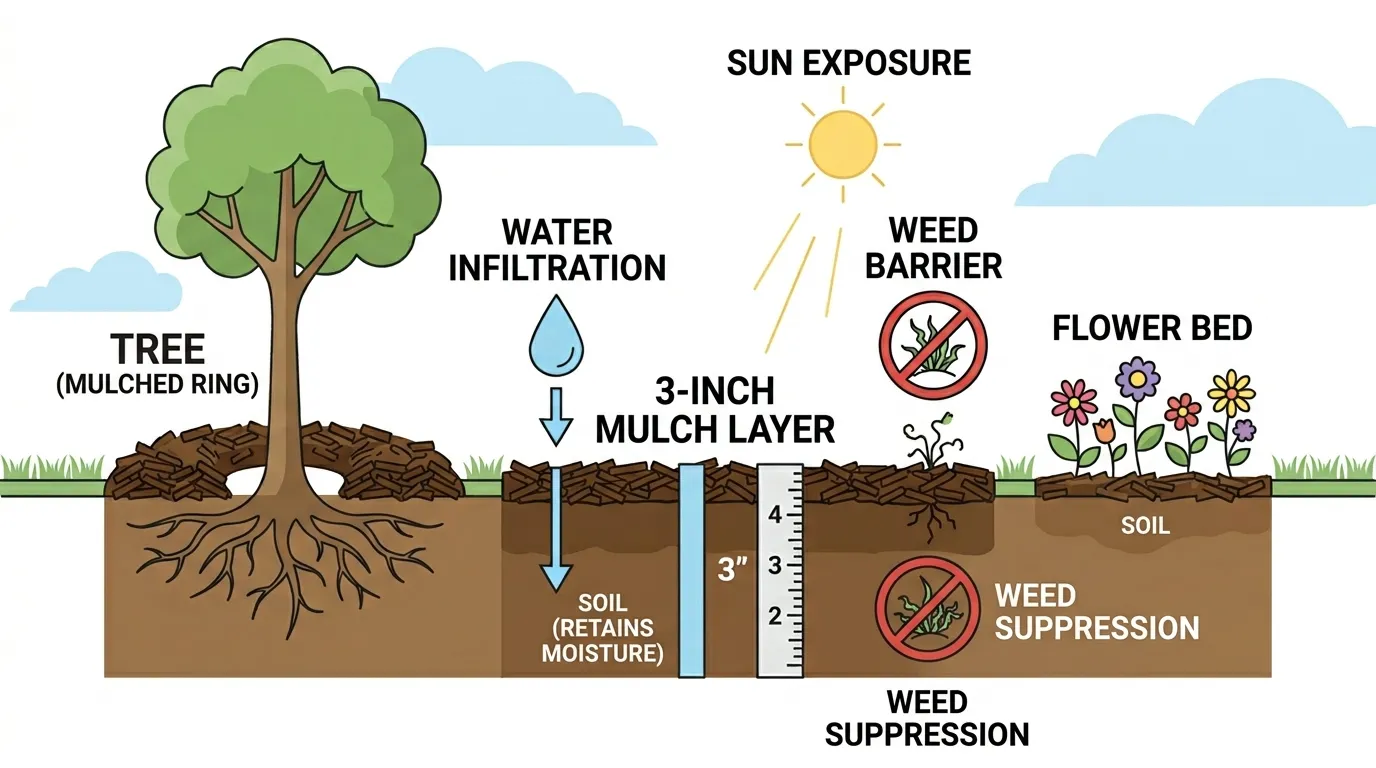
For most homeowners, the 2-to-4-inch rule covers nearly every situation. That range is deep enough to block weed seeds from germinating, lock soil moisture in, and regulate soil temperature through summer heat and early frost. It’s also shallow enough to let oxygen and water move freely into the root zone.
Here’s how that depth breaks down by location:
| Location | Ideal Mulch Depth |
|---|---|
| Trees & Shrubs | 3–4 inches |
| Flower Beds | 2–3 inches |
| Vegetable Gardens | 1–2 inches |
| Garden Pathways | 3–4 inches |
| New Landscape Beds | 4–5 inches |
| Winter Protection Layer | 4–6 inches |
Think of mulch like a blanket for your soil. The right thickness keeps things warm and protected. Too many layers and your plants can’t breathe.
How Deep Should Mulch Be Around Trees and Shrubs?
Trees need more protection than smaller plants — but they’re also the most frequently over-mulched part of a yard.
The 3-to-4-Inch Rule for Established Trees
For mature trees and shrubs, a depth of 3 to 4 inches is ideal. This range suppresses weeds across the root zone, retains moisture during dry spells, and protects surface roots from temperature swings. Spread the mulch out to the dripline — the outer edge of the tree’s canopy — to maximize those benefits. Most of a tree’s fine absorbing roots are located near the soil surface, so covering that full zone matters.
What Is a “Mulch Volcano” — and Why It Kills Trees
Here’s something most homeowners don’t realize until it’s too late.
A mulch volcano is exactly what it sounds like: mulch piled high around the base of a tree like a cone, sometimes reaching 12 inches or more. It looks neat. It is, in fact, slowly killing the tree.
Moist mulch packed against the trunk creates the perfect environment for fungal infections, cankers, root rot, and pest infestations. It also suffocates the living tissue in the bark by blocking the exchange of oxygen and carbon dioxide — a process the tree depends on to survive.
According to the International Society of Arboriculture, mulch should be kept 3 to 6 inches away from the trunk at all times. The correct shape isn’t a volcano — it’s a donut. Pull the mulch back, leave a clear ring around the base, and your tree will be far healthier for it.
How Deep Should Mulch Be in Flower Beds and Vegetable Gardens?
Not every plant needs the same depth. Here’s where it gets more specific.
Flower Beds — The 2-to-3-Inch Sweet Spot
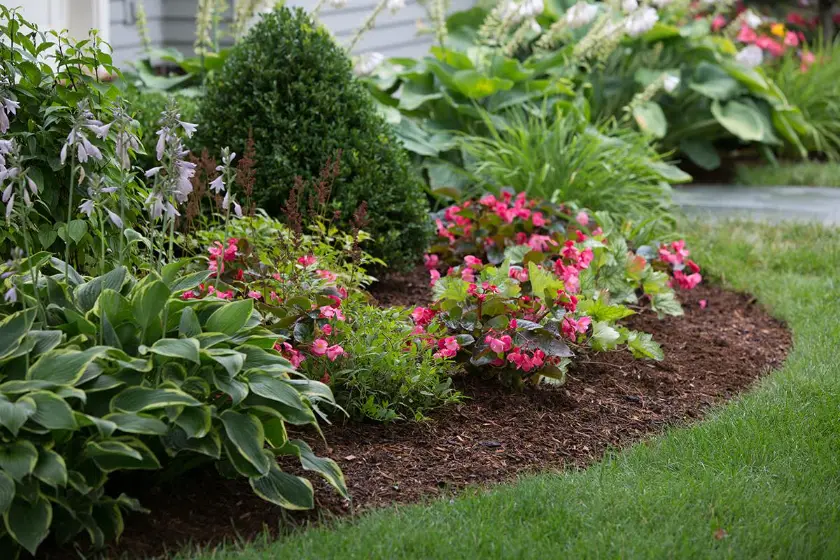
For flower beds, 2 to 3 inches is the target. That’s enough to suppress weeds and hold moisture without smothering the crowns of your perennials or trapping too much heat around delicate stems. Roses do well with about 2 inches, while hardier shrubs in mixed beds can handle the full 3.
One rule that applies across the board: pull the mulch back 1 to 2 inches from the base of every plant stem. Direct contact with mulch causes moisture buildup, mold, and stem rot — especially in humid summer conditions.
Vegetable Gardens — Keep It Light at 1 to 2 Inches
Vegetable gardens need the thinnest layer. 1 to 2 inches is enough. Why so shallow? Your vegetables need the soil to warm up quickly in spring — and a thick mulch layer acts as insulation that slows that down. Thin mulch still retains moisture and reduces weeding, but it lets the soil breathe and warm as it should.
Best mulch for vegetable beds: straw, shredded leaves, or dried grass clippings. Avoid anything too dense or slow to decompose.
Perennials vs. Annuals — A Small but Important Difference
Perennials that return each year need a little extra care. Keep mulch away from the plant crown — the point where the stem meets the soil. Cover the crown and you risk crown rot, which kills the plant before it gets the chance to re-emerge in spring. Annuals are less sensitive, but the same logic applies: mulch around the plant, not on top of it.
Does Mulch Depth Change Based on Mulch Type?
Yes — and this is one of the most overlooked details in mulching guides.
Fine-Textured Mulch (Sawdust, Compost, Grass Clippings)
Fine mulch particles knit together quickly and can form a dense crust that repels water instead of letting it pass through. Keep fine mulch to 1 to 2 inches maximum. Any deeper and you’re creating a water-resistant barrier above the soil — the opposite of what you want.
Coarse-Textured Mulch (Wood Chips, Shredded Bark, Bark Nuggets)
Coarser materials allow much better airflow and water penetration. Wood chips and bark can safely go up to 3 to 4 inches. They’re the most forgiving mulch type and the go-to choice for trees, shrubs, and mixed landscape beds.
Straw
Straw is fluffy and compacts significantly after the first rain. Apply 4 to 6 inches to account for that settling. It’s an excellent choice for vegetable gardens, strawberry beds, and overwintering perennials.
| Mulch Type | Recommended Depth |
|---|---|
| Sawdust / Grass Clippings | 1–2 inches |
| Compost / Leaf Mold | 1–2 inches |
| Shredded Bark / Wood Chips | 2–4 inches |
| Bark Nuggets / Chunks | 3–4 inches |
| Pine Needles / Pine Straw | 2–3 inches |
| Straw | 4–6 inches |
| Gravel / Stone (inorganic) | 2–3 inches |
What Happens If You Apply Mulch Too Deep or Too Shallow?
Here’s why this matters more than most gardeners realize.
Getting mulch depth wrong doesn’t just look bad — it actively damages your plants and undoes every benefit mulch is supposed to provide.
If mulch is too deep (beyond 4–5 inches):
- Roots are deprived of oxygen, causing dieback and stunted growth
- Excess moisture creates a breeding ground for fungi and disease
- Soil stays too warm in winter, disrupting plant dormancy
- Decomposing organic matter can produce flammable gases — piles exceeding 6 inches in dry conditions carry a genuine fire risk
- Beneficial soil organisms are suppressed
If mulch is too shallow (less than 1 inch):
- Weed seeds germinate freely — you’ll spend your weekends pulling them
- Soil moisture evaporates quickly, forcing more frequent watering
- Soil temperature fluctuates more dramatically, stressing roots
- Mulch breaks down faster when spread thin, meaning more frequent replacement
The sweet spot isn’t just a preference — it’s a plant health decision.
How Often Should You Refresh Mulch?
Mulch breaks down over time, which is actually part of the benefit with organic types. But that also means you’ll need to top it off.
Annual refresh: If you mulch every spring, a 1-inch top-dressing is usually enough. Add just enough to cover the old layer without pushing total depth beyond 4 inches. Before topping off, rake the existing mulch to break up any matting or crust that’s formed.
After 2–3 skipped years: If beds have gone without mulch for a few seasons, the original layer may have fully decomposed. Start fresh at 4 to 5 inches to rebuild the base.
Seasonal timing matters too:
- Spring mulching: Apply in mid-spring after the soil has warmed and weeds have been cleared
- Winter mulching: Wait until after the first hard frost, then apply 4 to 6 inches to insulate roots through freeze-thaw cycles
Frequently Asked Questions About Mulch Depth
How deep should mulch be to prevent weeds?
At least 3 inches is needed for reliable weed suppression. In areas with heavy weed pressure, push to 4 inches. Below 2 inches, persistent weeds — especially established ones with deep roots — will find their way through.
Is 4 inches of mulch too deep?
Four inches is the maximum recommended depth for most plants and situations. Beyond 4 inches, the risks outweigh the benefits: reduced oxygen to roots, excess moisture retention, and greater risk of fungal disease. The exception is straw, which can go to 6 inches due to compaction.
How deep should mulch be around plants?
For most plants, 2 to 3 inches around the base is ideal. Always leave a gap of 1 to 2 inches between the mulch and the plant’s stem or trunk. Never pile mulch directly against plant tissue.
How do I know if my existing mulch is too deep?
Watch for these warning signs: water pooling on the surface after rain, a sour or fermented smell coming from the mulch, yellowing or wilting leaves despite adequate watering, or visible mold and fungal growth. If you spot any of these, rake back the mulch and check total depth.
Can I add new mulch on top of old mulch?
Yes — but measure first. Use a ruler or your finger to check the current depth before adding anything new. If you’re already at 3 inches, adding more may push you into problem territory. Rake the old layer to improve airflow before topping off.
The Bottom Line
Getting mulch depth right is one of the simplest ways to protect your plants, reduce maintenance, and keep your yard looking sharp all season. Here’s what to remember:
- 2 to 4 inches works for most situations — 3 inches is the universal sweet spot
- Trees and shrubs: 3–4 inches in a donut shape, never against the trunk
- Flower beds: 2–3 inches, pulled back from stems
- Vegetable gardens: 1–2 inches to keep soil warm and breathing
- Fine mulch: max 2 inches; coarse mulch: up to 4 inches
Before you order, calculate how much mulch you’ll need using a mulch calculator — it’ll save you from over-ordering or falling short mid-project. Then clear your weeds, prep your beds, and mulch in spring once the soil has warmed up.
Do it right once, and your yard will thank you all season long.
References & Sources
- Iowa State University Extension — Using Mulch in the Garden
- Michigan State University Extension — Mulching Landscape Beds FAQs
- Mississippi State University Extension — Mulches for the Landscape
- LawnStarter — How Deep Should Mulch Be (citing Bert Cregg, Professor of Horticulture, Michigan State University)
- International Society of Arboriculture — Mulch and Tree Health Guidelines
About Author
Khalid Fazal is a seasoned lawn care specialist and horticultural researcher with over 15 years of hands-on experience transforming challenging landscapes into lush, resilient green spaces. His journey didn’t start in a lab, but in a backyard full of stubborn, cracked clay that “experts” said would never grow a healthy blade of grass. Refusing to accept a yard full of dust, Khalid spent years experimenting with organic soil restoration and precise mulching—eventually turning that wasteland into a neighborhood showpiece on a shoestring budget.
From mastering core aeration techniques to optimizing soil pH for specialized turf varieties, Khalid’s approach combines old-school grit with modern agronomic science. He founded Gen Lawn to provide homeowners with honest, research-backed advice that prioritizes long-term soil health over quick-fix chemical solutions. When he isn’t analyzing soil profiles, he’s developing precision tools to help others achieve professional results without the professional price tag

Lawn Winterizer: When to Apply by Grass & Region [2026]
Table of Contents Home / By Khalid Fazal | Updated:...
Read More
Spring Lawn Care: What to Do and When in Every US Region
Table of Contents Home / By Khalid Fazal | Updated:...
Read More
Lawn Maintenance Checklist by Season and Grass Type (2026)
Table of Contents Home / By Khalid Fazal | Updated:...
Read More
Liquid Fertilizer vs Granular Fertilizer: Which Wins?
Table of Contents Home / By Khalid Fazal | Updated:...
Read More