
Can You Use Car Oil for Lawn Mower? (What You Actually Need to Know)
Picture this: You’re ready to mow, you check the oil, and you’re bone dry. But you’ve got a fresh bottle of 10W-30 sitting on your garage shelf from your last car oil change. Can you just pour it in and get to work?
Here’s the truth: Yes, you can use car oil in most lawn mowers—but only if you match the right type to your engine. Get it wrong, and you could be looking at smoke, poor performance, or even engine damage.
In this guide, we’ll break down exactly when car oil is safe for your mower, when it’s a terrible idea, what the real differences are, and how to do it right. Whether you’re trying to save a trip to the store or wondering if you’ve been doing it wrong all along, you’ll have your answer by the end.
The Quick Answer: When Car Oil Works (And When It Doesn’t)
Let’s cut to the chase. The answer isn’t a simple yes or no—it depends on your mower’s engine type and the oil you’re using.
Yes, You Can Use It—For 4-Stroke Mowers
If you have a 4-stroke lawn mower (which most modern walk-behind and riding mowers are), you can absolutely use car oil like SAE 30 or 10W-30. These are the same viscosity grades many mowers recommend right in the owner’s manual.
Here’s what matters:
- Match the viscosity: If your manual says SAE 30 or 10W-30, car oil with that rating works fine.
- Check the API service rating: Look for SG, SH, SJ, SL, or newer ratings on the bottle.
- Short-term vs. long-term: Using car oil once in a pinch? No problem. Using it every single oil change? Consider switching to dedicated small engine oil for optimal protection.
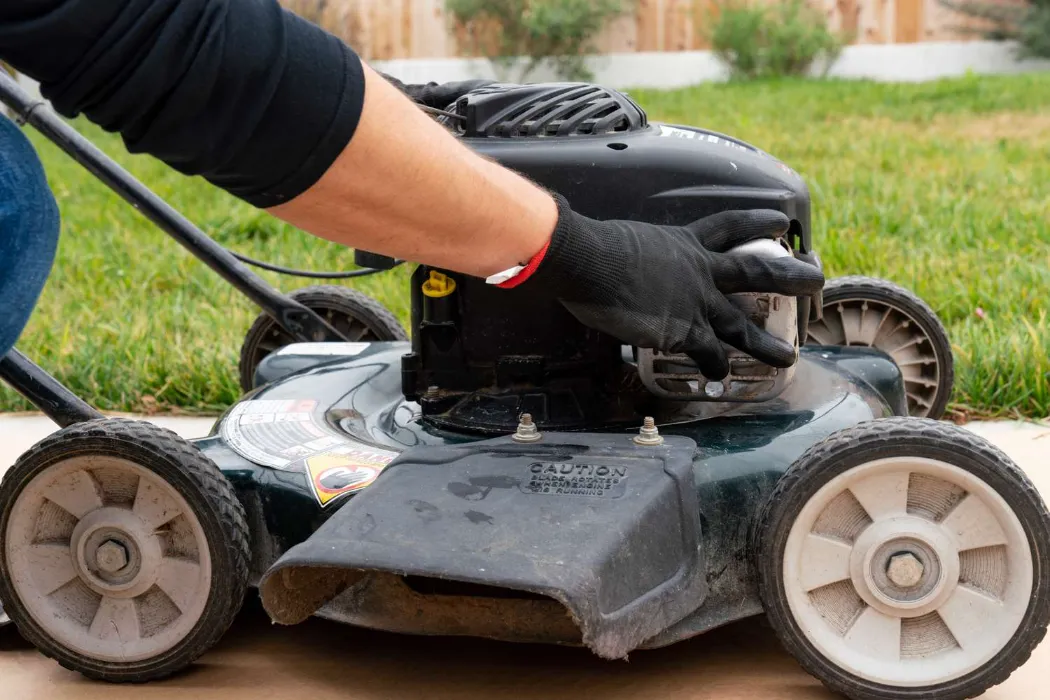
Never Use It—For 2-Stroke Engines
Here’s where things get critical.
If you have a 2-stroke engine, do NOT use regular car oil. Period.
Two-stroke engines require a special oil-fuel mixture to lubricate internal parts. Using regular car oil will cause catastrophic engine failure—we’re talking seized pistons, destroyed cylinders, and a dead mower.
How to tell if you have a 2-stroke:
- Check the number of fill ports: 2-stroke has ONE port for both oil and gas
- 4-stroke has TWO separate ports (one for gas, one for oil)
- When in doubt, check your owner’s manual or the engine label
Temperature and Climate Matter
Even with the right engine type, viscosity matters based on where you live.
SAE 30 works best in warm weather (above 40°F). It’s a single-grade oil that maintains consistent thickness in stable temperatures.
10W-30 is a multi-grade oil that handles temperature swings better. The “10W” means it flows easier when cold, while the “30” means it maintains protection when hot. Great for spring and fall mowing.
Avoid these in most mowers:
- 5W-20 or 0W-20 (too thin, designed for modern fuel-efficient cars)
- 20W-50 (too thick, makes starting difficult)
Understanding the Real Difference Between Car Oil and Lawn Mower Oil
You might be thinking, “Oil is oil, right?” Not quite. Here’s why lawn mowers need different considerations.
Why Air-Cooled vs. Liquid-Cooled Changes Everything
Your car engine is liquid-cooled—it has a radiator, coolant, and a sophisticated cooling system. Your lawn mower engine is air-cooled—it relies on fins and airflow to stay cool.
This creates a huge difference:
- Mowers run hotter. Air-cooled engines operate at higher temperatures because they can’t regulate heat as efficiently.
- Oil works harder. Without liquid cooling, the oil has to do more of the heavy lifting to prevent overheating and wear.
- Different protection needs. This is why lawn mower oil is formulated to handle extreme heat better than standard car oil.
Multi-Grade vs. Single-Grade: What SAE Numbers Mean
When you see SAE ratings like “SAE 30” or “10W-30,” that’s the Society of Automotive Engineers’ system for measuring oil thickness (viscosity).
SAE 30 (single-grade): The oil maintains one consistent thickness. It’s simple, reliable, and perfect for mowers that run in warm, stable temperatures.
10W-30 (multi-grade): The “W” stands for winter. The first number (10W) tells you how thin the oil is when cold. The second number (30) tells you how thick it is when hot. Multi-grade oils use viscosity modifiers to achieve this range.
Here’s the catch: Those viscosity modifiers can break down faster in small engines that run at high RPMs and high heat. That’s why some manufacturers still recommend straight SAE 30.
The Additive Package Problem
This is where car oil and lawn mower oil really start to diverge.
Car oil is loaded with additives:
- Detergents to clean carbon deposits
- Friction modifiers for fuel efficiency
- Dispersants to suspend contaminants
- Anti-wear compounds
Why this matters for mowers:
Some of these additives, especially heavy detergent packages, can actually create problems in small air-cooled engines. Excessive detergents can foam up, reducing lubrication effectiveness.
The Zinc (ZDDP) Issue:
Zinc dialkyldithiophosphate (ZDDP) is an anti-wear additive that’s crucial for engine protection. Small engines benefit from higher zinc levels because of their higher operating temperatures and the stress on moving parts.
Modern car oils have reduced zinc content to protect catalytic converters and meet emissions standards. That’s great for your car, but it can leave your mower with less protection than it needs.
No Oil Filter = Different Requirements
Here’s something most people don’t think about: Most walk-behind mowers don’t have oil filters.
Your car engine circulates oil through a filter that removes dirt, metal particles, and combustion byproducts. Your mower? The oil just sits there getting dirty with grass clippings, dust, and debris that gets past the air filter.
This is why:
- Small engine oil is formulated to handle contaminants without a filtration system
- Change intervals are shorter for mowers (every 25-50 hours vs. 3,000-5,000 miles for cars)
- Oil quality matters more since there’s no filter as a backup
When You Can Safely Use Car Oil in Your Lawn Mower
Alright, let’s get practical. You’ve got car oil and a 4-stroke mower. Here’s how to do it right.
Best Car Oils for Lawn Mowers
Not all car oils are created equal for mower use. Here are your safest bets:
SAE 30 car oil: This is essentially identical to lawn mower oil. If the bottle says “SAE 30” and meets API service rating SG or higher, you’re good to go.
10W-30 car oil: Works great in most modern 4-stroke mowers. It’s especially useful in cooler weather or if you’re mowing in early morning when temps are lower. Just know it may burn off slightly faster in summer heat compared to straight SAE 30.
What to look for on the bottle:
- API service classification of SJ, SL, SM, or SN
- Avoid bottles labeled “Energy Conserving” or “Resource Conserving” (these lack the zinc your mower needs)
Check Your Owner’s Manual First
I can’t stress this enough: Your manufacturer’s recommendations trump everything else.
Your owner’s manual will specify:
- Exact viscosity grade (SAE 30, 10W-30, etc.)
- API service rating requirements
- Capacity (how much oil to add)
- Special requirements for extreme temperatures
Can’t find your manual? Most manufacturers have them available as PDFs online. Just search “[your mower brand] + [model number] + owner’s manual.”
Warranty implications: Using the wrong oil can void your warranty. If your mower is relatively new, stick with what the manual says.
Emergency Use vs. Regular Use
Here’s the reality: Using car oil once in a pinch won’t hurt anything.
Ran out of mower oil and need to finish cutting before a rainstorm? Grab that bottle of 10W-30 and go for it. Your mower will be fine.
But for regular, long-term use?
Consider switching to dedicated small engine oil from brands like Briggs & Stratton, Honda, or Kohler. It’s formulated specifically for the demands of air-cooled engines and costs about the same as quality car oil.
Think of it like this: Car oil is the friend who helps you move in a pinch. Small engine oil is the friend with a truck who’s ready anytime.
When You Should Never Use Car Oil for Lawn Mower
Some situations are absolute deal-breakers. Here’s when car oil is a terrible idea.
Wrong Engine Type = Engine Failure
We touched on this earlier, but it’s worth repeating: Never, ever use regular car oil in a 2-stroke engine.
2-stroke engines need oil that:
- Burns cleanly when mixed with gasoline
- Provides lubrication during combustion
- Doesn’t leave carbon deposits
Regular car oil will:
- Clog the exhaust port
- Cause the engine to seize
- Lead to complete engine failure (expensive!)
The fix costs more than a new mower. Don’t risk it.
Wrong Viscosity = Performance Problems
Using oil that’s too thin or too thick creates immediate problems.
Too thin (0W-20, 5W-20):
- Excessive oil consumption (you’ll burn through it fast)
- Inadequate protection at operating temperature
- Potential for accelerated engine wear
Too thick (20W-50):
- Hard starts, especially in cooler weather
- Poor circulation when the engine is cold
- Increased wear during startup
Bottom line: Stick to SAE 30 or 10W-30 unless your manual says otherwise.
Avoid These Specific Car Oils
Some car oils are engineered for modern automotive technology that just doesn’t apply to your mower:
“Energy Conserving” oils: These are designed to improve fuel economy in cars by reducing friction. They typically have lower zinc content, which means less protection for your mower’s engine.
Diesel engine oil: These have different additive packages designed for compression-ignition engines. Unless your mower manual specifically approves it, skip it.
Full synthetic with heavy additive packages: While synthetic oil itself is fine (even great) for mowers, some high-performance synthetic blends have additives that air-cooled engines don’t need. You’re just paying extra for chemistry your mower can’t use.
How to Use Car Oil in Your Lawn Mower the Right Way
Ready to change your oil? Here’s the step-by-step process.
Step-by-Step Oil Change Guide
What you’ll need:
- Fresh oil (SAE 30 or 10W-30)
- Oil drain pan
- Funnel
- Rag or paper towels
- Wrench (for drain plug, if equipped)
The process:
- Warm up the engine (2-3 minutes). Warm oil drains faster and carries more contaminants out with it.
- Disconnect the spark plug wire. This prevents accidental starting while you’re working. Safety first.
- Drain the old oil. Depending on your mower:
- Some tip over (air filter side up) to drain through the fill tube
- Others have a drain plug on the bottom
- Place your drain pan underneath before you start
- Let it drain completely. Give it a few minutes to get every last drop out.
- Refill with the correct amount. Most walk-behind mowers take 15-20 ounces. Check your manual for exact capacity. Use a funnel to avoid spills.
- Check the level with the dipstick. Don’t overfill—too much oil causes smoking and poor running.
- Reconnect the spark plug wire. Double-check it’s secure.
- Start the mower and let it idle for a minute. Recheck the oil level and top off if needed.
How Much Oil and How Often
Capacity: Most push mowers hold 15-20 ounces (0.47-0.59 liters). Riding mowers can hold 1.5-2 quarts. Always check your manual.
Change frequency:
- Every 25-50 hours of operation, OR
- At least once per mowing season, OR
- More often if you mow in dusty, dirty conditions
Pro tip: Check your oil level before every single use. It takes 10 seconds and can prevent a blown engine.
Monitoring for Problems
Even with the right oil, stay alert for warning signs:
Good oil: Amber or light brown, smooth consistency
Bad oil: Black, thick, gritty, or smells burnt
If your oil goes from fresh to black in just a few hours of use, that’s a sign of engine wear or contamination. Time for a deeper inspection.
Signs You’re Using the Wrong Oil
Your mower will tell you when something’s off. Here’s what to watch for.
Immediate Warning Signs
Blue or white smoke from the exhaust: Usually means oil is burning where it shouldn’t be. Could be overfilled oil, wrong viscosity (too thin), or worn piston rings.
Engine runs louder or knocks: Insufficient lubrication causes metal-on-metal contact. You’ll hear it as knocking, ticking, or unusual rattling.
Difficulty starting (especially when warm): If the mower starts fine cold but won’t restart after a break, you might have oil that’s too thick or breaking down under heat.
Oil leaks around seals: Wrong oil viscosity can cause seals to fail, leading to leaks around the crankshaft or drain plug.
Long-Term Damage Indicators
Excessive oil consumption: If you’re constantly adding oil between changes, the oil might be too thin or your engine has wear issues.
Black, thick sludge on the dipstick: This is oil breaking down from heat and contamination. It’s not protecting your engine anymore.
Loss of power during cutting: Worn engine components from inadequate lubrication will rob your mower of power, especially in thick grass.
Overheating issues: If your mower shuts off after 15-20 minutes of use, oil might not be managing heat properly.
Frequently Asked Questions
Can you use 10W-30 car oil in a lawn mower?
Yes, 10W-30 car oil works in most 4-stroke lawn mowers, especially in variable temperatures. It may burn slightly faster than SAE 30 in hot weather, but it’s generally safe and effective. Just make sure it meets your manufacturer’s API service rating (usually SJ or newer) and avoid “energy conserving” formulations.
Is there a difference between lawn mower oil and car oil?
Yes. While base formulations can be similar, lawn mower oil typically has fewer detergents, higher zinc content (ZDDP), and is optimized for air-cooled engines running at high temperatures without oil filters. Car oil is designed for liquid-cooled engines with sophisticated filtration systems and different operating conditions.
Can you use synthetic car oil in a lawn mower?
Yes, synthetic oil works well in modern 4-stroke mowers and offers better temperature protection and longer service life. Just ensure it matches your manufacturer’s viscosity specs (SAE 30 or 10W-30 typically) and isn’t packed with unnecessary additives. Synthetic is actually a great choice for mowers that see heavy use or extreme temperatures.
What happens if you put the wrong oil in a lawn mower?
Using the wrong oil can cause smoking, hard starts, engine knocking, excessive wear, carbon buildup, or in severe cases (like using regular oil in a 2-stroke), complete engine failure. Most issues from slightly wrong viscosity are reversible by draining and refilling with correct oil. Using car oil in a 2-stroke engine causes permanent damage.
Can you mix car oil and lawn mower oil?
You can mix them if they’re the same viscosity (both SAE 30 or both 10W-30), but it’s better to drain completely and use one consistent type for optimal performance. Mixing different viscosities creates unpredictable protection levels. If you do mix, run the mower and drain it completely at your next oil change to get back to a single oil type.
What oil should you absolutely never use in a lawn mower?
Never use regular car oil in 2-stroke engines (requires special 2-cycle oil only), avoid 0W-20 or 5W-20 (too thin for most mowers), skip “energy-conserving” or “resource-conserving” labeled oils (low zinc content), and don’t use diesel engine oil unless your manual specifically approves it. These can cause poor lubrication, excessive wear, or complete engine failure.
The Bottom Line: Smart Oil Choices for Your Lawn Mower
Let’s wrap this up with what you actually need to remember:
 Yes for 4-stroke: SAE 30 or 10W-30 car oil works fine in most lawn mowers with 4-stroke engines
 Never for 2-stroke: These engines require specialized 2-cycle oil mixed with fuel—regular car oil will destroy the engine
 Check your manual: Manufacturer specifications always trump general advice. Follow what your owner’s manual recommends.
 Match your climate: SAE 30 for consistently warm weather (above 40°F), 10W-30 for variable temperatures and cooler conditions
 Monitor performance: Watch for smoke, unusual noise, hard starts, or oil consumption—these signal you need to change your approach
When in doubt, grab a bottle of small engine oil—it’s specifically designed for lawn mowers and gives you peace of mind. But if you’re in a pinch and have the right viscosity car oil (SAE 30 or 10W-30), your mower will handle it just fine.
Just remember: Never use it in a 2-stroke engine, always check your oil before you mow, and change it regularly. Your lawn mower will reward you with years of reliable service.
References & Additional Resources
- SAE International – Oil Viscosity Standards
- API – Motor Oil Guide and Service Classifications
- Briggs & Stratton – Small Engine Oil Recommendations
- Understanding ZDDP Anti-Wear Additives in Engine Oil
About Author
Khalid Fazal is a seasoned lawn care specialist and horticultural researcher with over 15 years of hands-on experience transforming challenging landscapes into lush, resilient green spaces. His journey didn’t start in a lab, but in a backyard full of stubborn, cracked clay that “experts” said would never grow a healthy blade of grass. Refusing to accept a yard full of dust, Khalid spent years experimenting with organic soil restoration and precise mulching—eventually turning that wasteland into a neighborhood showpiece on a shoestring budget.
From mastering core aeration techniques to optimizing soil pH for specialized turf varieties, Khalid’s approach combines old-school grit with modern agronomic science. He founded Gen Lawn to provide homeowners with honest, research-backed advice that prioritizes long-term soil health over quick-fix chemical solutions. When he isn’t analyzing soil profiles, he’s developing precision tools to help others achieve professional results without the professional price tag.

Lawn Winterizer: When to Apply by Grass & Region [2026]
Table of Contents Home / By Khalid Fazal | Updated:...
Read More
Spring Lawn Care: What to Do and When in Every US Region
Table of Contents Home / By Khalid Fazal | Updated:...
Read More
Lawn Maintenance Checklist by Season and Grass Type (2026)
Table of Contents Home / By Khalid Fazal | Updated:...
Read More
Liquid Fertilizer vs Granular Fertilizer: Which Wins?
Table of Contents Home / By Khalid Fazal | Updated:...
Read More