Florida Weeds with White Flowers: How to Identify and Remove Them
You noticed it this morning — a cluster of small white flowers spreading across your lawn that definitely wasn’t there last week. Now you’re wondering: what is this thing, is it harmful, and how do I get rid of it?
You’re in the right place.
Florida lawns are some of the most weed-prone in the entire country, and white-flowering weeds are among the most common culprits. Some spread quietly underground. Some pop up overnight after a summer rain. And a few look so pretty that homeowners accidentally let them take over before realizing the damage.
This guide covers the 7 most common Florida weeds with white flowers — what they look like, where they grow, and exactly how to deal with them.
Why Florida Lawns Are a Hotspot for Weeds with White Flowers
Before we get to the ID list, it helps to understand why Florida has such a weed problem in the first place. Spoiler: it’s not just you, and it’s not your fault.
Florida’s Climate Creates the Perfect Weed Environment
Florida’s humid subtropical climate means warm temperatures virtually year-round, high moisture levels, and intense sunlight — the exact trifecta that weeds love. Unlike northern states where a hard frost kills off weed seeds and slows growth, Florida gives weeds a nearly uninterrupted growing season.
Sandy, nutrient-variable soils also make it easier for opportunistic weeds to establish before your turf grass can compete. Add in the state’s naturally high rainfall and irrigation habits, and you’ve got conditions that are practically engineered for white-flowering weeds to thrive.
When These Weeds Are Most Active in Florida
Here’s the thing: Florida doesn’t really have “weed season” — it has multiple.
- Cool-season weeds (hairy bittercress, wild garlic) emerge in fall and winter
- Warm-season weeds (Florida pusley, chamberbitter) peak in summer
- Year-round offenders (white clover, dollarweed, woodsorrel) never fully go away
The earlier you identify what’s growing, the easier and cheaper it is to control. Waiting until a weed is in full bloom usually means it’s already setting seeds — and each plant can drop thousands of seeds before you pull it.
The Most Common Florida Weeds with White Flowers (With ID Tips)
Let’s get into the lineup. Here are the seven weeds you’re most likely staring at right now.
1. Dollarweed (Pennywort) — The Wet-Spot Invader
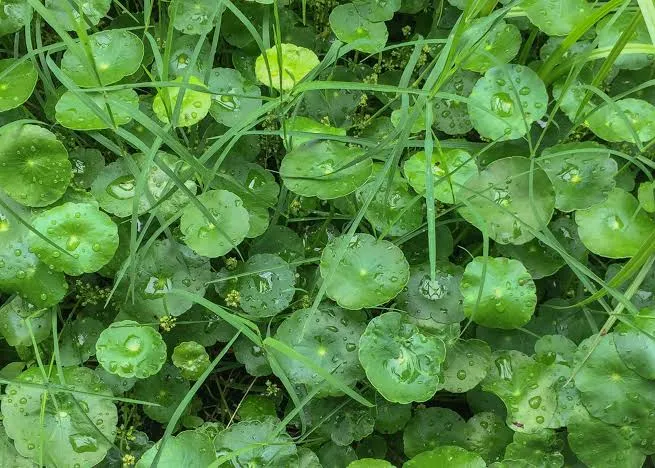
What it looks like: Round, scalloped leaves about the size of a silver dollar (that’s where the name comes from), with tiny white or pale flower clusters rising on thin stems. The leaves are glossy and distinctly round — almost like little lily pads on your lawn.
Where it grows: Dollarweed loves wet, poorly drained areas. If you’ve got low spots in your yard, overwatered sections, or lawn near a sprinkler head, that’s where you’ll find it.
Quick ID tip: Squeeze a leaf — it’s thick and slightly waxy, unlike most weeds. The stem attaches to the center of the leaf, not the edge, which is a dead giveaway.
2. White Clover — The Sneaky Spreader
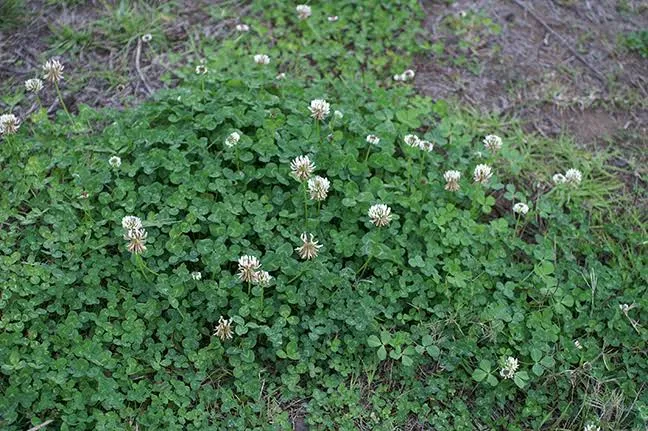
What it looks like: Round, pom-pom-shaped white flower heads (about the size of a marble) sitting above trifoliate leaves — three leaflets per stem. Look closely and you’ll often spot a pale V-shaped or chevron mark on each leaflet.
Where it grows: White clover thrives in nitrogen-poor lawns. It actually fixes nitrogen from the air, which is why it outcompetes turfgrass in fertilizer-neglected areas. Full sun and compacted soils are its favorites.
Quick ID tip: The triple-leaf structure with a faint pale marking is unmistakable once you know to look for it. Pull back the flowers — they smell faintly sweet, and bees absolutely love them.
3. Chamberbitter — Tiny Flowers, Big Problems
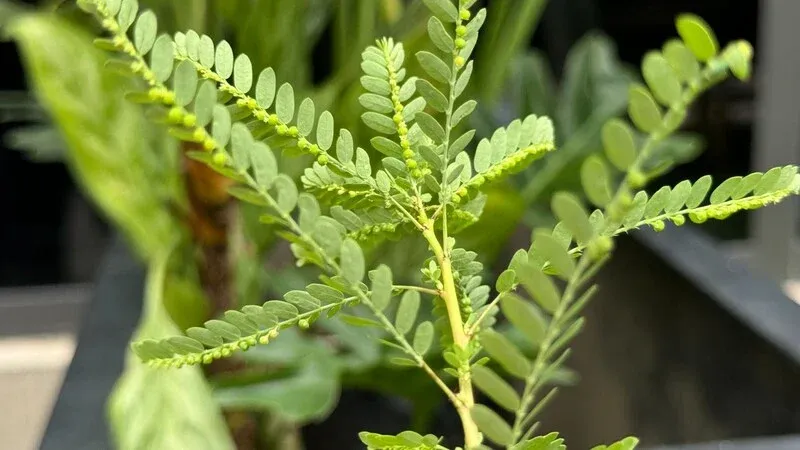
What it looks like: Fernlike, symmetrical rows of small oval leaves on branching stems — it honestly looks like it belongs in a houseplant section. The white flowers are tiny, almost invisible, tucked underneath the leaves in a row.
Where it grows: Disturbed soil, bare patches, and garden beds. It’s a summer annual in Florida that goes from seed to fully mature plant in just a few weeks.
Quick ID tip: Run your finger along the underside of a stem and you’ll feel tiny round seed pods lined up neatly in a row beneath the leaves — that’s the giveaway. Don’t do this near the end of the season unless you want to scatter seeds everywhere.
4. Florida Pusley (Richardia scabra) — A Summer Staple
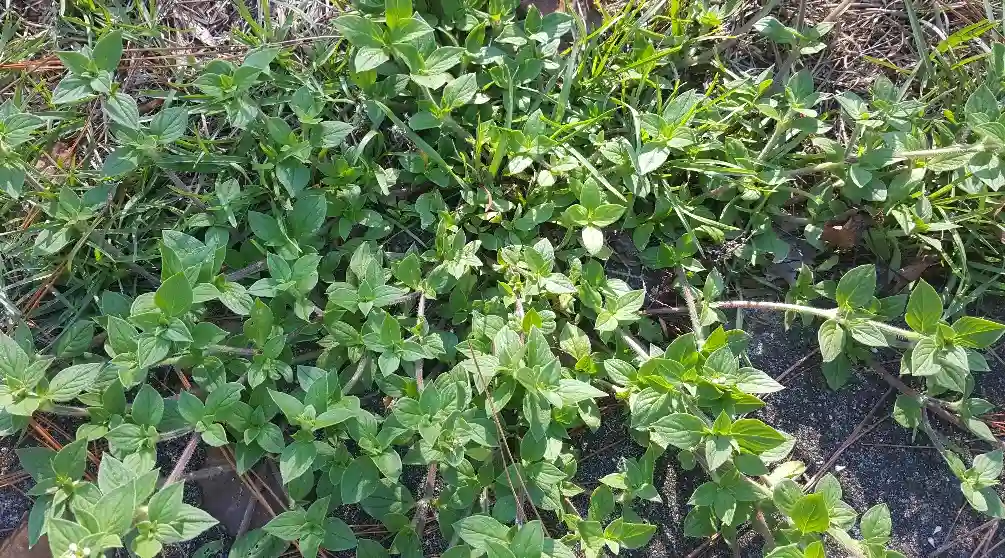
What it looks like: Star-shaped white flowers in tight clusters at the stem tips, hairy oval leaves, and a spreading, mat-forming habit. It stays low to the ground and can cover a surprising amount of lawn in a short time.
Where it grows: Hot, dry, sandy Florida lawns — which describes a huge portion of the state. It’s one of the most widespread summer weeds in Florida, particularly in central and south Florida.
Quick ID tip: The star-shaped flower clusters are distinctive, and the leaves feel rough and slightly hairy to the touch. It tends to sprawl outward from a central taproot.
5. Woodsorrel (Oxalis) — Pretty but Persistent
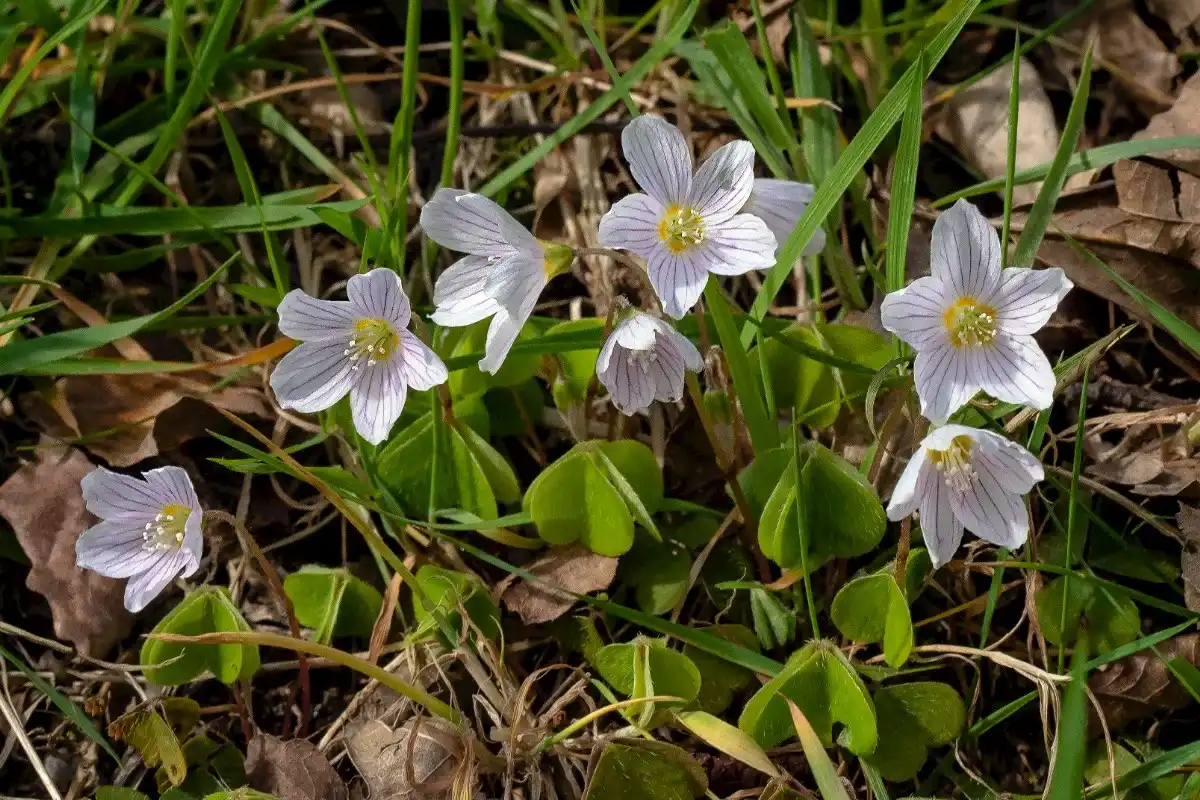
What it looks like: Delicate five-petal white (or pale yellow) flowers above clover-like, heart-shaped leaflets. It’s genuinely attractive, which is exactly the problem — people often let it go because it looks intentional.
Where it grows: Everywhere. Woodsorrel is one of the most adaptable weeds in Florida. It pops up in lawns, garden beds, sidewalk cracks, and container plants with zero preference.
Quick ID tip: The heart-shaped, three-lobed leaves look similar to white clover at first glance — but woodsorrel’s leaflets are distinctly heart-shaped, not oval. Also, oxalis has rhizomes (underground stems) that snap off and regrow when you pull it, making hand-pulling ineffective on its own.
6. Hairy Bittercress — The One That Pops Seeds at You
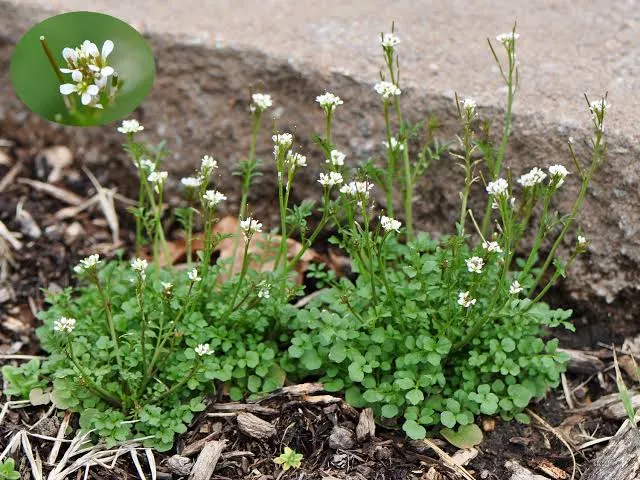
What it looks like: Small white four-petaled flowers on upright stems with a rosette of rounded lobed leaves at the base. It looks delicate and harmless. It is not.
Where it grows: Moist, shaded areas and mulched garden beds. It’s a cool-season weed, meaning it shows up in Florida’s fall and winter months — often sneaking into lawns while warm-season turf is dormant.
Quick ID tip: Touch a mature seed pod — they explode outward, launching seeds several feet in all directions. This is both impressive and deeply frustrating. If your bittercress has gone to seed, pull it carefully and bag it immediately.
7. Wild Garlic / Wild Onion — White-Tipped Clusters
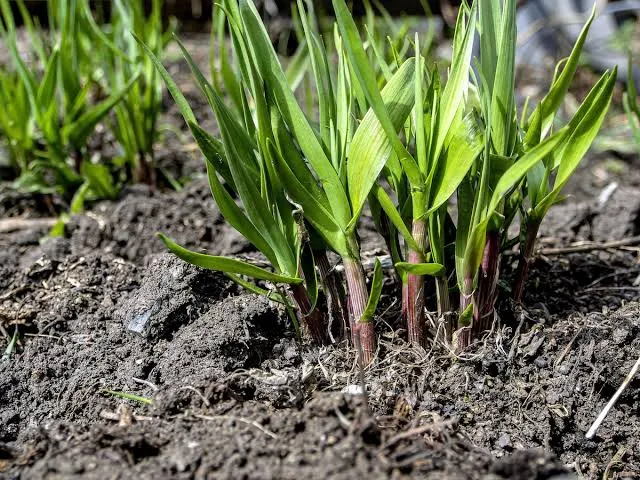
What it looks like: Upright, grass-like hollow leaves rising from a bulb, topped with clusters of white (or sometimes pinkish-white) star-shaped flowers arranged in an umbel — a globe-shaped cluster of small flowers on individual stalks.
Where it grows: Any lawn. It’s particularly common in fall through spring in Florida, often appearing in clusters.
Quick ID tip: Crush a leaf between your fingers. If it smells like onion or garlic, you’ve found it. Wild garlic has hollow leaves; wild onion has flat leaves — but both respond to the same controls.
How to Tell Florida Weeds with White Flowers Apart
Still not sure which one you’ve got? Here’s a quick-reference comparison table:
| Weed Name | Flower Type | Leaf Shape | Favorite Habitat | Active Season |
|---|---|---|---|---|
| White Clover | Round pom-pom | Trifoliate, oval | Full sun, low-N soil | Year-round |
| Florida Pusley | Star-shaped cluster | Oval, hairy | Sandy, dry | Summer |
| Dollarweed | Tiny clusters | Round, scalloped | Wet, shaded | Year-round |
| Hairy Bittercress | Small, 4-petal | Rounded lobes | Moist, shaded | Fall–Spring |
| Woodsorrel | 5-petal, delicate | Heart-shaped, 3-lobed | Anywhere | Year-round |
| Wild Garlic/Onion | Umbel clusters | Grass-like, hollow | Any lawn | Fall–Spring |
| Chamberbitter | Tiny, inconspicuous | Fern-like rows | Disturbed soil | Summer |
How to Get Rid of Florida Weeds with White Flowers
Identifying the weed is half the battle. Here’s how to finish the job.
Manual Removal: When It Works and When It Doesn’t
Hand-pulling works well for:
- Hairy bittercress (before it sets seed)
- Young chamberbitter (before the taproot deepens)
- Wild garlic/onion (if you remove the bulb completely)
But here’s the truth: hand-pulling fails for dollarweed and woodsorrel because both spread through underground rhizomes. You’ll pull the top and the plant regrows from what’s left below. For these, you need a different approach.
Pro tip: Always pull weeds after rain or irrigation when the soil is loose. Grab as close to the base as possible and pull straight up to get the root.
Herbicide Options for Florida White-Flower Weeds
When manual removal isn’t enough, herbicides are your next move. There are two types:
- Pre-emergent herbicides prevent weed seeds from germinating. Apply in early spring and early fall to stop Florida pusley and chamberbitter before they sprout.
- Post-emergent herbicides kill weeds that are already growing. These are what you need for the weeds you’re looking at right now.
Common effective active ingredients for Florida white-flowering weeds:
- Atrazine — effective on dollarweed and clover; safe for St. Augustine and centipede
- 2,4-D — broad-spectrum broadleaf killer; works on clover, bittercress, and pusley
- Triclopyr — strong option for wild garlic, onion, and woodsorrel
Critical note: Always match the herbicide to your grass type. Atrazine, for example, can damage Bermuda and Zoysia at certain rates. Read the label — every time, without exception. When in doubt, consult a local lawn care professional who knows Florida’s turf varieties.
Lawn Health as the Best Long-Term Defense
Here’s why some yards seem weed-magnet while others stay clean: dense, healthy turf crowds out weeds naturally.
Weeds need open soil and sunlight to germinate. A thick lawn denies them both. To keep your Florida lawn competitive:
- Mow at the right height. St. Augustine should be kept at 3.5–4 inches. Cutting too short stresses grass and opens the canopy for weeds.
- Fertilize correctly. White clover, in particular, thrives in nitrogen-deficient lawns. A proper fertilization schedule removes its competitive advantage.
- Water deeply, not daily. Frequent shallow watering encourages dollarweed and shallow-rooted weeds. Water deeply 1–2 times per week instead.
- Overseed bare spots. Bare patches are weed welcome mats. Fill them fast.
According to the University of Florida IFAS Extension, maintaining proper mowing height is one of the single most effective cultural practices for reducing weed pressure in Florida lawns. (Source: UF/IFAS)
Are Any Florida Weeds with White Flowers Actually Beneficial?
Not every white-flowering weed deserves a death sentence. Here’s the nuanced truth.
White clover is genuinely controversial in the lawn care world. It fixes atmospheric nitrogen, meaning it feeds your lawn while it grows. It also supports pollinators — bees, butterflies, and other beneficial insects rely on clover blooms. Some homeowners intentionally include it in a “microclover” lawn mix for exactly these reasons.
Wild garlic and onion are edible (though not particularly tasty from a lawn), and they don’t cause significant damage to turf in small numbers.
The bottom line: If a weed isn’t spreading aggressively, isn’t toxic to pets or children, and isn’t crowding out your grass, you can afford to be selective about what you treat. But if it’s taking over — treat it.
Frequently Asked Questions About Florida Weeds with White Flowers
What is the most common weed with white flowers in Florida?
Florida pusley (Richardia scabra) and white clover are arguably the most widespread Florida weeds with white flowers. Florida pusley dominates in summer across sandy soils statewide, while white clover appears year-round in lawns with low nitrogen levels. Dollarweed is a close third, especially in wetter areas of central and south Florida.
Are white flowering weeds in Florida harmful to pets or children?
Most common white-flowering lawn weeds in Florida are not toxic. However, woodsorrel (Oxalis) contains oxalic acid and can be harmful to pets if consumed in large quantities. Wild garlic and wild onion are in the Allium family, which is known to be toxic to dogs and cats. If you have pets that graze on lawn plants, it’s worth treating these two sooner rather than later.
How do I identify a Florida weed with small white flowers?
Start with the leaf shape — it’s the fastest differentiator. Round leaves = dollarweed. Trifoliate (three-leaf) = white clover or woodsorrel. Fern-like rows = chamberbitter. Grass-like = wild garlic. From there, check the flower shape: star-shaped clusters point to Florida pusley, pom-poms to clover, and tiny four-petaled flowers to bittercress. The comparison table above is your fastest ID tool.
Will white clover hurt my Florida lawn?
White clover is a low-growing broadleaf weed that competes with turf for space and light, but it rarely “kills” a lawn. The real concern is that it signals a nutrient imbalance — specifically, low nitrogen. Left unchecked, it can spread to cover large patches. A proper fertilization program will often slow or stop clover on its own, without any herbicide needed.
What kills white weeds in a Florida lawn without killing the grass?
The safest selective broadleaf herbicides for Florida lawns include products containing 2,4-D, dicamba, or MCPP for most broadleaf white-flowering weeds. For St. Augustine lawns specifically, atrazine is a widely used and turf-safe option for clover and dollarweed. Always confirm your grass type before applying any herbicide, and follow label rates carefully. When in doubt, a professional application ensures the right product at the right rate.
Conclusion: You’ve Got This
Florida weeds with white flowers are common, persistent, and sometimes genuinely tricky to tell apart — but they’re not unbeatable. Here’s the short version of everything we covered:
- Dollarweed loves wet spots; control watering and treat with atrazine
- White clover signals low nitrogen; fertilize first, then treat if needed
- Chamberbitter spreads fast via seeds; pull early or pre-emergent in spring
- Florida pusley is a sandy-soil summer weed; post-emergent controls it well
- Woodsorrel regrows from rhizomes; hand-pulling alone won’t cut it
- Hairy bittercress pops seeds when touched; bag it before it spreads
- Wild garlic/onion needs bulb-targeting treatment to fully eliminate
The best long-term defense isn’t just a bottle of herbicide — it’s a healthy, dense, well-maintained Florida lawn that doesn’t give weeds room to breathe.
Not sure where to start with your lawn care routine? Explore Gen Lawn’s guides on fertilization, mowing, and weed prevention to build a plan that keeps Florida weeds from coming back season after season.
References & Sources
- University of Florida IFAS Extension – Weed Management: https://edis.ifas.ufl.edu/topic_weed_management
- USDA PLANTS Database: https://plants.usda.gov
- UF/IFAS – Lawn Weed ID Guide: https://edis.ifas.ufl.edu/wg004
- Clemson Cooperative Extension – Weed Control in Lawns: https://hgic.clemson.edu/category/lawn/weeds/
About Author
Khalid Fazal is a seasoned lawn care specialist and horticultural researcher with over 15 years of hands-on experience transforming challenging landscapes into lush, resilient green spaces. His journey didn’t start in a lab, but in a backyard full of stubborn, cracked clay that “experts” said would never grow a healthy blade of grass. Refusing to accept a yard full of dust, Khalid spent years experimenting with organic soil restoration and precise mulching—eventually turning that wasteland into a neighborhood showpiece on a shoestring budget.
From mastering core aeration techniques to optimizing soil pH for specialized turf varieties, Khalid’s approach combines old-school grit with modern agronomic science. He founded Gen Lawn to provide homeowners with honest, research-backed advice that prioritizes long-term soil health over quick-fix chemical solutions. When he isn’t analyzing soil profiles, he’s developing precision tools to help others achieve professional results without the professional price tag.

Lawn Winterizer: When to Apply by Grass & Region [2026]
Table of Contents Home / By Khalid Fazal | Updated:...
Read More
Spring Lawn Care: What to Do and When in Every US Region
Table of Contents Home / By Khalid Fazal | Updated:...
Read More
Lawn Maintenance Checklist by Season and Grass Type (2026)
Table of Contents Home / By Khalid Fazal | Updated:...
Read More
Liquid Fertilizer vs Granular Fertilizer: Which Wins?
Table of Contents Home / By Khalid Fazal | Updated:...
Read More