
Remote Controlled Lawn Mower: The Complete Buyer’s Guide for 2025
Picture this. It is Saturday morning. The sun is already brutal, your back hurts just thinking about it, and you have half an acre of grass staring back at you.
You fire up the push mower and spend the next two hours sweating through your shirt, nearly slipping twice on the side slope near the fence.
Sound familiar? Here is the thing: lawn mowing is not just exhausting. It is genuinely dangerous.
According to the U.S. Consumer Product Safety Commission (CPSC), an estimated 80,000 people end up in emergency rooms every year because of lawn mower-related injuries. A Johns Hopkins University study found that the average mower injury costs around $37,000 in medical bills per patient.
That is where a remote controlled lawn mower changes everything.
Instead of pushing a heavy machine across your yard, you guide it from a safe distance using a handheld controller or smartphone app. No sweating. No back strain. No putting yourself inches away from a fast-spinning blade.
In this guide, you will learn:
- What a remote controlled lawn mower is and how it differs from a robotic mower
- The biggest benefits for homeowners, seniors, and landscaping professionals
- The best RC mowers available in the US right now
- What to look for before you buy
- Safety and maintenance tips to keep things running smoothly
Let’s get into it.
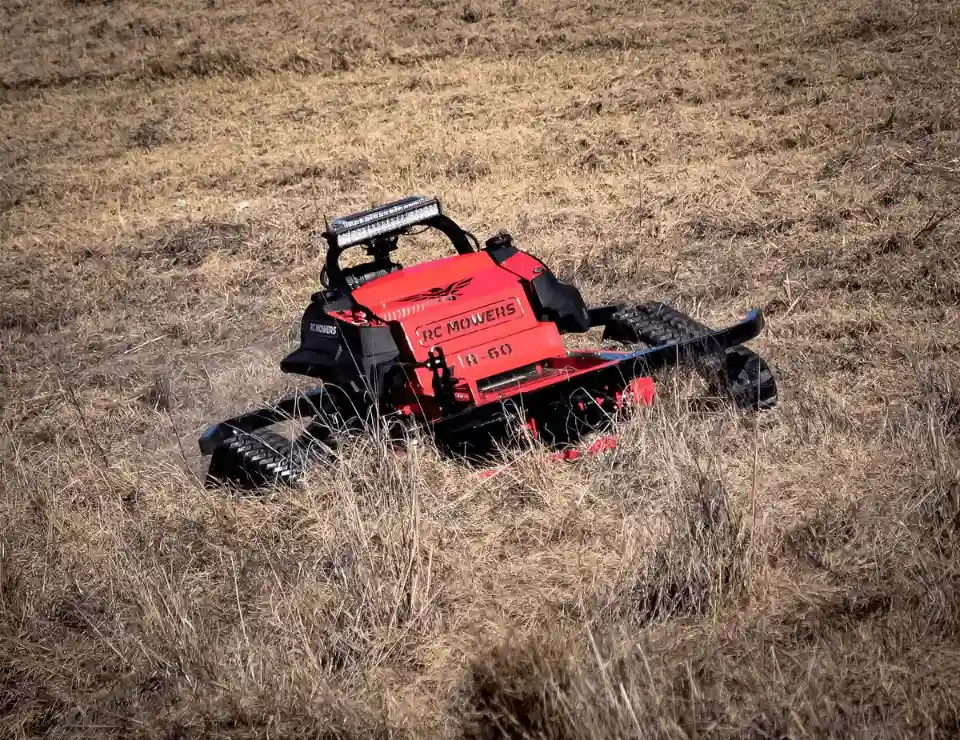
What Is a Remote Controlled Lawn Mower?
A remote controlled lawn mower (also called an RC mower) is a motorized mower that you steer and operate from a distance. You use a handheld controller or smartphone app to guide it from anywhere between 50 and 200 meters away, depending on the model.
Think of it like a large, powerful RC car, but instead of rolling around a driveway, it is cutting your grass.
These are not novelty toys. Modern RC mowers are heavy-duty machines designed for everything from standard suburban yards to extreme commercial slopes.
RC Mower vs. Robotic Mower: What Is the Real Difference?
This is one of the most common points of confusion, so let us clear it up right now.
| Feature | Remote Controlled Mower | Robotic Mower |
|---|---|---|
| How it operates | You steer it in real time via controller | Fully autonomous, runs on a schedule |
| Setup required | Minimal | Boundary wire or GPS mapping |
| Slope handling | Excellent (up to 85% grade) | Struggles on steep or complex terrain |
| Control level | Full manual control at all times | Set it and forget it |
| Price range | $500 to $8,700+ | $800 to $5,000+ |
| Best for | Slopes, large yards, precision work | Flat or gently rolling lawns |
| Wildlife safety | You steer around animals in real time | Sensors may miss small animals |
The bottom line: if you want full control and need to tackle challenging terrain, a remote controlled lawn mower is your best option. If you have a flat suburban lawn and want true hands-free automation, a robotic mower might suit you better.
How Does a Remote Controlled Lawn Mower Actually Work?
Most RC mowers use radio frequency (RF) signals transmitted between your handheld controller and the mower. Push the joystick forward, the mower moves forward. Tilt it left or right, it steers that way.
More advanced models connect via Bluetooth or Wi-Fi to a smartphone app, adding features like GPS tracking, scheduled mowing, and real-time maintenance alerts.
The mower itself runs on either a lithium-ion battery or a gas engine. Electric models are rapidly becoming the standard for residential use, which we cover in the buying guide section below.
Why More US Homeowners Are Switching to Remote Controlled Lawn Mowers
The remote controlled lawn mower market is growing fast. The US robotic and remote mower market alone generated over $1 billion in 2024 and is on track for steady growth through 2034.
Here is why homeowners are making the switch.
Safety First: Keep Yourself Away from the Blade
Let us go back to those CPSC numbers for a second.
Over 80,000 people visit US emergency rooms each year due to lawn mower injuries. Most of these accidents happen because the operator is physically too close to a spinning blade. A slip on a slope, a child running into the yard, a rock launched at full speed. These are all very real risks.
With a remote controlled lawn mower, you are guiding the machine from a safe distance. You are never in the direct danger zone. For more on mowing safety standards, OSHA’s landscaping safety guidelines are a solid reference.
Built for Slopes, Hills, and Rough Terrain
Here is where RC mowers truly stand out.
Traditional mowers can tip over on steep inclines. OSHA identifies hillside mowing as one of the leading causes of serious landscaping injuries in the US.
But modern remote controlled lawn mowers are specifically engineered for this type of terrain. The Mowrator S1 4WD handles slopes up to an 85% grade. The Mammotion LUBA 2 AWD manages inclines of up to 38.6 degrees. These are conditions where sending a person with a push mower is genuinely dangerous.
If your yard has any significant slope, a remote controlled mower is not just more convenient. It is significantly safer.
A Game-Changer for Seniors and Those with Limited Mobility
This angle does not get talked about enough, and it should.
As we age, the physical demands of lawn care become increasingly difficult. Pushing a heavy mower across uneven ground puts pressure on joints, challenges balance, and raises the real risk of falls. For elderly homeowners or anyone managing physical limitations, maintaining a yard often means paying for landscaping services or relying on family members.
A remote controlled lawn mower removes that dependency completely.
You stand on your porch. You hold a controller. Your lawn gets mowed.
Research published by Lawn Care Quarterly found that elderly users report 78% less physical strain with RC mowers compared to traditional push mowers. Disabled World has an excellent breakdown of how these machines are specifically designed to restore independence for elderly and disabled homeowners.
Time and Labor Savings for Landscaping Professionals
For professional landscapers, the business case is equally compelling.
One operator with a remote controlled lawn mower can handle a steep ditch or roadside embankment that previously required a crew of four to six people with weed trimmers. That is a direct reduction in labor costs, faster job completion, and the ability to bid on jobs that were not previously profitable.
RC mowers are increasingly used by municipalities for roadside maintenance, by utility companies for managing rights-of-way, and by golf courses for rough and bankside trimming.
Best Remote Controlled Lawn Mowers in 2025 (US Market)
Here are the top picks consistently cited by expert reviewers and verified user feedback across the US market.
Best Overall: Mowrator S1 4WD
The Mowrator S1 4WD is the most widely recognized top pick for 2025 across multiple independent review sources.
- Battery: 56V 18Ah LiFePO4 (lithium iron phosphate)
- Runtime: Up to 2.25 hours per charge
- Slope rating: Up to 85% grade
- Cutting deck: 21-inch reinforced steel
- Control: Handheld remote plus smartphone app
- Price: Approximately $2,821 to $3,499
Best for: Homeowners with steep or complex terrain, larger properties up to 1+ acre, and professionals needing commercial-grade durability.
Pros: Exceptional slope performance, long battery life, four-wheel drive stability, app connectivity.
Cons: Higher price point, may be more mower than flat suburban yards require.
Best for Slopes and Large Properties: Mammotion LUBA 2 AWD
The Mammotion LUBA 2 AWD is a wire-free machine that uses RTK technology (Real-Time Kinematic positioning) combined with binocular AI vision to map and navigate your yard without any buried boundary wire.
- Slope rating: Up to 38.6 degrees (80% grade)
- Coverage: 0.1 to 2.5 acres depending on model
- Zones: Supports up to 60 individual mowing zones
- Setup: No perimeter wire required
- Price: Varies by coverage model
Best for: Larger or multi-zone properties where wire-free setup is a priority and slope handling matters.
Pros: No wire installation, excellent AI navigation, strong slope performance, huge coverage range.
Cons: Higher cost for larger coverage models, app learning curve for first-time users.
Best Budget Pick: WORX Landroid
If you want to get started with remote and automated mowing without a large upfront investment, the WORX Landroid is a strong starting point.
- Coverage: Models available from 1/4 acre up to 1 acre
- Technology: Cloud-based wire-free navigation (2025 models)
- Price: Around $899 for the 1/4 acre model (reduced from $2,000 retail)
- Ideal for: Flat to gently rolling suburban yards
Best for: Budget-conscious homeowners with smaller, relatively flat lawns who want to explore RC mowing without a major investment.
Pros: Excellent price-to-performance ratio, no wire needed, easy app setup.
Cons: Less suited for steep slopes, limited power compared to premium models.
What to Look for When Buying a Remote Controlled Lawn Mower
Buying a remote controlled lawn mower is a real investment. Here is what to think through before you commit.
Yard Size and Slope Angle
Start here. Measure your lawn and note the steepest part of your yard.
- Under 1/4 acre, mostly flat: A budget model like the WORX Landroid works well
- 1/4 to 1 acre with moderate slopes: Mid-range picks like the Husqvarna Automower 435X or Mammotion LUBA 2
- Over 1 acre or slopes above 30 degrees: You need a serious RC mower like the Mowrator S1
Not sure how steep your slope is? Use this free slope calculator tool to measure it before you shop.
Battery vs. Gas-Powered Models
Both options have a place, depending on your situation.
Battery-powered (electric) RC mowers are quieter, produce zero direct emissions, require less maintenance, and are better suited for residential neighborhoods. Top electric models now deliver 1.5 to 2.25 hours of runtime per charge, which covers most suburban lawns comfortably.
Gas-powered RC mowers offer longer continuous runtime and more raw power, making them better for large commercial properties where stopping to recharge would create real problems.
Industry projections show that by 2030, 60% of all remote mowers will be electric. If you are buying for the long haul, electric is generally the smarter direction. The US Department of Energy has a helpful overview of electric lawn equipment if you want to understand the full cost and emissions picture.
Control Range
Most consumer RC mowers operate within a 50 to 200-meter control range. For typical residential properties, this is more than sufficient.
Commercial-grade models can reach up to 700 meters, aimed at operators managing large fields or utility rights-of-way.
Make sure the control range covers your entire property with room to spare. Losing signal mid-mow is a situation you want to avoid entirely.
Price Ranges in the US Market
Here is a practical breakdown of what to expect at each tier:
| Price Tier | Range | What You Get |
|---|---|---|
| Budget | $500 to $1,000 | Basic RC function, small flat yards, limited control range |
| Mid-Range | $1,000 to $3,000 | Better slope handling, longer battery, app connectivity, larger coverage |
| Pro-Grade | $3,000 to $8,700+ | Commercial durability, extreme slope ratings, wide cutting decks, extended range |
For most US homeowners, the mid-range tier provides the best balance of performance and long-term value.
Remote Controlled Lawn Mower Safety Tips You Should Not Skip
Even though you are not physically behind the mower, safe operation still matters.
Keep Kids and Pets Clear
Before every mowing session, clear the yard completely. Children and pets should be indoors or well away from the operating area.
Even with built-in obstacle detection sensors, remote controlled lawn mowers are running heavy spinning blades at speed. They should never be treated as fully safe to operate around children or animals without a clear perimeter.
The American Academy of Pediatrics recommends that children under 12 should not be near any operating mower. Always maintain a clear line of sight to the machine throughout the entire mowing session.
Basic Maintenance to Keep It Running Right
Your RC mower will last significantly longer with regular care. Here are the basics:
- Wipe down the exterior after every session with a damp cloth (mild soap and water, no harsh chemicals)
- Inspect blades every few weeks and sharpen or replace them as needed. Dull blades tear grass rather than cut it, which stresses your lawn
- Check battery terminals for corrosion and keep charge levels healthy
- Store the mower indoors or under proper cover when not in use
- Follow your model’s user manual for service intervals specific to your machine
For electric models, avoid letting the battery drain to zero before recharging. Keeping it between 20% and 80% charge consistently extends overall battery life. Battery University is a great free resource if you want to get more out of your battery over time.
Frequently Asked Questions About Remote Controlled Lawn Mowers
Are remote controlled lawn mowers worth the money?
For most homeowners dealing with slopes, large yards, or physical limitations, yes, they are worth it. The time saved, the safety benefits, and the reduction in physical strain deliver genuine value. Budget models start around $500 to $900, while mid-range options in the $1,000 to $3,000 range offer the best fit for most US suburban homeowners.
What is the difference between a remote controlled lawn mower and a robotic lawn mower?
A remote controlled lawn mower requires you to actively steer it using a controller or app in real time. A robotic lawn mower operates autonomously after initial setup without any ongoing input from you. RC mowers give you better terrain control and real-time precision. Robotic mowers give you true hands-free automation on flat lawns. The comparison table at the top of this guide breaks it down clearly.
Can a remote controlled lawn mower handle steep hills?
Yes, and this is one of its biggest advantages over robotic alternatives. Quality RC mowers handle slopes from 35 degrees up to 85% grade, depending on the model. This is terrain where traditional push and riding mowers pose genuine injury risks. The Mowrator S1 4WD and Mammotion LUBA 2 AWD are the leading options for steep terrain in the US market.
How far can you control a remote controlled lawn mower?
Consumer models typically offer a control range of 50 to 200 meters. Commercial-grade models can reach up to 700 meters. For most residential properties, even the lower-range models provide plenty of coverage for the full yard.
Where can I buy a remote controlled lawn mower in the US?
You can buy directly from manufacturer websites including Mowrator, Mammotion US, and WORX. They are also available through Amazon and specialty outdoor power equipment retailers. Always purchase from an authorized seller to ensure your warranty is valid and that you receive proper product support.
The Bottom Line
A remote controlled lawn mower is not a gimmick. It is a genuine, practical upgrade to how you maintain your property.
Whether you are a homeowner tired of weekend mowing in the heat, a senior who wants to stay independent without the physical risk, or a landscaping professional looking to take on tougher jobs with a smaller crew, RC mowers deliver real and measurable value.
Here is what to remember:
- RC mowers give you real-time control from a safe distance, unlike fully autonomous robotic mowers
- They handle slopes and rough terrain better than any robotic alternative on the market
- The US market has strong options at every price tier from $500 to over $8,000
- Safety and maintenance are still your responsibility, even when operating from a distance
- Match your choice to your yard size, slope angle, and budget for the best outcome
Ready to stop pushing and start controlling? Start with the product picks above, match them to your situation, and make the switch that thousands of US homeowners have already made.
References and External Resources
- US Consumer Product Safety Commission (CPSC) – Lawn Mower Safety Data
- Johns Hopkins Medicine – Lawn Mower Injury Cost Study
- Mowrator – RC Mower vs Autonomous Robotic Mower Comparison
- Disabled World – RC Mowers for Elderly and Disabled Homeowners
- OSHA – Landscaping and Grounds Keeping Safety
- US Department of Energy – Electric Lawn Mower Guide
- Battery University – How to Prolong Lithium-Ion Battery Life
- American Academy of Pediatrics – Lawn Mower Safety for Children
- Grand View Research – Global Lawn Mowers Market Report 2025
- Robot Lawn Smower – RC vs Robotic Mower Deep Dive
- BestIn Mower – Remote Control Mower Ultimate Buying Guide
- Slope Calculator Tool
- Battery University – Lithium Battery Care
About Author
Khalid Fazal is a seasoned lawn care specialist and horticultural researcher with over 15 years of hands-on experience transforming challenging landscapes into lush, resilient green spaces. His journey didn’t start in a lab, but in a backyard full of stubborn, cracked clay that “experts” said would never grow a healthy blade of grass. Refusing to accept a yard full of dust, Khalid spent years experimenting with organic soil restoration and precise mulching, eventually turning that wasteland into a neighborhood showpiece on a shoestring budget.
From mastering core aeration techniques to optimizing soil pH for specialized turf varieties, Khalid’s approach combines old-school grit with modern agronomic science. He founded Gen Lawn to provide homeowners with honest, research-backed advice that prioritizes long-term soil health over quick-fix chemical solutions. When he isn’t analyzing soil profiles, he’s developing precision tools to help others achieve professional results without the professional price tag.

Lawn Winterizer: When to Apply by Grass & Region [2026]
Table of Contents Home / By Khalid Fazal | Updated:...
Read More
Spring Lawn Care: What to Do and When in Every US Region
Table of Contents Home / By Khalid Fazal | Updated:...
Read More
Lawn Maintenance Checklist by Season and Grass Type (2026)
Table of Contents Home / By Khalid Fazal | Updated:...
Read More
Liquid Fertilizer vs Granular Fertilizer: Which Wins?
Table of Contents Home / By Khalid Fazal | Updated:...
Read More