
Artificial Grass Infill: The Complete Guide to Choosing the Right Type for Your Lawn
Most homeowners spend weeks picking the perfect artificial grass and barely a minute thinking about infill. That is exactly where things go wrong.
Skip infill or choose the wrong type, and your lawn will look flat within months, trap pet odors, and on a hot summer afternoon, feel like a surface you could fry an egg on. In states like Texas, Arizona, and Florida, artificial turf with rubber infill can reach surface temperatures of 120 to 140 degrees Fahrenheit on a 100-degree day.
Here is the good news: once you understand the options, choosing the right artificial grass infill is actually straightforward. This guide covers every type available, what the latest safety research says, how much you need, and how to pick the right one for your yard, pets, kids, or climate.
What Is Artificial Grass Infill and What Does It Actually Do?
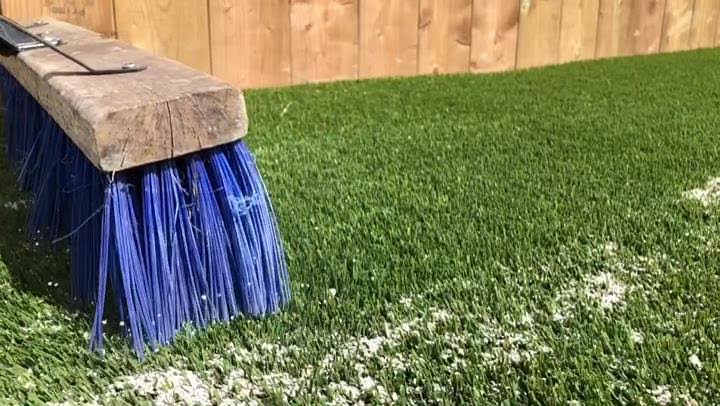
Artificial grass infill is the granular material spread between the blades of synthetic turf during and after installation. Think of it as the backbone of your entire turf system. Without it, the grass looks and feels nothing like it should.
The 4 Core Jobs of Artificial Grass Infill
Infill does more than just fill space. Here is what it is actually responsible for:
- Blade Support: Infill keeps synthetic grass fibers standing upright so your lawn looks natural and full rather than flat and matted.
- Stability and Weight: It weighs down the turf to prevent shifting, rippling, or lifting, especially in windy conditions or high-traffic areas.
- Cushioning: Many infill types add a layer of shock absorption underfoot, which matters a lot for kids play areas and sports surfaces.
- UV and Drainage Protection: Infill covers and shields the turf backing from ultraviolet (UV) radiation damage, while most types allow water to drain through freely.
Do You Always Need Artificial Grass Infill?
For most standard turf installations, yes. Skipping infill is one of the most common mistakes homeowners make. Without it, blade fibers lose their structure, the turf shifts underfoot, and the backing material degrades faster from UV exposure.
That said, some premium turf products come with thicker, denser backing systems that can perform with minimal infill. Always check the manufacturer’s recommendation for your specific turf product before deciding how much to use.
Types of Artificial Grass Infill: Full Breakdown
This is where most guides fall short. Here is a walkthrough of every major type, with real cost data and honest pros and cons included.
Silica Sand Infill
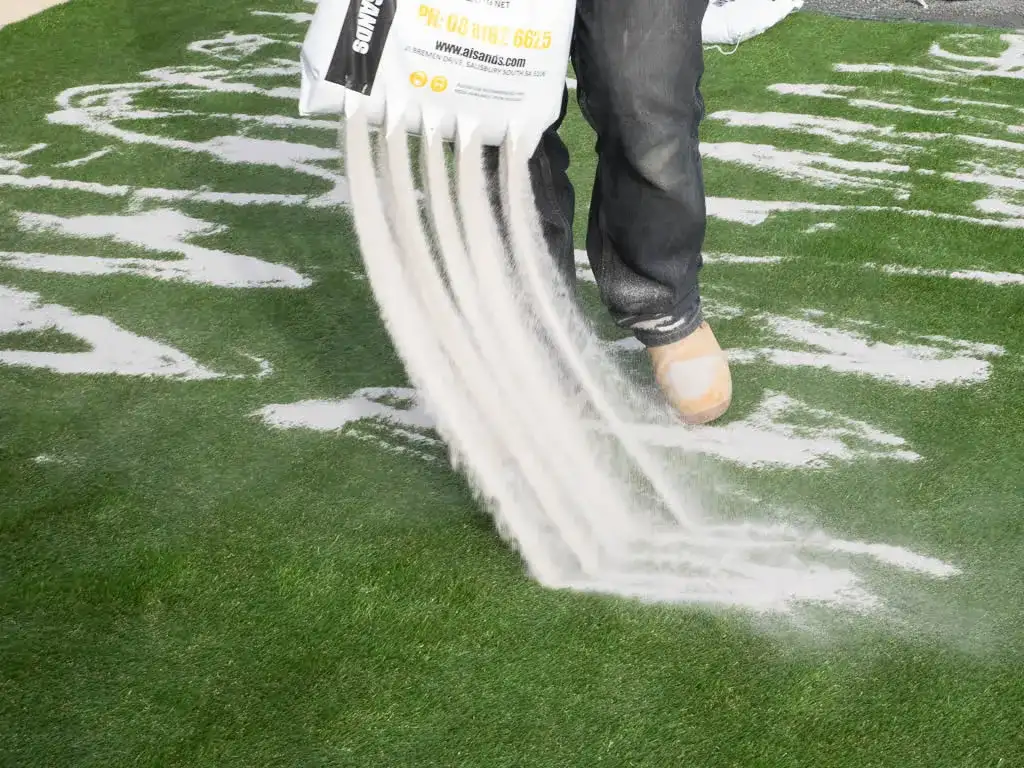
Silica sand is derived from quartz eroded over time by water and wind. It is the most widely used infill in the US and the most affordable option available.
Cost: $0.25 to $0.75 per square foot
Best For: General residential lawns, shaded areas, budget-conscious installs
Pros:
- Very affordable and widely available across the US
- Provides solid blade support and ballast weight
- Helps protect turf backing from UV damage
- Good drainage properties
Cons:
- Can hold heat in direct sunlight, making the surface warmer underfoot
- Jagged granule edges on standard silica can wear down grass fibers over time in high-traffic spots
- Does not control pet odors
Bottom line: A reliable, no-frills choice for a typical front or backyard without pets or extreme heat.
Crumb Rubber Infill
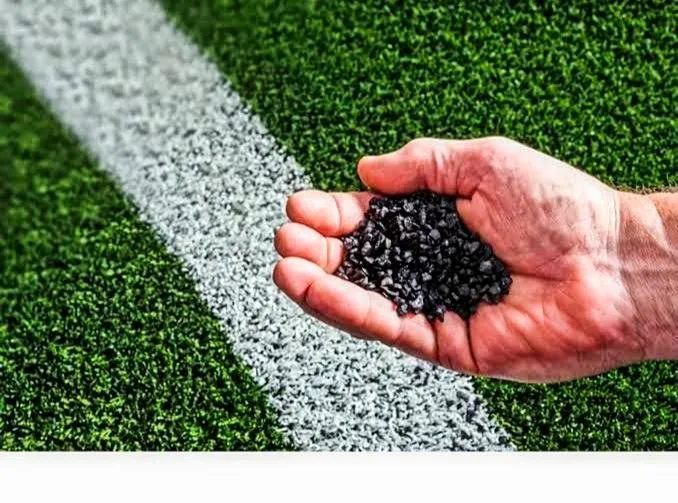
Crumb rubber is made from recycled tires ground down into small granules. It is the most common infill on sports fields because of its shock-absorbing properties.
Cost: $0.50 to $1.25 per square foot
Best For: Sports fields and athletic turf ONLY
Pros:
- Excellent shock absorption for player safety on athletic fields
- Durable and long-lasting under heavy foot traffic
- Budget-friendly for large-scale commercial applications
Cons:
- Gets dangerously hot in direct sun, reaching 120 to 140 degrees Fahrenheit in Southern US states
- Leaves black dust residue on skin and clothing
- Raises significant health concerns for residential use near children and pets
Important Safety Note: A 2025 peer-reviewed study published in PubMed Central reviewed existing literature and flagged crumb rubber infill for its content of polycyclic aromatic hydrocarbons (PAHs), volatile organic compounds (VOCs), and heavy metals from recycled tires. The State of California’s Office of Environmental Health Hazard Assessment (OEHHA) released a draft Health Risk Assessment in March 2025 with findings from 35 artificial turf fields statewide.
For residential lawns where kids and pets spend time, crumb rubber is not recommended.
Zeolite Infill
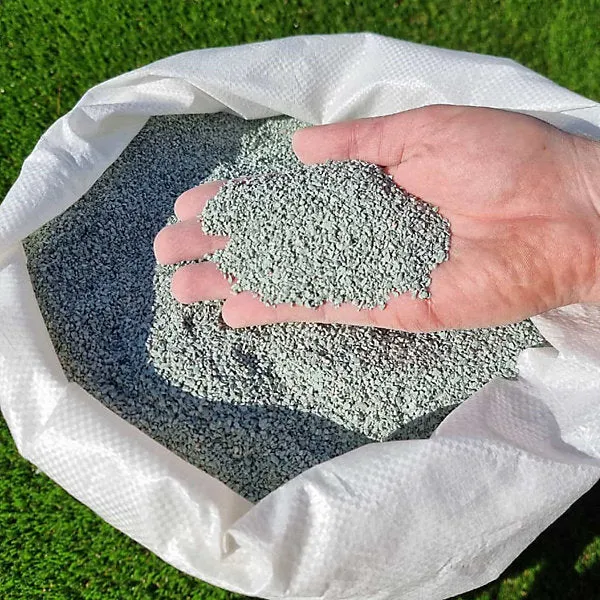
Zeolite is a naturally occurring volcanic mineral with a unique honeycomb-like molecular structure. It is the go-to choice for pet owners for one very specific reason: it absorbs and traps ammonia at the molecular level.
Cost: $1.00 to $1.50 per square foot
Best For: Pet areas, hot climates, yards with odor concerns
Pros:
- Absorbs ammonia from pet urine and eliminates odor at the source
- Stays 20 to 30% cooler than rubber infill in direct sunlight
- 100% natural and non-toxic
- Refreshes naturally after heavy rainfall flushes absorbed material through the turf
Cons:
- Lightweight on its own, so it works best layered over a base of heavier sand
- Slightly more expensive than basic silica sand
Pro tip from installers: Many professionals use a silica or coated sand base layer topped with zeolite for a cost-effective combination that handles both odor control and heat in one system.
Coated Sand (Envirofill and Durafill)
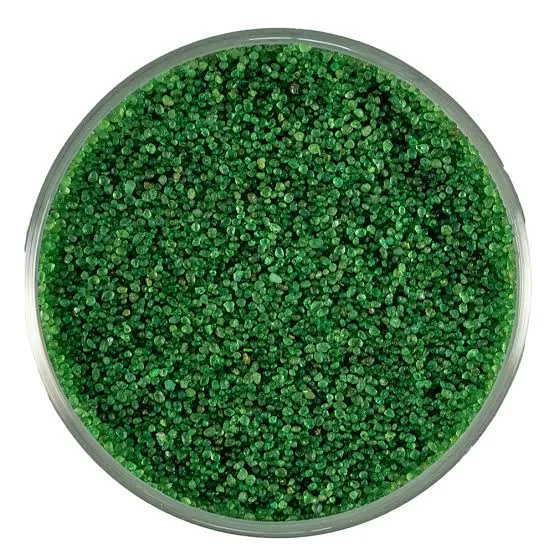
Coated sand, sold under brand names like Envirofill and Durafill, is silica sand with a polymer coating and built-in antimicrobial protection. It is one of the most popular premium options for residential installs across the US.
Cost: $1.50 to $2.00 per square foot
Best For: Families with kids, pet owners, high-traffic residential lawns
Pros:
- Rounded granule shape is softer underfoot and gentler on turf fibers compared to standard silica
- Built-in antimicrobial protection resists bacteria and mold growth
- Resists compaction better than standard sand, keeping your turf springy longer
- Provides odor control right out of the bag
Cons:
- Costs more than basic silica sand
- Not the coolest option available for extreme heat climates like Arizona
Bottom line: The best all-around choice for most US residential lawns. It balances safety, performance, and longevity without breaking the budget.
Organic Infill (Cork, Coconut Fiber, Walnut Shell)
Organic infills are made from natural materials like cork granules, ground coconut husks, and crushed walnut shells. They are the most eco-friendly option on the market and run cooler than any other infill type available.
Cost: $1.50 to $2.50 per square foot
Best For: Eco-conscious homeowners, hot climates, low-to-moderate traffic lawns
Pros:
- Lowest surface temperature of any infill type available
- Completely biodegradable and sustainably sourced
- Non-toxic for both kids and pets
- Natural feel underfoot
Cons:
- Compacts more quickly than synthetic options and needs regular brushing and fluffing
- Can break down faster in very wet or humid climates
- Works best in lower-traffic residential settings
Worth knowing: Cork and coconut infills cool the turf through natural insulation and mild evaporative cooling, keeping surfaces significantly more comfortable on hot days compared to any rubber option.
TPE and EPDM Rubber Infill
Thermoplastic Elastomer (TPE) and Ethylene Propylene Diene Monomer (EPDM) rubber are both virgin rubber materials, meaning they are not made from recycled tires. They are considered safer and more performance-consistent alternatives to crumb rubber.
Cost: $2.00 to $3.50 per square foot
Best For: Sports fields, school playgrounds, commercial turf applications
Pros:
- Better safety profile compared to crumb rubber
- Can be produced in multiple colors for sports field marking
- Excellent shock absorption and impact attenuation for athletic use
- Resists breaking down over time under heavy use
Cons:
- More expensive than crumb rubber
- Still holds heat in direct sunlight, so not ideal for residential southern lawns
- More than most standard home lawns need
Artificial Grass Infill: Quick Comparison Table
| Infill Type | Cost per Sq Ft | Best For | Heat Level | Pet Safe | Eco Friendly |
|---|---|---|---|---|---|
| Silica Sand | $0.25 to $0.75 | General residential | Medium | Moderate | No |
| Crumb Rubber | $0.50 to $1.25 | Sports fields only | Very High | Not Recommended | No |
| Zeolite | $1.00 to $1.50 | Pets and hot climates | Low | Yes | Yes |
| Coated Sand (Envirofill) | $1.50 to $2.00 | Families and everyday use | Medium | Yes | Partial |
| Organic (Cork/Coconut) | $1.50 to $2.50 | Eco lawns and hot climates | Lowest | Yes | Yes |
| TPE and EPDM Rubber | $2.00 to $3.50 | Sports and commercial | Medium-High | Yes | Partial |
How to Choose the Right Artificial Grass Infill for Your Needs
Now the practical part. Here is how to match your specific situation to the right infill type.
Best Artificial Grass Infill for Pet Owners
If you have dogs, odor control and bacteria resistance are your top priorities.
Standard silica sand absorbs pet urine but traps ammonia, which leads to odor buildup over time. Zeolite solves this at the molecular level by binding to ammonia ions and neutralizing the smell before it escapes.
Recommended setup:
- Base layer: Silica or coated sand for weight and stability (2 lbs per square foot)
- Top layer: Zeolite at 0.5 lbs per square foot for targeted odor control
- For heavy daily pet use: Use antimicrobial coated sand like Envirofill throughout the entire depth
Look for infill products that meet IPEMA safety certification standards if the area will also be used by children.
Best Artificial Grass Infill for Kids Play Areas
Safety is non-negotiable when children are involved. Two things matter most: cushioning and non-toxic materials.
Avoid crumb rubber entirely in play areas. The 2025 research from PubMed Central is clear on the chemical risk when rubber infill overheats, which happens regularly on sunny afternoons.
Recommended options:
- Coated sand like Envirofill or Durafill for safe, antimicrobial, soft-feel performance
- Organic infill such as cork or coconut for a fully natural, non-toxic surface
- Add a shock pad underlayer beneath the turf for additional cushioning on dedicated play surfaces
Best Artificial Grass Infill for Hot Climates
Here is something most installers do not tell you upfront: the type of infill you choose has a massive impact on surface temperature.
In Dallas, Houston, Phoenix, and similar markets, rubber infill in direct sunlight can push turf surface temperatures to 120 to 140 degrees Fahrenheit on a 100-degree day. That is dangerous for bare feet and dog paws.
Best choices for heat:
- Zeolite (stays 20 to 30% cooler than rubber)
- Organic infills like cork or coconut (coolest running of all available types)
- Hydrophilic cooling coated sand, which works through evaporation when pre-wetted before the hottest part of the day
Avoid in full-sun southern yards: Crumb rubber and standard EPDM rubber infill.
Best Artificial Grass Infill for Sports Turf and High-Traffic Areas
Sports and athletic surfaces need a layered system focused on shock absorption and durability.
Recommended setup:
- Base layer: Sand ballast at 4 to 6 lbs per square foot
- Performance layer: EPDM or TPE rubber for consistent shock absorption
- Add a shock pad underlayer for fields requiring specific fall height and impact ratings
For high school football or soccer fields, installers typically combine 4 lbs of sand and 8 lbs of rubber per square foot. For commercial playgrounds and indoor soccer courts, 2 to 4 lbs per square foot is the typical working range.
How Much Artificial Grass Infill Do You Need?
This is one of the most common questions homeowners ask, and it has a straightforward answer once you know the formula.
Simple Infill Calculator
Here is the method used by most US turf manufacturers and professional installers, as confirmed by Purchase Green:
The formula: Square footage multiplied by lbs per square foot equals total lbs needed
| Application Type | Lbs per Sq Ft | Example: 500 Sq Ft Yard |
|---|---|---|
| Residential lawn (light traffic) | 1 to 2 lbs | 500 to 1,000 lbs needed |
| Pet area | 2 to 3 lbs | 1,000 to 1,500 lbs needed |
| Kids play area | 2 to 3 lbs | 1,000 to 1,500 lbs needed |
| Sports field or high traffic | 3 to 12 lbs | 1,500 to 6,000 lbs needed |
A standard 50 lb bag covers roughly 25 to 50 square feet depending on application rate. Always order a little extra to have material available for future top-ups.
For a more detailed breakdown by turf pile height and application type, The Motz Group’s infill quantity guide is one of the most thorough resources available.
How Deep Should Artificial Grass Infill Go?
The golden rule: infill should sit just below the tip of the grass fibers. Not above them. Not halfway up.
Overfilling is just as damaging as underfilling. Too much infill buries the blades and causes that flat, matted look that makes artificial grass look cheap. Too little and the blades fall over, the turf shifts underfoot, and UV damage starts eating at the exposed backing material.
For most residential pile heights between 1 inch and 1.75 inches, this typically means 0.5 to 1 inch of settled infill depth once the installation is complete.
How to Install Artificial Grass Infill: Step-by-Step
Installing infill is the final step of your turf project, and it moves faster than most people expect. Here is exactly how to do it right.
What you will need:
- Drop spreader or lawn fertilizer spreader (rent one for jobs over 200 square feet)
- Stiff-bristle broom or power broom
- Your chosen infill material
- Measuring tape to spot-check depth
Step 1: Confirm your turf is fully secured
All seams should be locked down, edges secured with nails or staples, and the turf lying completely flat with no bubbles or ripples. Infill over an unsecured turf will highlight every imperfection.
Step 2: Load your drop spreader
Pour your infill into the spreader hopper. Set it to a medium-open setting to allow even distribution without dumping in clumps. Test on a small patch first before covering the full area.
Step 3: Start at one end and work in parallel rows
Walk steadily across the turf in overlapping parallel rows. Consistent, even passes prevent thin spots that show up once the turf is brushed and blades are standing upright.
Step 4: Work infill between the fibers
This is the most important step. Use a stiff-bristle broom or power broom to brush the infill down into the base of the turf. Infill sitting on top of the blades instead of between them at the base will not support the fibers properly.
Step 5: Check your depth
Run your hand across the surface. Blade tips should be visible and upright, with infill filling the space below them without covering the tops of the fibers.
Step 6: Top up any thin spots
Add a small amount of infill to any areas that look sparse after brushing and work it in the same way. Thin spots are usually along edges and seams.
Step 7: Do a final broom pass
One last pass with the stiff broom lifts any flattened fibers and gives your lawn that natural, full appearance right from day one.
Pro tip: Renting a power broom for jobs over 200 square feet cuts the work time in half and distributes infill more evenly than any hand tool. Most equipment rental shops carry them.
Frequently Asked Questions About Artificial Grass Infill
What is the best infill for artificial grass?
There is no single universal answer since it depends on your specific use case. For general residential use, coated sand like Envirofill is the most well-rounded choice available. For pet owners, a zeolite top layer over a sand base works best. For hot climates, organic infills like cork or coconut keep surfaces coolest. Match the infill to how you will actually use your lawn.
Can artificial grass be installed without infill?
In some cases, yes. Premium turf products with dense, thickened backing systems can function with minimal infill. However, for standard turf products, skipping infill results in flat blades, a turf that shifts underfoot, and accelerated UV damage to the backing. Most professional installers strongly recommend using infill in all standard residential installations. Check with your turf manufacturer for their specific guidance.
Is crumb rubber infill safe for kids and pets?
This is a concern worth taking seriously. A 2025 review published in PubMed Central examined the scientific literature on crumb rubber infill and flagged the presence of PAHs, VOCs, and heavy metals derived from recycled tires. California’s OEHHA released a draft Health Risk Assessment in March 2025 following field sampling from 35 turf sites across the state. For residential lawns used regularly by children and pets, crumb rubber is not the recommended choice. Coated sand, zeolite, or organic options are safer alternatives.
How often should I replace or top up my artificial grass infill?
Infill does not last forever. Over time it compacts, migrates toward edges, and depletes slowly from foot traffic and rain. Most residential lawns benefit from an infill top-up every 2 to 3 years. Pet areas may need attention more frequently depending on usage. During regular turf maintenance, brushing helps redistribute existing infill before deciding whether to add more.
How much does artificial grass infill cost?
According to data from Angi’s 2026 turf cost guide, infill typically adds $0.50 to $2.00 per square foot to your overall installation cost. For a 500 square foot yard, that is an additional $250 to $1,000 depending on the type you choose. Budget silica sand sits at the lower end of that range, while premium coated sands and organic infills sit at the higher end. Pet-friendly specialty blends can run $2.00 to $4.00 per square foot.
Conclusion
Artificial grass infill is not an afterthought. It is what separates a lawn that looks incredible for 15 years from one that looks tired and flat within two seasons.
Here is what to take away from this guide:
- Silica sand works for general residential use on a tight budget
- Coated sand like Envirofill is the best all-rounder for most US families
- Zeolite is the top pick for pet owners and homeowners in hot climates
- Organic infills like cork and coconut run coolest and are safest for eco-conscious homeowners
- Crumb rubber belongs on sports fields, not in residential yards where kids and pets spend time
- Most residential lawns need 1 to 2 lbs of infill per square foot
Choosing the right infill is one decision that pays off every single day you look at your lawn. Get it right from the start and your turf practically takes care of itself for years to come.
Ready to get your lawn done the right way? Reach out to the Gen Lawn team for a free consultation and expert infill recommendation tailored to your yard, climate, and lifestyle.
References and Resources
- PubMed Central: Rubber Crumb Infill Health Outcomes Review (2025)
- California OEHHA: Crumb Rubber Health Risk Assessment Project
- EPA: What Are Volatile Organic Compounds?
- ATSDR: Toxicological Profile for Polycyclic Aromatic Hydrocarbons
- Angi: Artificial Turf Cost Guide 2026
- The Motz Group: How Many Pounds of Infill Do You Need Per Square Foot?
- Purchase Green: What Is the Deal With Infill?
- Artificial Turf Express: DIY Infill Installation Guide
- IPEMA: Surface Systems Safety Certifications
- Magnolia Turf: Infill Types and Heat Data for Texas and Florida
About Author
Khalid Fazal is a seasoned lawn care specialist and horticultural researcher with over 15 years of hands-on experience transforming challenging landscapes into lush, resilient green spaces. His journey didn’t start in a lab, but in a backyard full of stubborn, cracked clay that “experts” said would never grow a healthy blade of grass. Refusing to accept a yard full of dust, Khalid spent years experimenting with organic soil restoration and precise mulching, eventually turning that wasteland into a neighborhood showpiece on a shoestring budget.
From mastering core aeration techniques to optimizing soil pH for specialized turf varieties, Khalid’s approach combines old-school grit with modern agronomic science. He founded Gen Lawn to provide homeowners with honest, research-backed advice that prioritizes long-term soil health over quick-fix chemical solutions. When he isn’t analyzing soil profiles, he’s developing precision tools to help others achieve professional results without the professional price tag.

Lawn Winterizer: When to Apply by Grass & Region [2026]
Table of Contents Home / By Khalid Fazal | Updated:...
Read More
Spring Lawn Care: What to Do and When in Every US Region
Table of Contents Home / By Khalid Fazal | Updated:...
Read More
Lawn Maintenance Checklist by Season and Grass Type (2026)
Table of Contents Home / By Khalid Fazal | Updated:...
Read More
Liquid Fertilizer vs Granular Fertilizer: Which Wins?
Table of Contents Home / By Khalid Fazal | Updated:...
Read More