
Baumalight Mulcher: Complete Buyer’s Guide to Models, Specs, and Which One Fits Your Land
If you’re comparing land clearing attachments, a Baumalight mulcher is one of the names that keeps coming up, and for good reason. Baumalight has spent over a decade building forestry and agricultural attachments through a dealer network across North America, and their mulchers show up on everything from subcompact tractors to full-size skid steers.
Here’s the thing: “Baumalight mulcher” isn’t just one product. It’s a full lineup, and picking the right one depends on what you’re driving, how much brush you’re dealing with, and what your land actually needs. This guide walks through the models, the specs that matter, real pricing, and how to match a mulcher to your equipment so you don’t overspend or underbuy.
What Is a Baumalight Mulcher?
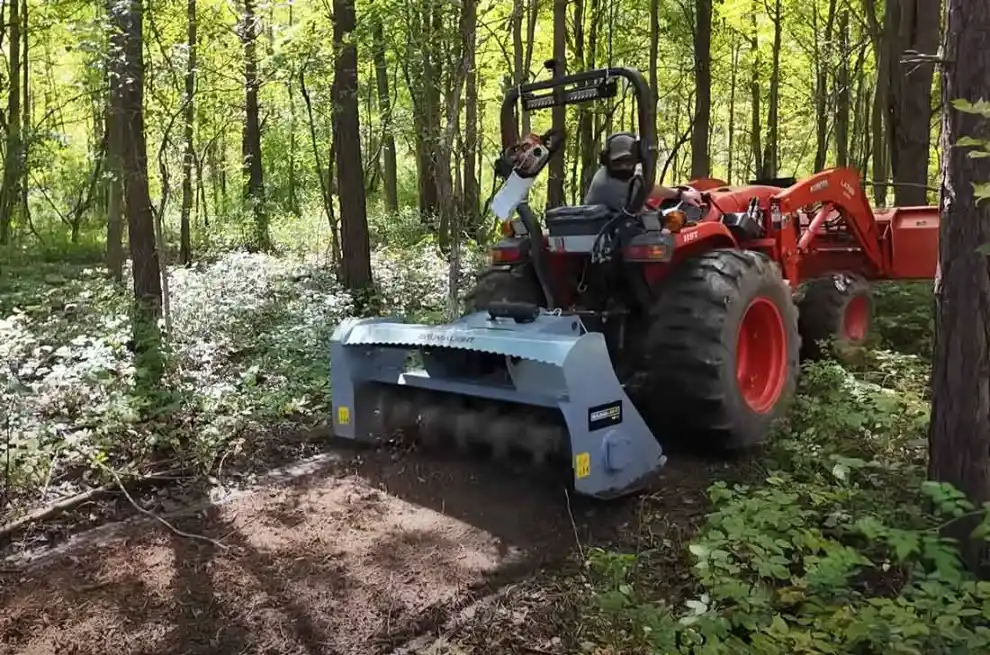
A Baumalight mulcher is a rotary cutting attachment that shreds brush, saplings, and small trees into fine mulch in a single pass, instead of cutting and leaving debris behind like a brush hog does. They mount to tractors, skid steers, or excavators depending on the model.
Brand Background
Baumalight is a Canadian manufacturer based in Ontario, and the company has built its reputation on rugged, low-maintenance attachments sold through dealers across the US and Canada. Their product range goes beyond mulchers too, covering stump grinders, tree saws, augers, and trenchers, but mulchers are consistently one of their most popular categories.
What Sets Baumalight Mulchers Apart
Baumalight’s fixed-tooth mulchers use replaceable carbide teeth, which cuts down on downtime since you’re swapping teeth instead of replacing entire cutting heads. One detail that’s easy to miss but genuinely useful: Baumalight offers two tooth styles.
- Planer-style teeth take smaller bites for a cleaner, more efficient cut.
- Ripper-style teeth use a v-shaped design that’s more shred-focused and holds up better against impacts with rocks or below-grade obstacles, which makes them a smarter pick for fence line work.
Knowing which tooth style you need before you buy can save you a service call down the road.
Baumalight Mulcher Models Explained
Baumalight splits its mulchers into three main categories based on what they mount to: tractor PTO units, skid steer units, and excavator/mini skid steer units. Here’s how the core lineup breaks down.
Tractor PTO Mulchers (MP Series)
These are 3-point hitch, PTO-driven mulchers built for tractors. If you’re not familiar with how PTO power works, United Ag & Turf has a clear breakdown of PTO horsepower requirements that’s worth a quick read before you shop.
- MP330: Built for subcompact tractors (15 to 40 HP), 30-inch cutting path, under 600 lbs. Good for trail maintenance and tight spaces.
- MP348: 25 to 50 HP, 48-inch rotor, 60-inch overall width. A solid entry point for fence line and general farm work.
- MP360: 25 to 65 HP, 60-inch rotor, up to 72-inch path width. A step up for mid-size farm and ranch use.
- MP560: 60-inch rotor, 75-inch path, cuts brush up to 6 inches in diameter. Built for pasture reclamation and entry-level contracting.
Skid Steer Mulchers (MS Series)
Skid steer models run on hydraulic flow instead of a PTO shaft, so compatibility comes down to your machine’s GPM (gallons per minute). If that term is new to you, this explainer on high-flow versus standard-flow skid steers covers it well.
- MS530M: For mini skid steers, 12 to 20 GPM, 30-inch cutting width. Ideal for confined spaces and landscape-scale jobs.
- MS348 / MS548 / MS560: 18 to 40 GPM, 48 to 60-inch cutting widths. General-purpose skid steer clearing.
- MS960 / MS1160 / MS1472: 30 to 45 GPM, 60 to 75-inch cutting widths. Heavy-duty models for dense brush and professional-grade clearing.
Quick Comparison Table
| Model | Type | Power Requirement | Cutting Width | Best For |
|---|---|---|---|---|
| MP330 | Tractor PTO | 15 to 40 HP | 30″ | Subcompact tractors, trails |
| MP348 | Tractor PTO | 25 to 50 HP | 48″ | Entry-level farm/fence line |
| MP360 | Tractor PTO | 25 to 65 HP | 60″ | Mid-size farm/ranch |
| MP560 | Tractor PTO | Up to 65 HP | 60″ (75″ path) | Land clearing, pastures |
| MS530M | Skid Steer | 12 to 20 GPM | 30″ | Mini skid steers, tight spots |
| MS348/548/560 | Skid Steer | 18 to 40 GPM | 48″-60″ | General skid steer clearing |
| MS960/1160/1472 | Skid Steer | 30 to 45 GPM | 60″-75″ | Heavy brush, contractor work |
Which Baumalight Mulcher Fits Your Land Clearing Needs?
For Homeowners and Small Acreage Owners
If you’re clearing trails, maintaining a few acres, or knocking back overgrowth around a property line, look at the MP330 or MS530M. Both are compact, lighter to handle, and sized for equipment most homeowners already have on hand.
For Farmers and Ranchers
Fence line maintenance and pasture reclamation call for something with more cutting depth. The MP348, MP360, or MP560 handle saplings and heavier brush without needing a full-size tractor, and the ripper-tooth option is worth considering if you’re working near fence posts or rocky ground.
For Contractors and Land Clearing Professionals
Daily use on dense brush and larger trees means you want the heavy-duty end of the lineup, like the MS960, MS1160, or MS1472. These are built for higher hydraulic flow machines and are engineered for the kind of repeated, all-day use a contractor puts them through.
Key Factors Before Buying a Baumalight Mulcher
Matching HP or GPM to Your Equipment
This is the single most common mistake buyers make. A mulcher rated for 40 GPM won’t perform on a machine putting out 20 GPM, and running an underpowered setup can strain both the attachment and your equipment’s hydraulic system. Always check your tractor’s PTO horsepower or your skid steer’s rated flow before choosing a model.
Attachment Compatibility
Tractor models use 3-point hitch mounts, most commonly Category 1 or Category 2. If you’re unsure which category your tractor uses, Hobby Farms has a straightforward breakdown of hitch categories that makes it easy to check before you order. Skid steer models, by contrast, use universal quick-attach plates, so compatibility mostly comes down to hydraulic flow rather than mounting hardware.
Pricing Range and What Affects Cost
Real market data gives a useful benchmark here. Average pricing across Baumalight’s mulcher lineup runs around $14,000, with entry-level models like the MP330 and MP348 typically starting between $7,000 and $10,000, and heavy-duty skid steer units climbing toward $25,000 to $30,000 depending on size and configuration. Several dealers also offer financing with no payments for the first several months, which can make a heavier-duty model more accessible upfront.
Finding a Local Dealer and Service Support
Because Baumalight sells through a dealer network rather than direct-to-consumer, parts availability and service turnaround vary by region. It’s worth confirming with your local dealer that they stock carbide teeth and common wear parts for the model you’re buying, since that’s what keeps a mulcher running long-term.
Frequently Asked Questions
How much does a Baumalight mulcher cost?
Pricing typically ranges from around $7,000 for entry-level tractor models like the MP330 up to $25,000 or more for heavy-duty skid steer units like the MS1472. Average market pricing across the full lineup sits around $14,000.
What size tractor do I need for a Baumalight mulcher?
It depends on the model. The MP330 works with subcompact tractors as low as 15 HP, while larger models like the MP560 need up to 65 HP. Always match the mulcher’s rated HP range to your tractor’s PTO output, not just its engine horsepower.
Are Baumalight mulchers good for food plots?
Yes. The MP series mulchers, particularly the MP348 and MP360, are commonly used for clearing and maintaining food plots since they mulch brush and saplings directly into ground cover without needing a separate cleanup pass.
What’s the difference between Baumalight planer teeth and ripper teeth?
Planer teeth take smaller, more efficient bites for a cleaner cut, while ripper teeth use a v-shaped design built to handle impacts with rocks and below-grade debris. Ripper teeth are the better choice for fence line and pasture work where hidden obstacles are common.
Where can I service or buy parts for a Baumalight mulcher?
Baumalight sells and services through a North American dealer network. Contact your local dealer directly to confirm parts availability, particularly carbide teeth, since these are the most frequently replaced wear items.
Conclusion
A Baumalight mulcher can genuinely simplify land clearing, but only if you match the right model to your equipment and workload. Quick recap:
- Baumalight splits its lineup into tractor PTO models (MP series) and skid steer models (MS series)
- Matching HP or GPM to your equipment is the most important buying decision you’ll make
- Planer teeth suit clean cutting, ripper teeth suit rocky or below-grade work
- Pricing ranges from roughly $7,000 for entry models to $25,000+ for heavy-duty units
- Local dealer support matters for parts and long-term service
If you’re still weighing which model fits your acreage and equipment, talk to a local dealer who can walk through your specific HP or GPM numbers before you buy. It’s a five-minute conversation that saves a lot of guesswork.
References and Sources
- Baumalight official product pages (baumalight.com)
- Skid Steer Store, Baumalight model specifications
- Equipment Trader and Machinery Trader, current market pricing data
- United Ag & Turf, PTO horsepower guide
- Dozr, skid steer hydraulic flow guide
- Hobby Farms, 3-point hitch category guide
About Author
Khalid Fazal is a seasoned lawn care specialist and horticultural researcher with over 15 years of hands-on experience transforming challenging landscapes into lush, resilient green spaces. His journey didn’t start in a lab, but in a backyard full of stubborn, cracked clay that “experts” said would never grow a healthy blade of grass. Refusing to accept a yard full of dust, Khalid spent years experimenting with organic soil restoration and precise mulching, eventually turning that wasteland into a neighborhood showpiece on a shoestring budget.
From mastering core aeration techniques to optimizing soil pH for specialized turf varieties, Khalid’s approach combines old-school grit with modern agronomic science. He founded Gen Lawn to provide homeowners with honest, research-backed advice that prioritizes long-term soil health over quick-fix chemical solutions. When he isn’t analyzing soil profiles, he’s developing precision tools to help others achieve professional results without the professional price tag.

Lawn Winterizer: When to Apply by Grass & Region [2026]
Table of Contents Home / By Khalid Fazal | Updated:...
Read More
Spring Lawn Care: What to Do and When in Every US Region
Table of Contents Home / By Khalid Fazal | Updated:...
Read More
Lawn Maintenance Checklist by Season and Grass Type (2026)
Table of Contents Home / By Khalid Fazal | Updated:...
Read More
Liquid Fertilizer vs Granular Fertilizer: Which Wins?
Table of Contents Home / By Khalid Fazal | Updated:...
Read More