
The Difference Between Grass and Weeds (And How to Tell Them Apart in Your Lawn)
You pull it out. Feels like a weed. Three days later your neighbor tells you that was Kentucky Bluegrass you just ripped clean out of your lawn.
Sound familiar? You’re not alone. Millions of US homeowners make this mistake every single year — and in many cases, the wrong move does more damage than the weed itself ever would have.
Here’s the truth: telling the difference between grass and weeds is not always obvious. Some weeds are designed by nature to look almost identical to your turf. But once you know what to look for, you’ll never second-guess yourself again.
This guide gives you a plain-English breakdown — what grass actually is, what makes something a weed, how to spot the most common imposters, and a simple 4-step field checklist you can run while standing in your yard.
Let’s get into it.
What Actually Makes Something a “Weed”?
Before you can spot the difference, you need to understand what these two things actually are — because one of them has a scientific definition and one does not.
The Scientific Definition of Grass
True lawn grasses belong to a plant family called Poaceae — one of the largest and most important plant families on the planet. This family includes over 10,000 species, from wheat and rice to corn, bamboo, and the turf under your feet. What all grasses share: narrow blade-like leaves, hollow jointed stems, and roots that anchor densely into healthy, nutrient-rich soil.
Why “Weed” Has Nothing to Do With Science
Here’s what surprises most people: “weed” is not a scientific term at all.
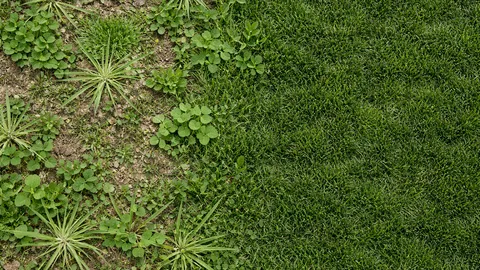
A weed is simply any plant growing where you don’t want it. That’s the entire definition. Which means the same plant can be a premium lawn grass in one yard and a destructive invasive weed next door. Bermuda grass is a perfect example — it’s a top-choice turf grass for warm-season Southern lawns, but if it creeps into a cool-season Kentucky Bluegrass lawn, it becomes a weed problem fast.
Context determines everything. The difference between grass and weeds often comes down to: did you plant this, and does it belong here?
The Core Difference Between Grass and Weeds: What to Look For
Now for the practical stuff. Here are the four key visual differences you can assess without any tools.
Leaf Shape and Blade Width
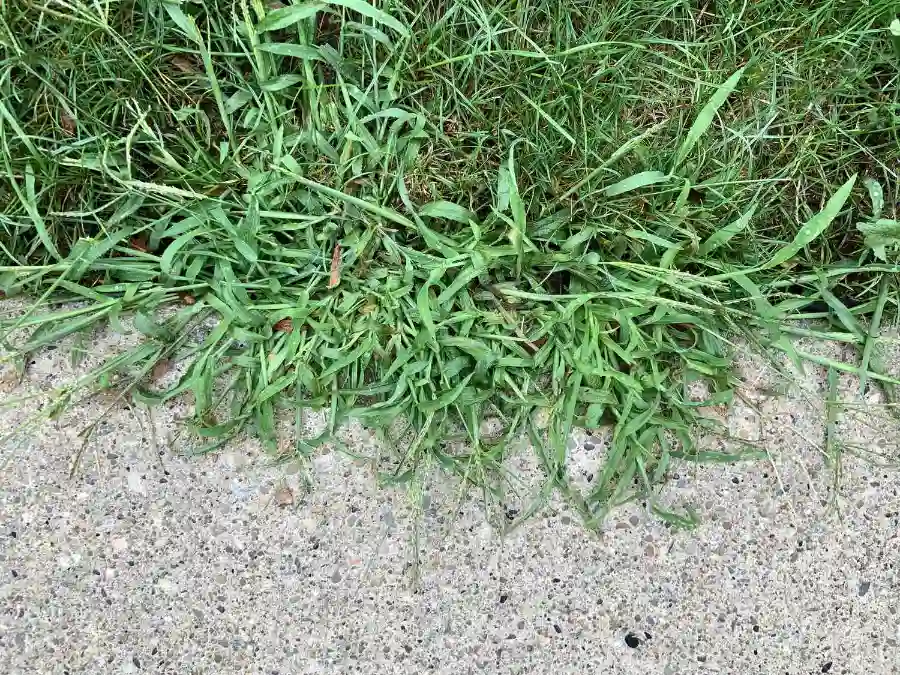
Grass blades are long, narrow, and feature parallel veins running the length of the blade. Weeds — especially broadleaf varieties — have noticeably wider leaves with branching or netted veins, much like a tree leaf in miniature.
If you hold a blade up to light and the veins branch out like a river system, it’s almost certainly a weed.
Growth Pattern — Uniform vs. Patchy
A healthy lawn grows evenly. Grass fills in consistently across the surface, giving you that smooth, level appearance.
Weeds, by contrast, grow in irregular clumps or patches. They show up randomly, disrupt the texture of your lawn, and often create bare spots around them as they compete aggressively for water and nutrients.
Stem Structure and Root Depth
Grass stems are round, smooth, and hollow with visible nodes (the bumpy joints along the stem). Their root systems are deep and dense — which is exactly why healthy grass resists being pulled.
Weeds have shallower roots in many cases, and some — particularly sedges — have triangular stems you can feel by rolling them between your fingers. Round stem = grass. Three-sided stem = sedge/weed.
Growth Speed After Mowing
Grass grows at a relatively predictable rate. Weeds don’t play by those rules.
If something in your lawn is shooting up noticeably faster than everything else just days after a mow — take a closer look. Yellow nutsedge, for example, is infamous for visibly outpacing surrounding turf within 48 hours of cutting.
Quick Comparison: Grass vs. Broadleaf Weed vs. Grassy Weed
| Feature | Lawn Grass | Broadleaf Weed | Grassy Weed |
|---|---|---|---|
| Leaf shape | Long, narrow blade | Wide, rounded leaf | Narrow — looks like grass |
| Vein pattern | Parallel | Branching/netted | Parallel |
| Stem | Round, hollow, jointed | Varies | Round or triangular |
| Growth pattern | Uniform, even | Random, patchy | Clumpy, uneven |
| Flowers/seed heads | Small, inconspicuous | Often visible (dandelion, clover) | Fuzzy or spiked heads |
| Root system | Deep, dense | Varies | Shallow to moderate |
| Soil preference | Healthy, nutrient-rich | Often thrives in poor/dry soil | Varies |
The Trickiest Part: Weeds That Look Exactly Like Grass
This is where most homeowners get burned. These are the weeds that blend in — and they’re the most important ones to learn.
Crabgrass — The #1 Imposter
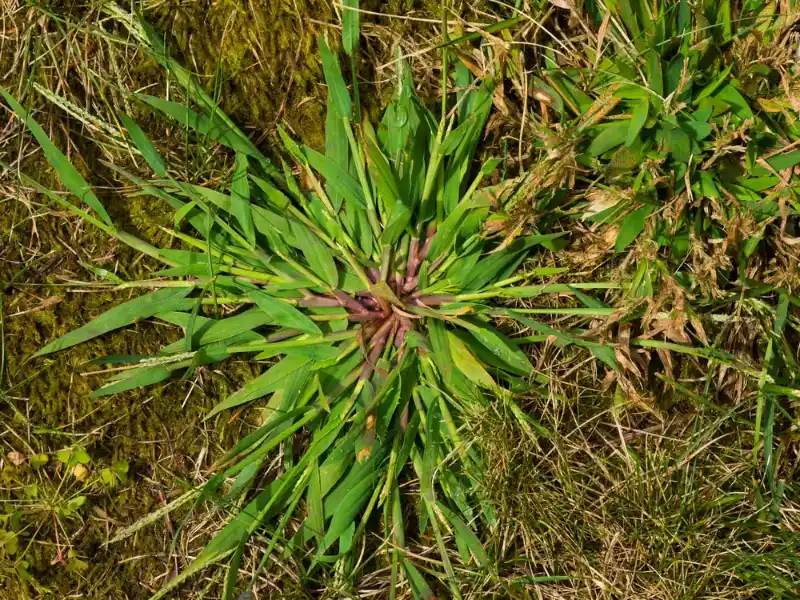
Crabgrass is a summer annual that starts small and innocent-looking, then spreads outward in a star-shaped mat low to the ground. It’s lighter green than most turf and has wider, coarser blades.
Here’s the alarming part: a single crabgrass plant can produce up to 150,000 seeds. Miss it once, and you’re fighting it for seasons.
Quick ID: Star-shaped spreading mat, lighter green, wider blades than surrounding turf.
Nutsedge (Nutgrass) — Grows Back After Every Mow
Nutsedge is not actually a grass at all — it’s a sedge. But it looks so much like grass that most homeowners don’t catch it until it’s completely taken over.
The telltale sign: triangular stem (roll it between your fingers), yellow-green color, and it grows noticeably faster than your turf after every mowing. One important rule — do not pull nutsedge by hand. Pulling stimulates the underground tubers to multiply and produce new plants.
Quick ID: Three-sided stem, yellow-green color, shoots up faster than the rest of your lawn.
Foxtail — The Fast Spreader
Foxtail is a summer annual weed that goes from seedling to seed-producer shockingly fast. It gets its name from the fuzzy, bristled seed heads that look like a drooping fox’s tail.
It thrives when soil temperatures exceed 65°F and loves thin, bare areas of lawn. A dense, thick lawn is your best defense against it taking hold.
Quick ID: Fuzzy cylindrical seed head, grows in bare or thin areas of the lawn.
Goosegrass — Low, Flat, and Sneaky
Goosegrass grows flat against the ground in a rosette pattern and is frequently confused with crabgrass. One easy tell: the base of its stems is white or silver — very distinctive up close.
It favors compacted soils and high-traffic areas, which is why aerating your lawn helps prevent it.
Quick ID: White or silver stem base, flat rosette growth pattern, herringbone seed head pattern.
Poa Annua (Annual Bluegrass) — The Seasonal Surprise
Poa annua is a cool-season annual that pops up in fall and winter — often in lawns that are otherwise thriving. It’s light green, slightly lighter than your turf, and produces a visible tassel-like seed head when mature.
One plant can produce thousands of seeds that remain dormant in your soil for years. It’s often in your lawn before you ever see it.
Quick ID: Light green color, appears in cooler months, tasseled seed head rising above your turf line.
How to Tell Grass From Weeds: Your 4-Step Field Checklist
Here’s a fast system you can run right now, in your yard, with zero equipment.
Step 1 — The Leaf Test Hold a blade between your fingers. Is it narrow with parallel veins? Likely grass. Wide leaves with branching veins? Broadleaf weed. Narrow but growing in a clump? Possible grassy weed.
Step 2 — The Pull Test Gently tug at the base. Lawn grass resists firmly — its dense root system holds tight. A weed often gives way more easily, especially annual varieties. A spindly or shallow root that lifts clean out of the soil? That’s your weed.
Step 3 — The Stem Roll Test Pick the stem and roll it slowly between your thumb and index finger. A perfectly round, smooth stem = grass. A stem with three distinct flat edges (triangular feel) = sedge/nutsedge. This one trick alone identifies nutsedge correctly almost every time.
Step 4 — The Growth Speed Test Check the area 2-3 days after mowing. If one plant is visibly outgrowing everything around it — shooting up taller than the rest of the lawn — it’s almost certainly a weed. Normal grass grows at a predictable, consistent pace.
Still can’t tell? Your local county extension office offers free plant identification services. Many can ID from a photo alone. Getting it right before treatment prevents expensive damage.
How to Get Rid of Weeds Without Harming Your Grass
Now that you’ve identified the problem, here’s how to handle it.
Pre-Emergent Herbicides — Stop Them Before They Start
[Pre-emergent herbicides](https://extension.uga.edu/publications/detail.html?number=C 1077) create a chemical barrier in the soil that prevents weed seeds from germinating. Timing is everything — they must be applied before soil temperatures reach the germination threshold for the target weed.
For crabgrass in most US regions, that means applying in early spring before soil hits 55°F consistently.
Post-Emergent Herbicides — Target What’s Already There
Post-emergent herbicides work on weeds that have already emerged. The younger the weed, the more effective the treatment. Always read product labels carefully — some formulations harm desirable grasses if misapplied.
Sedges like nutsedge require sedge-specific herbicides (look for halosulfuron or sulfentrazone as the active ingredient). Standard broadleaf or grassy weed products have no effect on them.
Natural Methods That Work
Not ready for chemicals? These approaches genuinely help:
- Hand pulling works for broadleaf weeds with taproots — get the full root or they grow back
- Corn gluten meal acts as a natural pre-emergent and mild fertilizer
- Overseeding thin areas closes the gaps that weeds exploit
- Proper mowing height — keeping grass taller (3–4 inches) shades soil and reduces weed germination
Why a Thick, Healthy Lawn Is Your Best Defense
Here’s the thing most people overlook: a dense, well-fed lawn is your single most powerful weed prevention tool. Weeds need light to germinate. A thick lawn canopy blocks that light at the soil level — making it incredibly difficult for weed seeds to take hold.
Regular aeration, proper fertilization, and consistent watering on a deep-but-infrequent schedule all contribute to the kind of turf that weeds simply can’t compete with.
Frequently Asked Questions
What is the main difference between grass and weeds?
Grass refers to plants from the Poaceae family intentionally cultivated for lawn coverage. A weed is any plant — including certain grasses — growing where it isn’t wanted. The distinction is functional, not botanical.
Can grass become a weed?
Absolutely. Bermuda grass, for example, is a popular warm-season turf but becomes an invasive weed when it spreads into cool-season lawns. Any plant growing outside its intended area or disrupting your desired lawn can be classified as a weed.
Is crabgrass a grass or a weed?
Crabgrass (Digitaria species) is technically a grass — it belongs to the Poaceae family. But because it invades lawns uninvited, spreads aggressively, and disrupts turf uniformity, it’s universally treated as a weed. Learn more from the University of Minnesota Extension.
How do I know if something growing in my lawn is a weed?
Run the 4-step field checklist above: check the leaf shape, try the pull test, roll the stem, and observe growth speed after mowing. If it’s growing faster than your turf, looks patchy, or has an unusual leaf or stem structure — it’s likely a weed.
What kills weeds but not grass?
Selective post-emergent herbicides are formulated to target specific weed types without harming turf. Always match the product to the weed type — broadleaf, grassy, or sedge — and verify your grass species is listed as safe on the label before applying.
The Bottom Line
The difference between grass and weeds comes down to four things: leaf structure, growth pattern, stem type, and whether the plant belongs in your lawn in the first place.
Here’s what to remember:
- Grass = Poaceae family, narrow parallel-veined blades, uniform growth, deep root system
- Weeds = anything growing where it’s not wanted, including grassy look-alikes
- The hardest weeds to spot are grassy ones — crabgrass, nutsedge, foxtail, goosegrass, and Poa annua
- Your 4-step checklist — leaf test, pull test, stem roll, growth speed — works every time
- A thick, healthy lawn is your most powerful long-term weed prevention strategy
Still not sure what’s growing in your yard? Don’t guess — and definitely don’t spray before you know.
Gen Lawn’s team can identify exactly what’s in your lawn and build a treatment plan that protects your turf while clearing out the problem. Contact us today for a free lawn assessment.
References & Further Reading
- USDA PLANTS Database — Poaceae Family
- Penn State Extension — Grass Identification Basics
- Clemson HGIC — Nutsedge Control
- University of Minnesota Extension — Crabgrass
- Purdue Extension — Poa Annua Management
- Sod Solutions — Common Lawn Weed Identification
- Michigan State University Extension — Foxtail Identification
- University of Georgia Extension — Goosegrass
- NIFA — Find Your Local Extension Office
- Penn State Extension — Lawn Aeration Guide
About Author
Khalid Fazal is a seasoned lawn care specialist and horticultural researcher with over 15 years of hands-on experience transforming challenging landscapes into lush, resilient green spaces. His journey didn’t start in a lab, but in a backyard full of stubborn, cracked clay that “experts” said would never grow a healthy blade of grass. Refusing to accept a yard full of dust, Khalid spent years experimenting with organic soil restoration and precise mulching—eventually turning that wasteland into a neighborhood showpiece on a shoestring budget.
From mastering core aeration techniques to optimizing soil pH for specialized turf varieties, Khalid’s approach combines old-school grit with modern agronomic science. He founded Gen Lawn to provide homeowners with honest, research-backed advice that prioritizes long-term soil health over quick-fix chemical solutions. When he isn’t analyzing soil profiles, he’s developing precision tools to help others achieve professional results without the professional price tag.

Lawn Winterizer: When to Apply by Grass & Region [2026]
Table of Contents Home / By Khalid Fazal | Updated:...
Read More
Spring Lawn Care: What to Do and When in Every US Region
Table of Contents Home / By Khalid Fazal | Updated:...
Read More
Lawn Maintenance Checklist by Season and Grass Type (2026)
Table of Contents Home / By Khalid Fazal | Updated:...
Read More
Liquid Fertilizer vs Granular Fertilizer: Which Wins?
Table of Contents Home / By Khalid Fazal | Updated:...
Read More