Fairy Ring on Golf Greens: What It Is, Why It Spreads, and How to Control It
You walk out to check the 7th green early morning and something’s off. There’s a dark circular band cutting through the turf — crisp, unmistakable, and definitely not there last week.
That’s fairy ring on golf greens. And here’s the frustrating part: it didn’t just show up. It’s been quietly spreading underground for months.
Fairy ring disrupts ball roll, weakens root systems, creates dead turf patches, and forces superintendents into costly recovery cycles. Left unmanaged, it expands 5 inches to 2 feet radially every single season — getting bigger, deeper, and harder to manage.
This guide gives you everything: what fairy ring is, why it keeps returning, and a step-by-step protocol that actually works.
What Is Fairy Ring on Golf Greens?
The Fungus Behind the Ring
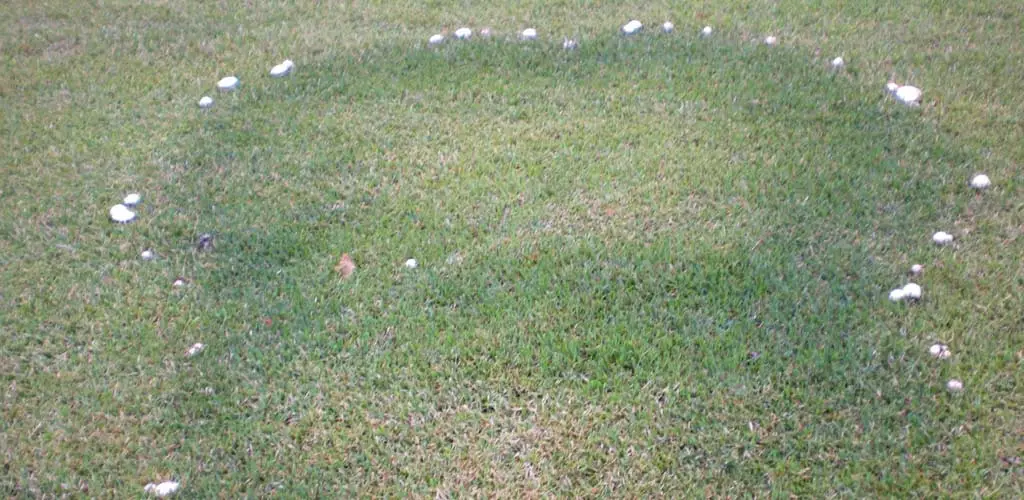
Fairy ring is caused by soil-borne basidiomycete fungi — a class of organisms that live in the thatch and root zone and feed on decaying organic matter like dead tree roots, buried wood, and accumulated clippings.
More than 60 species of these fungi can produce fairy ring symptoms in turf. But here’s what most blogs don’t tell you: research by Dr. Lane Tredway at NC State University found that only three specific fungal species are consistently associated with fairy rings on golf putting greens. That distinction matters when you’re choosing a fungicide program.
The fungi don’t attack your turf directly. Instead, they alter the soil’s physical and chemical properties — creating conditions that starve, suffocate, or overstimulate grass depending on which type of infection you’re dealing with.
Why Golf Greens Are Especially Vulnerable
Golf greens check every box for fairy ring development:
- Sand-based root zones — sand particles are easily coated by fungal mycelium (the underground web of fungal threads), making the soil water-repellent
- Organic matter accumulation — years of thatch buildup, dead roots, and decomposing material feed the fungi continuously
- Low mowing heights — close-cut putting surfaces have reduced turf stress tolerance and less root mass to fight back
- Wet-dry irrigation cycles — inconsistent soil moisture is one of the strongest environmental triggers for fairy ring outbreaks
Here’s the thing: older greens with high organic matter layers are significantly more vulnerable than newer ones. If your course has greens over ten years old without aggressive thatch management, your fairy ring risk is substantially elevated.
How to Identify Fairy Ring vs. Lookalike Diseases
This is where most guides leave you guessing. Fairy ring on golf greens is frequently confused with other turf diseases:
- Dollar spot — produces small bleached patches, but no circular arc pattern and no water-repellent soil layer
- Localized dry spot — also creates hydrophobic patches, but without the distinctive circular expansion of fairy ring
- Brown patch — causes large, irregular blighted areas with a smoke-ring border; does not expand in circular arcs
The diagnostic combination to look for is three things together: a circular or arc-shaped pattern, a hydrophobic (water-repellent) soil layer when you extract a core sample, and visible white fungal strands in the thatch profile. If you have all three, you’re dealing with fairy ring — not something else.
The 3 Types of Fairy Ring on Golf Greens
Not all fairy rings behave the same. The three recognized types appear under different conditions, cause different damage levels, and require different management responses.
Type I — The Most Destructive
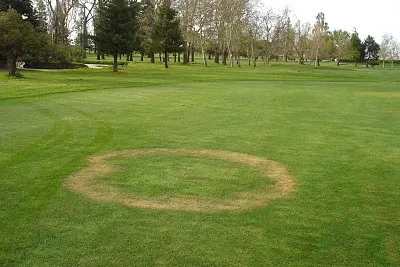
Type I fairy ring is the one that scares superintendents. It creates rings or arcs of dead, wilted, or severely damaged turf driven by hydrophobic conditions in the root zone. Water literally cannot infiltrate the soil in the affected zone — even when your irrigation system is running at full capacity.
The turf wilts and dies not from the fungus attacking it directly, but from drought stress caused by the water-repellent soil layer beneath. Type I is most aggressive during hot, dry summer weather when heat stress compounds the damage.
Type II — The Green Ring
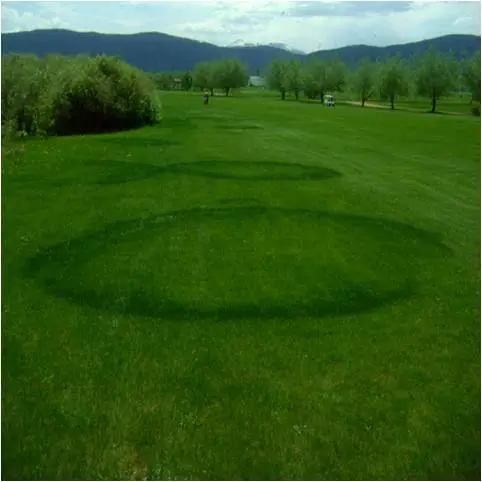
Type II is less damaging to turf health but highly disruptive to playability. It produces bands of dark green, stimulated, fast-growing grass — exactly the kind of visual inconsistency that throws off ball speed and frustrates golfers on premium putting surfaces.
The dark green coloration comes from nitrogen released as the fungi break down organic matter below the surface. That nitrogen feeds the grass directly above the ring, creating uneven growth you can’t mow away. Type II symptoms peak during summer heat and are easier to mask than Type I — but difficult to fully suppress without a fungicide program.
Type III — Mushrooms and Puffballs
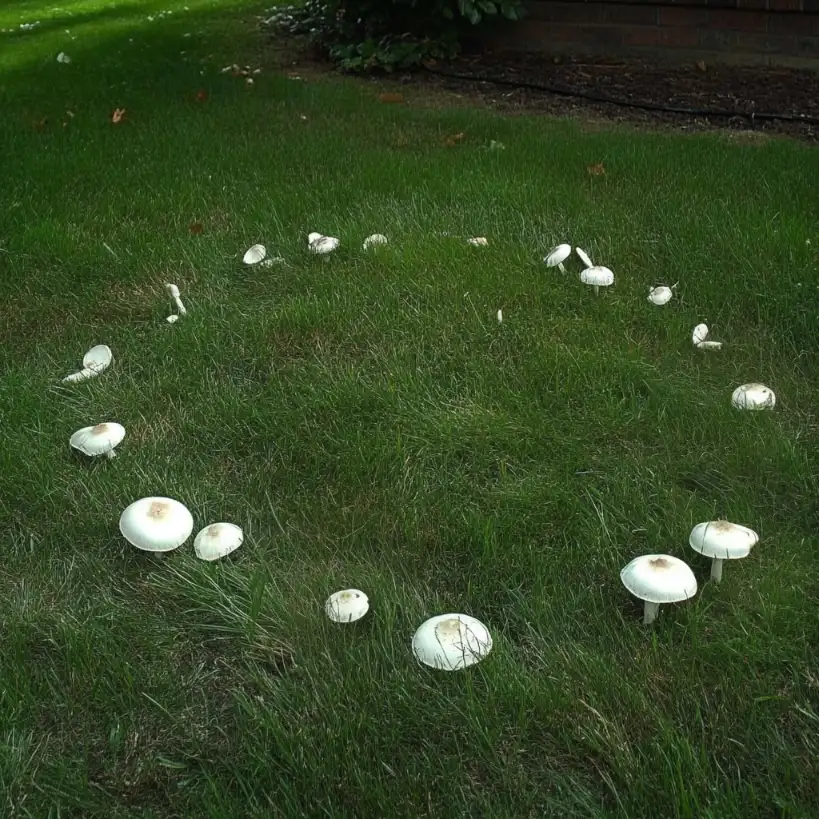
Type III is the most visible and the least damaging. Mushrooms or puffballs emerge in a ring or arc above the turf surface. While primarily cosmetic, they signal active fungal colonization in the soil profile below — and are a reliable early warning sign that Type I or II symptoms may be developing.
Type III symptoms are most common following extended wet periods, making them more frequent in spring or during rainy summer stretches.
Important: A single fairy ring can shift between all three symptom types at different points in the season, depending on temperature and soil moisture conditions. What looks like a manageable Type II ring in May can become a damaging Type I ring by July.
What Causes Fairy Ring to Keep Coming Back?
The Lifecycle of Fungal Mycelium
Fairy ring fungi grow outward from a central starting point, consuming organic matter as they expand. The mycelium spreads radially at 5 inches to 2 feet per year — silently, below the surface, until symptoms break through.
Here’s the critical detail: the fungus never dies back to its origin. It moves outward and keeps moving, leaving behind a trail of spent mycelium that has already altered the soil chemistry and hydrophobicity of the root zone — even after the active fungal zone has passed. This is why fairy ring comes back in the same location year after year, typically as a slightly larger ring.
Why Curative Fungicides Often Fail
This is the part that frustrates most golf course managers who feel like they’re spending money with no results.
When you apply a fungicide after symptoms are already visible, you may kill the active fungus. But the dead mycelium stays in the soil. And dead mycelium is still hydrophobic. The water-repellent conditions persist even after the fungus is gone, so turf damage continues.
Worse: fungicide applications watered in through overhead irrigation often don’t reach the mycelial zone at all. The hydrophobic layer causes irrigation water — and your expensive product — to sheet off or redirect rather than penetrate. You spend the budget and the fungicide never reaches where it needs to go.
The Honest Truth: Fairy Ring Cannot Be Eradicated
Let’s be direct about something most lawn care content avoids saying.
According to the USGA Green Section, it is impractical to fully eradicate fairy rings from golf course putting greens. The realistic goal is management, not elimination.
That means building a consistent program that reduces severity, limits annual spread, and protects your turf quality — not chasing a permanent fix that doesn’t exist. This shift from reactive to proactive is the single biggest mindset change that separates well-managed courses from ones that fight fairy ring every summer.
How to Treat Fairy Ring on Golf Greens
There is a specific sequence to effective treatment. Skip any step and you significantly reduce the outcome.
Step 1 — Break the Hydrophobic Barrier With Wetting Agents
Before anything else, address the water-repellent soil layer. Apply a penetrant wetting agent (non-ionic surfactant) to the affected area. Penetrant wetting agents work by reducing the surface tension that causes water to bead and sheet off soil particles coated in fungal residue — restoring infiltration so moisture (and subsequent treatments) can reach the root zone.
Without this step, every treatment that follows is working at a fraction of its potential.
Step 2 — Needle-Tine Aeration Before Any Chemical Application
This is the step that most programs skip — and it’s the most impactful one.
Needle-tine aeration creates small vertical channels through the hydrophobic layer, giving wetting agents and fungicides a direct pathway into the root zone where the fungus actually lives. Without aeration first, you’re asking a liquid product to penetrate a surface that is actively repelling liquid.
Aerate the affected area. Then apply your wetting agent and fungicide directly into the holes while they’re open.
Step 3 — Fungicide Application
Preventive (the most reliable approach):
Apply in spring when soil temperatures at the 2-inch depth reach 55°F. Research by Dr. Tredway at NC State demonstrated that two applications of Bayleton (triadimefon) on a 21–28 day interval provided season-long control on both bermudagrass and bentgrass greens when applied at this soil temperature trigger.
Other effective active ingredients:
- Flutolanil (Prostar) — specifically labeled for fairy ring on putting greens
- Azoxystrobin (Heritage) — effective in combination with wetting agents; strobilurin class
- Trifloxystrobin — also in the strobilurin class; works well preventively
For a full list of currently labeled products and application rates, refer to the USGA Fairy Ring 101 fungicide guide.
Curative (when symptoms are already visible):
Apply in high water volumes — 3 to 5 gallons per 1,000 sq ft — to push the product through the soil profile. Repeat every 28 days until symptoms subside. Expect to suppress the fungus and reduce active damage, but do not expect hydrophobic soil conditions to resolve quickly.
Step 4 — Hand Water Into Aeration Holes
Do not rely on overhead irrigation to water in treatments on actively affected fairy ring zones. If water is sheeting off the surface before your application, irrigation will do the same after it.
Hand watering directly into aeration holes ensures the chemical moves down into the mycelial zone where it needs to work. This single practice — confirmed by USGA agronomists — is what separates wasted applications from effective control.
Preventive vs. Curative Fairy Ring Treatment — At a Glance
| Factor | Preventive | Curative |
|---|---|---|
| Timing | Spring; 55°F soil temp at 2″ depth | After symptoms appear |
| Application frequency | 2x, 21–28 days apart | Every 28 days until resolved |
| Best fungicide class | DMI (Bayleton) + strobilurins | Strobilurins in high water volumes |
| Wetting agent required? | Recommended | Absolutely essential |
| Effectiveness | High — prevents symptom development | Moderate — suppresses fungus, doesn’t fix soil |
| Relative cost | Lower | Significantly higher |
Preventing Fairy Ring: Long-Term Management for Golf Greens
Spring Preventive Fungicide Timing
Mark this on your turf calendar now: when your soil thermometer reads 55°F at the 2-inch depth in spring, that’s your window for the first preventive application. A second application 21–28 days later locks in season-long suppression in most cases.
Starting early is non-negotiable. Once symptoms are visible, you’re already in curative territory — more expensive, less effective, and more disruptive to playing conditions.
Thatch and Organic Matter Control
Fairy ring fungi thrive on organic matter. Remove the food source and you reduce the problem over time. Key cultural practices:
- Core aeration at a minimum twice per year to physically remove organic matter from the soil profile
- Sand topdressing after aeration to dilute organic accumulation over multiple seasons
- Avoid over-fertilization with nitrogen — excess nitrogen accelerates thatch development, which directly feeds the fungal cycle
Consistent Irrigation = Your First Line of Defense
Wet-dry cycles are one of the most significant drivers of fairy ring severity. Allowing greens to dry down — even briefly during stress periods — creates the conditions Type I fairy ring needs to establish hydrophobic patches.
Consistent soil moisture doesn’t just protect turf health in general. It actively suppresses fairy ring development by maintaining an environment where fungal colonization is harder to initiate and sustain. Use moisture meters in known problem areas and check daily during summer heat.
Map, Monitor, and Plan
Fairy ring is highly location-specific and predictable. The ring that appeared on Green 7 this year will appear in approximately the same location next year — a bit larger in diameter.
Map every outbreak by location, type, and size at the end of each season. This documentation enables you to apply targeted preventive fungicide treatments to known problem areas in spring, rather than treating entire greens uniformly. Over time, this approach substantially reduces both treatment costs and symptom severity.
Frequently Asked Questions About Fairy Ring on Golf Greens
What causes fairy ring on golf greens?
Fairy ring on golf greens is caused by soil-borne basidiomycete fungi that feed on decomposing organic matter in the thatch and root zone. Over 60 species can produce fairy ring symptoms in turfgrass, though research specific to putting greens has identified three primary species. Sandy root zones with accumulated organic matter, inconsistent irrigation, and low mowing heights create the ideal environment for these fungi to thrive.
Can fairy ring spread from one green to another?
Not through direct soil-to-soil contact. However, fairy ring spores travel by wind, water runoff, and golf course maintenance equipment — including mowers, aerators, and core-extraction machines. Equipment hygiene, particularly cleaning and disinfecting before moving between greens, is an underappreciated but important part of a comprehensive management program.
How long does it take to get rid of fairy ring on golf greens?
Honest answer: symptoms can be suppressed within 2–6 weeks with a proper treatment sequence (aeration + wetting agent + fungicide + hand watering). However, because the fungal mycelium and hydrophobic compounds remain in the soil profile, fairy ring typically returns in subsequent seasons in the same location. A consistent preventive program keeps symptoms minimal year-over-year, but total elimination is not a realistic expectation.
What’s the best fungicide for fairy ring on golf courses?
For preventive programs, Bayleton (triadimefon) has the strongest research backing for season-long control when applied at the 55°F soil temperature trigger. For curative applications, Prostar (flutolanil) and Heritage (azoxystrobin) are the most widely used labeled products. Rotating between fungicide classes — DMI fungicides and strobilurins — is important to reduce the risk of resistance developing over time. Always consult the USGA’s current fungicide guide for your specific grass species and region.
Why does fairy ring keep coming back every year?
Because the fungal mycelium never fully disappears — it expands outward while leaving behind spent material that permanently alters soil chemistry in that zone. Curative fungicides kill active fungal growth but cannot remove the hydrophobic compounds already deposited in the soil. Without ongoing preventive treatment and long-term organic matter reduction through aeration and topdressing, the conditions that caused the ring remain in place — and new fungal activity restarts the cycle each growing season.
Conclusion
Fairy ring on golf greens is one of the most persistent and misunderstood diseases in turf management. Here’s what to take away:
- Identify the type before you treat. Type I kills turf, Type II disrupts play, Type III signals what’s developing below. Each needs a different response at a different urgency level.
- Preventive always beats curative. A spring fungicide program applied at 55°F soil temperature costs a fraction of what reactive treatment costs once symptoms are visible and damage is done.
- Delivery is everything. Aerate first. Apply wetting agent. Hand water into the holes. Getting your product to the mycelial zone matters more than which product you choose.
Fairy ring on golf greens can’t be eliminated — but with the right program, it stops being a recurring crisis and becomes a manageable, predictable part of your annual maintenance schedule.
References
- University of Georgia CAES Field Report — Fairy Ring in Turfgrass: Identification and Control in Georgia
- USGA Green Section Record — Fairy Ring on Greens is No Fun (Chris Hartwiger, USGA)
- USGA Green Section — New Fairy Ring Discovery Providing Results — Dr. Lane Tredway, NC State University
- USGA Green Section — Recurring Nuisance Fairy Rings
- USGA Green Section — Fairy Ring 101 — Fungicide Guide (PDF)
- Penn State Turfgrass Pest Diagnostic Lab — Fairy Ring Pest Profile
- NC State Extension Publications — Fairy Ring in Turf
- Missouri Extension Turfgrass Science — Fairy Ring Disease Profile
- Purdue University Extension — Thatch in Turfgrass
About Author
Khalid Fazal is a seasoned lawn care specialist and horticultural researcher with over 15 years of hands-on experience transforming challenging landscapes into lush, resilient green spaces. His journey didn’t start in a lab, but in a backyard full of stubborn, cracked clay that “experts” said would never grow a healthy blade of grass. Refusing to accept a yard full of dust, Khalid spent years experimenting with organic soil restoration and precise mulching—eventually turning that wasteland into a neighborhood showpiece on a shoestring budget.
From mastering core aeration techniques to optimizing soil pH for specialized turf varieties, Khalid’s approach combines old-school grit with modern agronomic science. He founded Gen Lawn to provide homeowners with honest, research-backed advice that prioritizes long-term soil health over quick-fix chemical solutions. When he isn’t analyzing soil profiles, he’s developing precision tools to help others achieve professional results without the professional price tag.

Lawn Winterizer: When to Apply by Grass & Region [2026]
Table of Contents Home / By Khalid Fazal | Updated:...
Read More
Spring Lawn Care: What to Do and When in Every US Region
Table of Contents Home / By Khalid Fazal | Updated:...
Read More
Lawn Maintenance Checklist by Season and Grass Type (2026)
Table of Contents Home / By Khalid Fazal | Updated:...
Read More
Liquid Fertilizer vs Granular Fertilizer: Which Wins?
Table of Contents Home / By Khalid Fazal | Updated:...
Read More