How Many Bags Is 2 Yards of Mulch? (The Exact Numbers)
If you’re buying standard 2 cubic foot bags — the most common size at Home Depot and Lowe’s — 2 yards of mulch equals 27 bags. Using 1.5 cubic foot bags? You’ll need 36 bags. Grabbing the larger 3 cubic foot bags? 18 bags will do it.
But here’s the thing: a lot of homeowners head to the store, grab whatever bags are on the shelf, and end up either running short mid-project or hauling home a stack of extras they didn’t need. This guide gives you the exact math, a quick-reference table, coverage estimates by depth, and a straight answer on whether bags or bulk is the smarter buy for your project.
How Many Bags Is 2 Yards of Mulch? The Quick Answer
The answer changes based on one thing — bag size. Mulch bags in the US come in three standard sizes: 1.5 cubic feet, 2 cubic feet, and 3 cubic feet. Always flip the bag over and check before loading up your cart — not every bag on the shelf holds the same amount.
If You’re Using 2 Cubic Foot Bags
This is the standard bag size at most big-box stores. One cubic yard equals 13.5 of these bags, so 2 yards = 27 bags. Since you can’t buy half a bag, 27 is your number — and it’s smart to grab one or two extra as a buffer.
If You’re Using 1.5 Cubic Foot Bags
These smaller bags are common at garden centers and regional retailers. One yard requires 18 bags, which means 2 yards = 36 bags. Easier to carry individually, but you’ll be making a lot more trips back and forth from the car.
If You’re Using 3 Cubic Foot Bags
Less common but available at some wholesale and landscape suppliers. One yard = 9 bags, so 2 yards = 18 bags. Fewer trips, but each bag is significantly heavier.
Quick Reference Table: Bags Needed for 2 Yards of Mulch
| Bag Size | Bags Per 1 Yard | Bags for 2 Yards |
|---|---|---|
| 1.5 cu ft | 18 bags | 36 bags |
| 2 cu ft | 13.5 bags | 27 bags |
| 3 cu ft | 9 bags | 18 bags |
How the Math Works (So You Can Calculate Any Amount)
Once you understand the formula, you can calculate the right bag count for any project — not just 2 yards. According to Travis County Extension, the simplest way to convert yards to bags is to multiply your cubic yards by 27, then divide by your bag size.
What Is a Cubic Yard of Mulch?
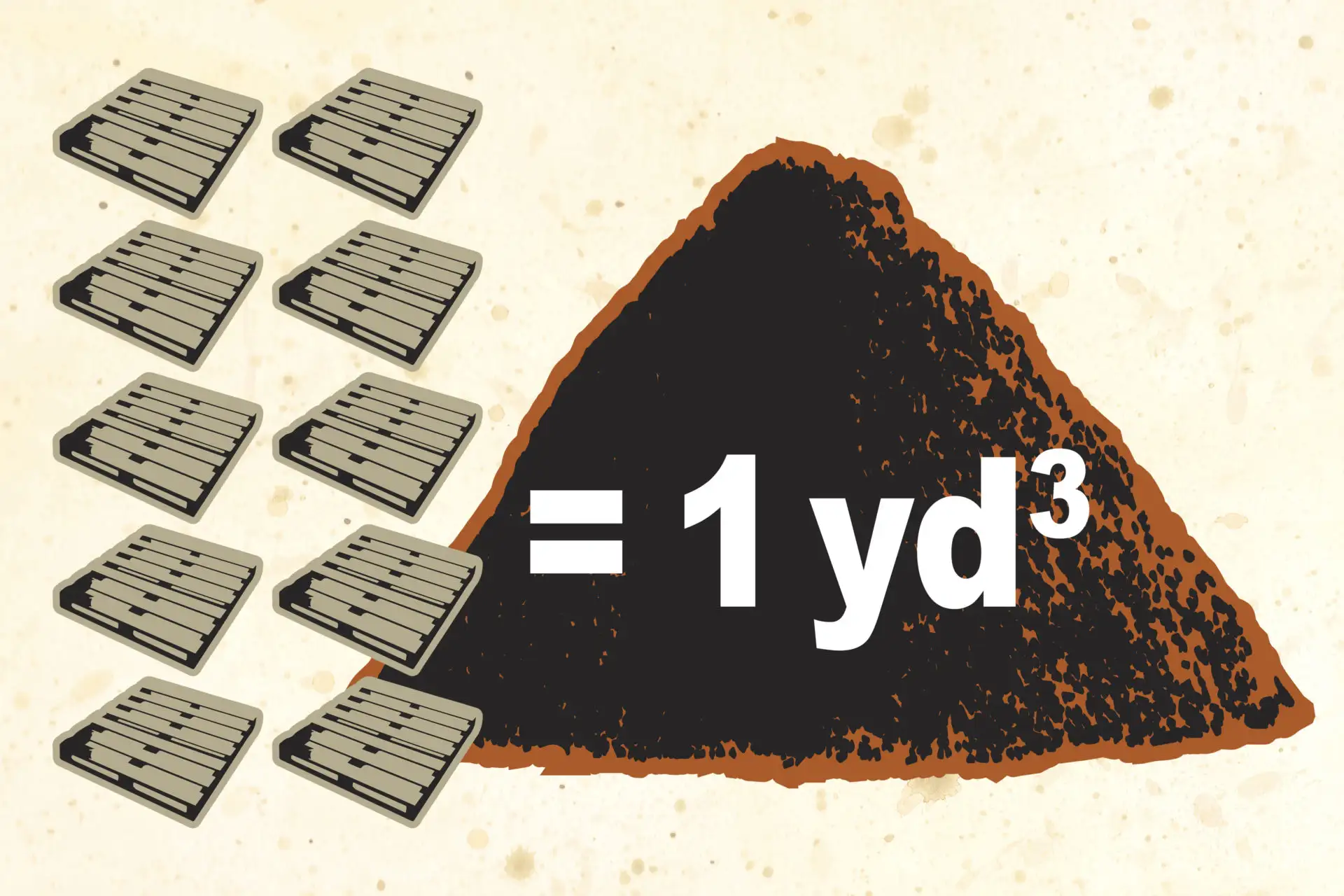
A cubic yard is a volume measurement equal to 27 cubic feet. Picture a cube that’s 3 feet wide, 3 feet tall, and 3 feet deep — that’s exactly one cubic yard. When you order mulch in bulk or see pricing listed “per yard,” this is the unit they’re referring to.
The Simple Formula to Convert Yards to Bags
Total Bags = (Cubic Yards × 27) ÷ Bag Size in Cubic Feet
Here’s how it runs for 2 yards using a standard 2 cu ft bag:
- 2 yards × 27 = 54 cubic feet total
- 54 ÷ 2 = 27 bags
That’s it. Swap in your bag size and you have your answer in seconds. As Inch Calculator’s mulch guide recommends, always round up to the nearest whole bag — you can’t buy a fraction, and running short mid-project wastes more time than grabbing one extra bag upfront.
How Much Area Will 2 Yards of Mulch Cover?
Knowing how many bags you need is only half the battle. You also need to know whether 2 yards is actually enough for your beds — and that depends entirely on how deep you plan to spread it.
According to Angi’s mulch coverage guide, one cubic yard covers around 162 square feet at 2 inches deep or 108 square feet at 3 inches deep.
Coverage at 2-Inch Depth
At a 2-inch depth — the standard for refreshing existing beds and vegetable gardens — 2 yards covers approximately 324 square feet. Think of that as a garden area roughly 18 feet by 18 feet.
Coverage at 3-Inch Depth
At a 3-inch depth — recommended for new beds, around trees, and in areas with heavy weed pressure — 2 yards covers approximately 216 square feet. That’s a solid coverage area for most front-yard flower bed projects.
Coverage Table: 2 Yards of Mulch by Depth
| Mulch Depth | Coverage for 2 Yards |
|---|---|
| 1 inch | ~648 sq ft |
| 2 inches | ~324 sq ft |
| 3 inches | ~216 sq ft |
| 4 inches | ~162 sq ft |
Pro tip: Measure your beds before you go shopping. Length × Width = square footage. Add up each bed separately, then use the table above to confirm 2 yards is enough — or whether you actually need 3.
Not sure which depth is right for your plants? Check out LawnStarter’s complete mulch depth guide for expert-backed recommendations by plant type.
Should You Buy Bags or Bulk Mulch for 2 Yards?
This is where a lot of homeowners leave money on the table. Two yards sits right on the borderline where the math starts to favor bulk — so it’s worth doing a quick comparison before you decide.
When Bagged Mulch Makes Sense
Bags win when you have a small project, limited vehicle space, or need multiple mulch types across different beds. A standard 2 cu ft bag typically runs $3 to $6 at major retailers. At $4 per bag × 27 bags, you’re looking at roughly $108 for 2 yards — no delivery required.
Bags are also far easier to store if you overbuy, and they’re cleaner to transport through narrow gates or tightly landscaped yards.
When Bulk Mulch Is the Smarter Buy
Bulk mulch typically costs $45 to $75 per cubic yard delivered, depending on your region and mulch type. According to Gardener’s Supply Company, bulk mulch is significantly cheaper per cubic foot — often around $1.70/cu ft versus $3.00/cu ft for bagged. At $60/yard delivered, 2 yards of bulk runs about $120, often including delivery, and you get fresher, less-compressed material with zero plastic bag waste.
If your project is 3 yards or more, bulk almost always wins on both price and convenience.
Side-by-Side Cost Comparison
| Option | Estimated Cost for 2 Yards | Notes |
|---|---|---|
| Bagged (2 cu ft at $4/bag) | ~$108 | No delivery, easier to transport |
| Bulk (delivered at $60/yd) | ~$120 | Fresher material, less plastic waste |
| Bulk (self-pickup at $30/yd) | ~$60 | Cheapest option, needs a truck or trailer |
For a deeper breakdown of bagged vs. bulk pricing, GreenPal’s mulch cost guide is a solid resource used by professional landscapers.
Tips Before You Buy Your Mulch
A little prep now saves a frustrating second trip to the store later.
Always Round Up
Mulch settles after spreading. It shifts in wind and rain, and you’ll almost always find a thin spot or two once everything is laid out. Inch Calculator recommends adding a 10% buffer to your estimate — for 2 yards, that means keeping 2–3 extra bags on hand.
Check the Bag Size Before You Assume
This is one of the most common buying mistakes. Not every bag on the shelf holds 2 cubic feet. Grab the bag, flip it over, and check the volume before tossing it in the cart. Buying 27 bags of a 1.5 cu ft variety when you needed 2 cu ft bags means you’ll come up over 13 cubic feet short of your target.
Factor In Mulch Depth for Your Specific Project
The right depth depends on what you’re mulching. Per LawnLove’s mulch depth guide:
- 1–2 inches: Vegetable beds, annuals, refreshing existing mulch
- 2–3 inches: Flower beds, perennial borders, general landscaping
- 3–4 inches: Around trees, shrubs, new beds, and slopes with erosion risk
One important rule regardless of depth: keep mulch 3 inches away from plant stems and 6 inches away from tree trunks. Piling it directly against the base — known as a “mulch volcano” — traps moisture and causes rot and bark decay over time. Lowe’s landscaping guide explains how to avoid this common mulching mistake in detail.
Frequently Asked Questions About Mulch Bags and Yards
How many bags of mulch do I need for 2 cubic yards?
It depends on bag size. For standard 2 cubic foot bags, you need 27 bags. For 1.5 cubic foot bags, you need 36 bags. For 3 cubic foot bags, you need 18 bags.
How many 2 cu ft bags of mulch are in one yard?
There are 13.5 bags of 2 cubic foot mulch in one cubic yard. Since you can’t purchase half a bag, most people round up to 14 bags per yard to ensure full coverage. For a full breakdown with other bag sizes, see CalculatorSoup’s free mulch calculator.
Is it cheaper to buy mulch by the bag or by the yard?
For smaller projects under 2 yards, bagged mulch is usually more convenient and similarly priced when you skip delivery fees. For 3 yards and above, bulk mulch is almost always cheaper per cubic foot and produces significantly less plastic waste.
How much does 2 yards of mulch weigh?
Weight varies by mulch type and moisture content. Generally, one cubic yard weighs between 400 and 800 pounds, meaning 2 yards could weigh anywhere from 800 to 1,600 pounds. Wet mulch is considerably heavier than dry. This matters if you’re hauling it in a pickup — always check your vehicle’s payload rating before loading up.
What is the best mulch depth for flower beds?
For most flower beds, 2 to 3 inches is the sweet spot. It suppresses weeds, retains moisture, and doesn’t smother plant roots. New beds and areas around established shrubs can go up to 4 inches. For a complete guide by plant type, Mulch Pros Landscape Supply’s depth guide covers everything in one place.
The Bottom Line
Two yards of mulch is straightforward once you know your bag size. Here’s what to take with you:
- 27 bags of 2 cu ft mulch = 2 cubic yards
- 36 bags of 1.5 cu ft mulch = 2 cubic yards
- 18 bags of 3 cu ft mulch = 2 cubic yards
- Two yards covers roughly 324 sq ft at 2 inches or 216 sq ft at 3 inches
- Always add a 10% buffer and double-check bag size before buying
- For 3+ yards, bulk mulch is almost always the better value
Before your next mulch run, measure your beds, choose your depth, and use the formula above to nail your order the first time. No second trips. No leftover bags stacking up in the garage.
Want to skip the math entirely? Use the free mulch calculator at CalculatorSoup to get exact bags and cubic yards for any project size instantly.
About the Author
Khalid Fazal is a seasoned lawn care specialist and horticultural researcher with over 15 years of hands-on experience transforming challenging landscapes into lush, resilient green spaces. His journey didn’t start in a lab, but in a backyard full of stubborn, cracked clay that “experts” said would never grow a healthy blade of grass. Refusing to accept a yard full of dust, Khalid spent years experimenting with organic soil restoration and precise mulching—eventually turning that wasteland into a neighborhood showpiece on a shoestring budget.
From mastering core aeration techniques to optimizing soil pH for specialized turf varieties, Khalid’s approach combines old-school grit with modern agronomic science. He founded Gen Lawn to provide homeowners with honest, research-backed advice that prioritizes long-term soil health over quick-fix chemical solutions. When he isn’t analyzing soil profiles, he’s developing precision tools to help others achieve professional results without the professional price tag.
References & Resources

Lawn Winterizer: When to Apply by Grass & Region [2026]
Table of Contents Home / By Khalid Fazal | Updated:...
Read More
Spring Lawn Care: What to Do and When in Every US Region
Table of Contents Home / By Khalid Fazal | Updated:...
Read More
Lawn Maintenance Checklist by Season and Grass Type (2026)
Table of Contents Home / By Khalid Fazal | Updated:...
Read More
Liquid Fertilizer vs Granular Fertilizer: Which Wins?
Table of Contents Home / By Khalid Fazal | Updated:...
Read More