
How to Get Rid of Mushrooms in Your Yard (And Keep Them From Coming Back)
You walk outside with your morning coffee, and there they are — a fresh cluster of mushrooms that definitely wasn’t there yesterday. You pull them out, toss them, and move on. But two days later? They’re back. Same spot. Maybe even more of them.
Here’s the frustrating truth: pulling mushrooms doesn’t solve the problem. What you see above ground is just the tip of the iceberg. The real issue is a fungal network called mycelium living beneath your soil — and as long as the conditions are right, it will keep sending up new mushrooms no matter how many times you remove them.
Worse? Some of those mushrooms could be toxic to your kids or pets.
This guide covers everything you need: how to safely remove mushrooms, how to kill the underlying fungal conditions, natural DIY remedies that actually work (and ones that don’t), and how to prevent them from ever coming back. Let’s dig in.
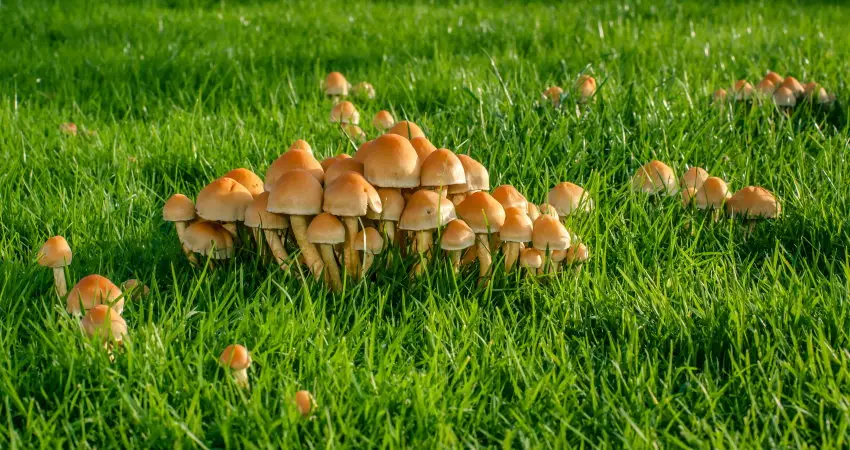
Why Mushrooms Keep Growing in Your Yard
Before you fix it, you need to understand why it keeps happening. Most homeowners skip this step — and that’s exactly why mushrooms keep coming back.
What Causes Mushrooms to Grow in Grass
Mushrooms need three things to thrive: moisture, warmth, and organic matter. When those three line up in your yard, fungal growth is almost inevitable.
The most common causes include:
- Decaying organic matter underground — buried tree stumps, old roots, construction wood, or even heavy thatch can all serve as a food source for fungi
- Poor drainage or overwatering — mushrooms love damp, waterlogged soil; if your yard stays wet after rain or irrigation, you’re essentially rolling out the welcome mat
- Shade — low-light areas dry out slowly, creating the humid conditions fungi prefer
- Thatch buildup — a thick layer of dead grass and debris pressed against the soil surface traps moisture and feeds fungal networks
According to Iowa State University Extension, most lawn mushrooms cause no actual damage to your grass or soil. They’re decomposers doing their job. But they signal conditions in your yard that, if left unchecked, can invite more serious lawn diseases.
Are Mushrooms in Your Yard Dangerous?
Here’s where it gets important — especially if you have curious kids or pets.
Most yard mushrooms are harmless to your lawn. But some species are highly toxic if ingested. According to Dr. Brian Shaw, Professor at Texas A&M’s Department of Plant Pathology and Microbiology, white mushrooms growing in US yards are frequently Chlorophyllum molybdites — also known as the “false parasol” or colloquially the “vomiter.” It’s one of the most commonly consumed poisonous mushrooms in North America, often mistaken for edible varieties like button mushrooms.
The bottom line: unless you’re a trained mycologist, never assume yard mushrooms are safe to eat. If you have pets or children, remove them promptly.
How to Get Rid of Mushrooms in Your Yard: Step-by-Step
This is what most people came here for. Here’s the right sequence — don’t skip steps, because each one builds on the last.
Step 1 — Remove Mushrooms the Right Way
Start with physical removal, but do it correctly. Done wrong, you’ll actually spread the problem.
What to do:
- Put on gardening gloves before touching anything
- Pull or dig out the entire mushroom — use a spade for cluster groups, digging at least 12 inches down to remove as much of the root structure as possible
- Place them directly into a sealed plastic bag
- Throw the bag in the trash — not the compost bin
Two things you must never do:
- Never mow over mushrooms without a grass-catcher bag attached. Mowing without bagging sends spores flying across your entire yard, multiplying your problem significantly.
- Never compost mushrooms. Your compost pile is exactly the warm, moist, organic-rich environment fungi love. You’d be creating a mushroom factory.
Step 2 — Eliminate the Underground Food Source
This is the step most guides skip — and it’s the most important one for long-term results.
Mushrooms keep coming back because the fungal mycelium underground is still feeding on something. Your job is to find and eliminate that food source.
Common culprits include:
- Old tree stumps or buried roots — if you’ve had a tree removed in the past few years, the underground root system may still be decomposing
- Construction debris — buried lumber, sawdust, or wood chips from landscaping projects
- Heavy thatch — if your thatch layer is thicker than ½ inch, it becomes a buffet for fungi
For stumps, consider professional stump grinding rather than just cutting flush with the ground. Grinding removes more of the root mass that feeds fungal growth. For thatch, dethatching your lawn in early fall or spring removes the food source and opens the soil up to better airflow.
Step 3 — Apply a Fungicide (Know What Actually Works)
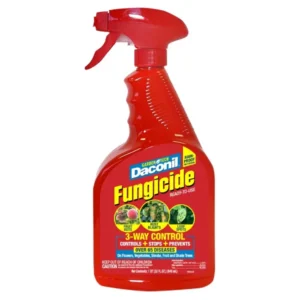
Here’s the truth that most lawn care articles won’t tell you: commercial fungicides are largely ineffective against mushrooms.
Dr. Clint Waltz, a turfgrass extension specialist at the University of Georgia, explains that fungicides can’t penetrate deeply enough into the soil to kill the underground mycelium responsible for producing mushrooms. “Mow them, kick them over, or use a golf wedge,” he says. “They’ll decompose quickly if knocked over.”
That said, fungicides do have a role in suppressing fairy rings (more on those below) and preventing the spread of fungal lawn diseases. For fairy ring treatment specifically, products containing alkyl dimethyl benzyl ammonium chloride — such as Monterey Consan 20 — are among the most recommended options by lawn care professionals.
Step 4 — Fix the Lawn Conditions That Invited Them
Remove the mushrooms, eliminate the food source, and then change the environment so fungi can’t get comfortable again.
Improve drainage and reduce moisture:
- Aerate your lawn once a year — this relieves soil compaction, improves water penetration, and disrupts shallow fungal networks (internal link: Gen Lawn Aeration Guide)
- Fix leaking sprinkler heads or hoses that create wet spots
- Water in the morning (no more than 1 inch per week) so the lawn has time to dry before nightfall
- For chronically waterlogged yards, consider installing French drains or dry creek beds to redirect stormwater
Reduce shade:
- Trim back overhanging tree branches to increase sunlight in problem areas
- Mow regularly at the correct height for your grass type — taller grass creates more shade at soil level
Keep the lawn clean:
- Rake up grass clippings, fallen leaves, and dead debris after mowing
- Replace old, compacted mulch in garden beds — decomposing mulch is a prime mushroom habitat
Natural Ways to Get Rid of Mushrooms in Your Yard
Prefer to skip chemicals? These natural remedies can help reduce surface mushroom growth. Just know that none of them eliminate the underground mycelium — they’re surface treatments, not cures.
| Remedy | How to Use | Effectiveness | Grass-Safe? |
|---|---|---|---|
| Dish soap + water | 2-3 tbsp dish soap per gallon of water; spray affected area | Mild fungicide, good for surface suppression | Yes |
| Baking soda | Mix 1 tbsp per gallon of water; spray or sprinkle directly | Raises soil pH, which fungi dislike | Use carefully — can harm grass in large amounts |
| Vinegar | Horticultural vinegar only (20% acetic acid) — see note below | Moderate; kills surface growth only | Shield surrounding grass with cardboard |
| Nitrogen fertilizer | Apply per package directions | Speeds up decomposition of organic matter | Yes (also benefits lawn) |
The vinegar caveat: This one trips a lot of people up. Regular household white vinegar contains only about 5% acetic acid — not strong enough to affect mushrooms meaningfully. You need horticultural vinegar at 20% acetic acid. Even then, it only kills what it touches. The mycelium underground? Unaffected. Apply it carefully — use a piece of cardboard to shield surrounding grass from contact.
Regardless of which remedy you use, apply early in the morning or late in the evening, and repeat every few days until you see results.
What to Do About Fairy Rings
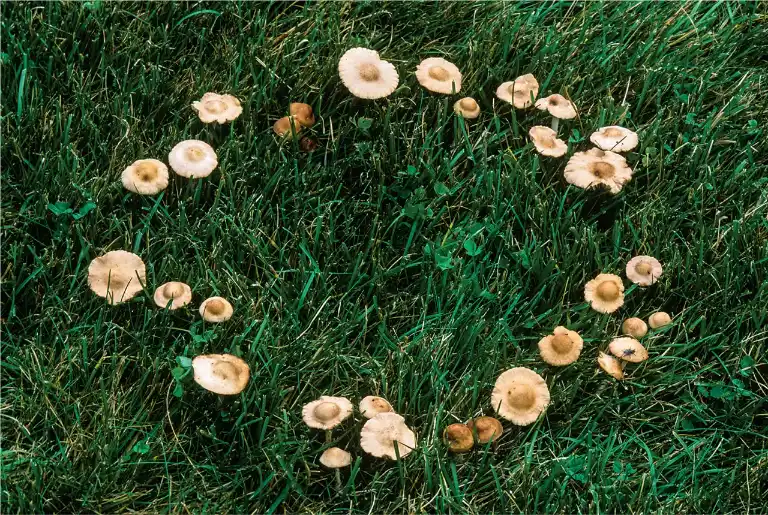
If mushrooms keep appearing in a circle or arc shape in the same part of your yard, you’re dealing with something called a fairy ring — and it needs a slightly different approach.
Fairy ring is caused by a colony of fungi growing outward underground in a circular pattern. As the center dies off, the ring expands — sometimes growing up to 12 inches in diameter per year. They can range from 3 feet to over 20 feet across.
According to Lawn Doctor, there are three types:
- Type 1 — A ring of dead or brown grass with dry, water-repellent soil underneath. The fungus is hydrophobic, meaning it actually repels water and starves the grass. Most damaging type.
- Type 2 — A ring of unusually dark green, fast-growing grass. The fungi release nitrogen as they break down organic matter, fertilizing the ring. Mostly cosmetic.
- Type 3 — The visible ring of mushrooms. The most recognizable type. Less damaging than Type 1 but still worth treating.
How to treat fairy rings:
- For Type 1, aerate heavily within and around the ring, then improve irrigation to break the hydrophobic soil barrier
- For Type 2, apply a nitrogen fertilizer to your entire lawn to even out the color contrast
- For Type 3, remove mushrooms per Step 1 above, then apply a fungicide like Monterey Consan 20 to the ring area
- For all types: core aeration, dethatching, and removing any buried organic matter underneath the ring are the most effective long-term solutions
Be patient. Fairy rings are stubborn. As Oregon State University Extension notes, even after treatment, fairy rings can re-establish over a period of years.
How to Prevent Mushrooms from Coming Back
Once you’ve dealt with the immediate problem, here’s how to make sure mushrooms don’t become a recurring issue.
Lawn Care Habits That Discourage Fungal Growth
Think of these as your year-round mushroom defense plan:
- Water smart — irrigate in the morning, limit to 1 inch per week, and fix any drainage issues promptly
- Mow regularly — consistent mowing reduces shade at soil level and keeps grass healthy enough to outcompete fungal growth
- Bag your clippings — especially when mushrooms are present; loose clippings are both a food source and a spore transport vehicle
- Dethatch annually — if your thatch layer exceeds ½ inch, remove it in early fall or spring (internal link: Gen Lawn Dethatching Guide)
- Core aerate once a year — improves drainage, disrupts mycelium, and encourages deeper root growth
- Clean up debris — remove fallen leaves, old mulch, wood scraps, and pet waste promptly; these are all mushroom fuel
When to Call a Lawn Care Professional
Sometimes DIY just doesn’t cut it. Consider calling a professional if:
- Mushrooms keep returning in the exact same spot year after year despite your best efforts
- You have a fairy ring that’s expanding in diameter each season
- You notice large sections of dying or thinning grass associated with mushroom growth
- You suspect buried organic matter (stumps, construction debris) that requires excavation to remove
A licensed lawn care professional can assess the underground cause, recommend the right fungicide protocol for your specific situation, and in some cases, remove buried organic matter that DIY methods can’t reach. (internal link: Find a Gen Lawn Pro Near You)
Frequently Asked Questions About Getting Rid of Mushrooms in Your Yard
Why do mushrooms keep growing back in the same spot in my yard?
Because the underground fungal network — called mycelium — is still alive and feeding on something beneath the surface. Removing the visible mushroom doesn’t kill the mycelium. You need to identify and remove the decaying organic matter (buried roots, stumps, thatch) that’s feeding it. Until that food source is gone, mushrooms will keep reappearing.
What kills mushrooms in the yard without killing the grass?
The safest surface options are a dish soap and water spray (2-3 tablespoons per gallon) or a baking soda solution. Both are gentle on grass when used carefully. For deeper suppression, a targeted fungicide like Monterey Consan 20 works for fairy rings. Avoid vinegar unless you’re using horticultural-grade (20% acetic acid) with a protective shield around surrounding grass.
Is it safe to mow over mushrooms in the yard?
No — not without a grass-catcher bag. Mowing over mushrooms without bagging the clippings spreads spores widely across your lawn, which can cause mushrooms to pop up in new areas. Always bag clippings when mushrooms are present, and clean your mower deck afterward.
Are yard mushrooms a sign of a healthy or unhealthy lawn?
Both, depending on context. Mushrooms mean your soil has organic matter breaking down, which can indicate healthy biological activity. But they also signal excess moisture, shade, thatch, or decaying matter — conditions that, if unchecked, invite more serious fungal lawn diseases. Think of mushrooms as a flag, not a diagnosis.
How do I get rid of a fairy ring of mushrooms in my yard?
Start by removing the visible mushrooms (gloves, sealed bag, trash). Then aerate heavily inside and around the ring, and look for buried organic matter underneath that the fungus is feeding on. Apply a fungicide containing alkyl dimethyl benzyl ammonium chloride for suppression. Managing the underlying lawn health — correct watering, fertilization, and aeration — is the best long-term approach. For large or persistent fairy rings, a lawn care professional may be needed.
The Bottom Line
Mushrooms in your yard are rarely a crisis — but they are a signal. Here’s the simple playbook:
- Remove mushrooms the right way (gloves, sealed bag, never mow without a catcher)
- Eliminate the underground food source (stumps, buried roots, thick thatch)
- Adjust your lawn conditions (drainage, shade, watering habits)
- Prevent with consistent lawn care (aeration, dethatching, smart irrigation)
Do all four, and mushrooms won’t stand a chance.
Not sure where your lawn’s fungal problem is coming from? Start with a soil assessment or reach out to a local lawn care professional who can diagnose the root cause — literally. (internal link: Gen Lawn Services)
References & External Resources
- Iowa State University Extension — Mushrooms in Lawns and Garden Beds
- Oregon State University Extension — Mushroom Fairy Ring
- Texas A&M / MedicalXpress — False Parasols and Toxic Yard Mushrooms (2025)
- Lawn Doctor — Fairy Ring Fungus Treatment and Prevention
- Penn State Extension — Lawn Aeration
- University of Minnesota Extension — Thatch in Lawns
- Solutions Stores — Monterey Consan 20 Fairy Ring Treatment
- LawnLove — Horticultural Vinegar for Mushrooms
About Author
Khalid Fazal is a seasoned lawn care specialist and horticultural researcher with over 15 years of hands-on experience transforming challenging landscapes into lush, resilient green spaces. His journey didn’t start in a lab, but in a backyard full of stubborn, cracked clay that “experts” said would never grow a healthy blade of grass. Refusing to accept a yard full of dust, Khalid spent years experimenting with organic soil restoration and precise mulching—eventually turning that wasteland into a neighborhood showpiece on a shoestring budget.
From mastering core aeration techniques to optimizing soil pH for specialized turf varieties, Khalid’s approach combines old-school grit with modern agronomic science. He founded Gen Lawn to provide homeowners with honest, research-backed advice that prioritizes long-term soil health over quick-fix chemical solutions. When he isn’t analyzing soil profiles, he’s developing precision tools to help others achieve professional results without the professional price tag.

Lawn Winterizer: When to Apply by Grass & Region [2026]
Table of Contents Home / By Khalid Fazal | Updated:...
Read More
Spring Lawn Care: What to Do and When in Every US Region
Table of Contents Home / By Khalid Fazal | Updated:...
Read More
Lawn Maintenance Checklist by Season and Grass Type (2026)
Table of Contents Home / By Khalid Fazal | Updated:...
Read More
Liquid Fertilizer vs Granular Fertilizer: Which Wins?
Table of Contents Home / By Khalid Fazal | Updated:...
Read More