
How to Improve Soil Quality for Your Lawn: A Step-by-Step Guide for US Homeowners
You’ve watered it. You’ve fertilized it. You’ve reseeded bare patches more times than you can count. And still — the lawn looks the same.
Here’s what most homeowners miss: the problem isn’t on top of the soil. It’s in it.
Poor soil quality is behind almost every common lawn frustration — thin grass, patchy growth, water pooling after rain, and fertilizer that delivers zero visible results. Fix the soil, and the rest of your lawn care routine finally starts to work. This guide walks you through exactly how to improve soil quality for your lawn, step by step, without digging everything up and starting over.
Why Lawn Soil Quality Matters More Than Anything Else
Think of your soil as the foundation of a building. You can put the best windows and roofing on a building with a cracked foundation — it still falls apart.
Healthy lawn soil holds the right balance of air, water, and nutrients. It gives grass roots room to go deep, which is what creates drought tolerance, disease resistance, and that thick, dense look you’re going for. According to USDA Agricultural Research Service, a teaspoon of healthy soil contains roughly one billion bacteria alone — a living ecosystem that breaks down organic matter, cycles nutrients, and protects grass from pathogens.
Lawns growing in genuinely healthy soil can also need up to 20% less water. That’s not a small number when you’re running sprinklers through a dry summer.
Signs Your Lawn Soil Is in Bad Shape
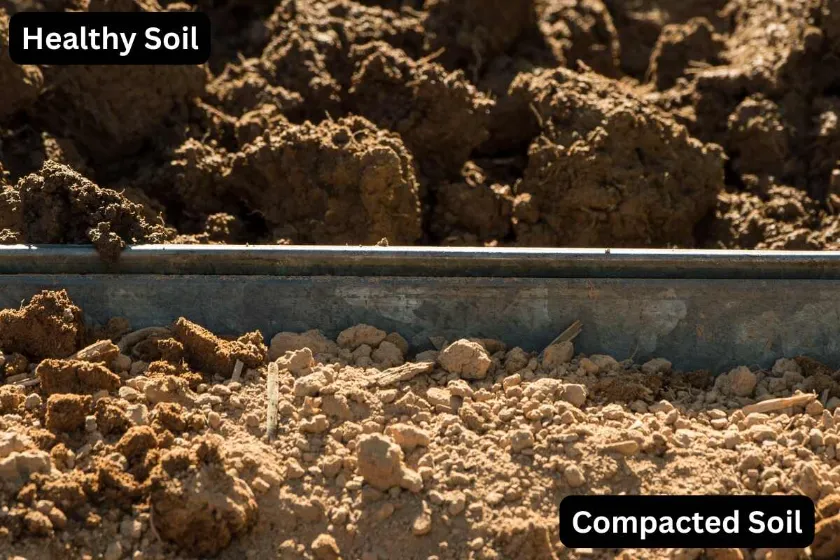
Before you buy a single product, look at what your lawn is telling you. These are the most common signals that your soil needs attention:
- Grass is thin, patchy, or slow to fill in — even after reseeding
- Water puddles on the surface after rain or irrigation instead of soaking in
- Fertilizer produces little or no visible improvement
- Weeds are outcompeting grass — particularly crabgrass and dandelions, which thrive in compacted, nutrient-poor soil
- The lawn feels hard underfoot, especially after a dry spell
Here’s a quick test you can do right now: push a standard flathead screwdriver into your lawn with moderate hand pressure. If you can’t get it 6 inches deep without real effort, your soil is compacted — one of the most common and damaging soil problems in American yards.
Step 1: Test Your Soil — Don’t Skip This
This is the step most homeowners skip. And it’s also the reason most homeowners are guessing.
A soil test costs $10–$20 and tells you everything you need to know before spending money on amendments. Without it, you might be adding lime to soil that’s already alkaline, or fertilizing with nitrogen when your real deficiency is phosphorus. That’s money wasted and a lawn that still won’t respond.
How to Get a Soil Test in the US
The most reliable route is your state’s Cooperative Extension Service. These are university-based offices funded by the USDA that offer inexpensive, lab-accurate soil tests for homeowners. Just search “[your state] cooperative extension soil test” — every state has one.
At-home kits from garden centers (brands like Luster Leaf Rapitest) are a reasonable starting point for checking pH quickly, but they won’t give you nutrient readings as accurately as a lab. For a complete picture — especially if your lawn has persistent problems — go with the extension service.
Your test results will cover:
- Soil pH — how acidic or alkaline your soil is (the single most important number)
- Nitrogen (N), Phosphorus (P), Potassium (K) — the three primary nutrients for grass growth
- Organic matter percentage — indicates biological activity and long-term soil health
- Micronutrient levels in more comprehensive tests (calcium, magnesium, sulfur)
How to Read Your Results
The ideal lawn soil pH in the US sits between 6.2 and 7.0. Below 6.0 means your soil is too acidic; above 7.2 means it’s too alkaline. Both conditions cause nutrient lockout — a state where nutrients are physically present in the soil but chemically unavailable to grass roots. You can fertilize all season and see nothing, because the nutrients can’t be absorbed.
Your test report will usually include specific amendment recommendations. Follow them. The quantities matter.
Step 2: Fix What the Test Reveals — How to Improve Soil Quality for Your Lawn
Now you know what you’re working with. Here’s how to fix it.
Fix Compaction with Core Aeration
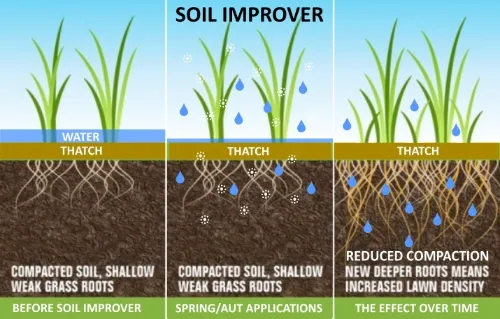
Compaction is the most widespread lawn soil problem in the US, especially in high-traffic yards, clay-heavy regions, and lawns built on construction fill. When soil is dense, oxygen can’t circulate, water can’t drain, and grass roots hit a wall at 2–3 inches instead of growing to 6 inches or deeper.
Core aeration — the process of pulling small plugs of soil out of the ground — opens channels for air, water, and nutrients and gives roots room to expand. A spike aerator (which just pokes holes) is far less effective; it actually increases compaction around the holes over time. Rent or hire a core aerator.
Timing matters:
- Cool-season grasses (fescue, bluegrass, ryegrass): aerate in early fall, when grass is actively growing and can recover
- Warm-season grasses (Bermuda, zoysia, St. Augustine): aerate in late spring to early summer
Run two passes at right angles for maximum coverage, particularly in high-traffic areas. Immediately after aeration, topdress lightly with compost — it filters into the holes and feeds the soil biology underneath.
Fix pH Imbalances
Once you know your pH reading, the fix is straightforward — the key is using the right product and the right rate.
- Acidic soil (pH below 6.2): Apply agricultural lime — either calcitic (calcium carbonate) or dolomitic (calcium and magnesium carbonate, better if your test also shows low magnesium). Pelletized lime is easiest to spread with a broadcast spreader. Work with your test’s recommended application rate — over-liming is a real problem.
- Alkaline soil (pH above 7.2): Apply elemental sulfur, which soil bacteria convert to sulfuric acid over time. This works more slowly than lime — expect 3–6 months for meaningful change. Acidifying fertilizers containing ammonium sulfate can also help.
Regional note: Acidic soils are most common in the Southeast, Mid-Atlantic, and Pacific Northwest. Alkaline soils are typical of arid Western states where rainfall is low and evaporation concentrates calcium carbonate. If you’re in the Midwest, you could have either — test first.
Add Organic Matter (The Universal Fix)
Whatever else your soil test shows, adding organic matter will help. It’s the one amendment that improves every soil type. Compost makes clay soil drain better and sandy soil hold moisture longer — the same input solving opposite problems.
Here’s the thing: you don’t need much. In nature, organic matter makes up only about 5% of healthy soil. A little goes a long way.
Best ways to add organic matter to an established lawn:
- Compost topdressing — the gold standard. Spread a ¼ to ½ inch layer of screened compost across your lawn, ideally right after aeration so it falls into the holes. Use finished compost (dark, crumbly, earthy-smelling — not fresh or chunky). The EPA’s home composting guide explains how to make your own for free.
- Composted manure — well-aged cow or poultry manure adds both nutrients and biology. Never use fresh manure; it burns grass and carries weed seeds.
- Mulch mowing (grasscycling) — leave your grass clippings on the lawn after every mow. They decompose quickly, returning nitrogen and organic matter continuously throughout the season. A sharp mower blade makes short clippings that don’t mat or smother the grass.
- Shredded fall leaves — run your mower over dry leaves and let the shredded material work into the turf. One of the highest-value free inputs available to any homeowner.
Aim for two organic matter applications per year — once in fall after aeration, once in spring.
Regional Soil Quick Reference
| US Region | Common Soil Problem | Primary Fix |
|---|---|---|
| Midwest (IL, OH, MO) | Heavy clay, compaction | Core aerate + compost topdress |
| Southeast (GA, FL, SC) | Sandy, low nutrients, low pH | Organic matter + lime if pH low |
| Northeast (NY, PA, MA) | Acidic, compacted | Lime + aeration + compost |
| Pacific Northwest | Acidic, waterlogged | Aeration + lime + drainage check |
| Southwest / Arid West | Alkaline, low organic matter | Sulfur + consistent compost additions |
Step 3: Feed the Soil — Fertilization That Actually Works
After improving soil structure and pH, fertilization finally starts to do what it’s supposed to. But the type of fertilizer you use matters enormously for soil health long-term.
Choose the Right Fertilizer Based on Your Soil Test
Your test report will tell you which nutrients are deficient. Don’t just buy a generic bag — match the fertilizer to the deficiency.
- Slow-release nitrogen fertilizers (look for “slow-release” or “controlled-release” on the label) feed grass steadily over weeks rather than all at once. This protects soil microorganisms from nitrogen burn and reduces leaching into groundwater. Milorganite is a widely available slow-release organic option.
- Starter fertilizers (higher phosphorus) are ideal if you’re overseeding or establishing new lawn areas — phosphorus drives root development.
- Organic fertilizers — products like blood meal (fast nitrogen), bone meal (phosphorus), and feather meal (slow nitrogen) also feed soil biology, not just the plant. Over time, they increase the organic matter percentage of your soil.
Whatever you apply, always water in fertilizer after application — it moves nutrients into the soil and prevents surface burn.
Fertilization Timing by US Region
| Grass Type | Where It Grows | Best Fertilization Window |
|---|---|---|
| Tall fescue, bluegrass, ryegrass | Northeast, Midwest, Pacific NW | Late August through October (primary); light feeding in spring |
| Bermuda, zoysia, centipede | Southeast, South | Late spring through summer (April–August) |
| St. Augustine | Gulf Coast, Florida | Spring and early summer; avoid late fall feeding |
| Buffalo grass | Great Plains, Southwest | Spring only |
Over-fertilizing warm-season grasses in fall, or cool-season grasses in summer heat, does more harm than good. Timing is as important as application rate.
Step 4: Maintain Improved Soil Quality Long-Term
Getting your soil in good shape is one thing. Keeping it there is another.
The good news: once you’ve done the initial work, maintenance is low-effort. You’re just protecting what you’ve built.
Watering Habits That Protect Soil Structure
Frequent shallow watering — say, 10–15 minutes every day — trains grass to develop shallow roots and gradually compacts the surface. It also encourages fungal disease.
The better approach: water deeply and infrequently. One inch of water per week, applied in one or two sessions, encourages roots to go down looking for moisture. You can check your output with a rain gauge or an empty tuna can. The Irrigation Association has region-specific guidance on watering schedules.
Your Seasonal Soil Care Calendar
Fall (September–October):
- Core aerate your lawn
- Apply compost topdressing immediately after aeration
- Overseed thin areas if needed (best germination time for cool-season grasses)
- Apply lime if pH test shows acidic soil
Spring (March–April):
- Light fertilization based on your most recent soil test
- Re-test pH every 2–3 years or if grass performance drops
- Begin grasscycling from the first mow
Year-round:
- Mulch mow (never bag clippings unless they’re excessively long or diseased)
- Avoid heavy foot traffic on wet soil — it compacts far more easily when saturated
- Keep mowing height appropriate to your grass type (see USDA grass species guide) — taller grass shades the soil, reducing evaporation and protecting soil biology
How Long Until You See Real Results?
This is the question no competitor answers — so here’s a straight answer:
| Improvement | Expected Timeline |
|---|---|
| pH correction (lime or sulfur) | 4–8 weeks for initial shift; 3–6 months for full correction |
| Compaction relief after aeration | Visible within 1 growing season |
| Organic matter increase | 2–3 seasons of consistent application |
| Microbial activity improvement | 1 season after consistent compost additions |
| Full transformation of poor soil | 2–3 years of consistent seasonal practice |
Soil improvement is not a weekend project — it’s a process. But with each season, the compounding effect becomes visible: thicker turf, less fertilizer needed, fewer weeds, and grass that recovers faster from heat and drought.
Frequently Asked Questions About Improving Lawn Soil Quality
What is the fastest way to improve lawn soil quality?
The fastest single-season improvement is core aeration followed immediately by compost topdressing. This addresses compaction, adds organic matter, and feeds soil biology in one sequence. Combined with a pH correction based on a soil test, most lawns show visible improvement within 6–8 weeks.
How do I fix hard, compacted soil in my lawn without tearing it up?
Core aeration is the solution. A core aerator pulls plugs of soil out of the ground, creating channels that allow air, water, and nutrients to penetrate. You don’t need to tear up the lawn — the plugs you remove break down on the surface within 2–3 weeks. Follow with compost topdressing for the best results. You can rent a core aerator from most home improvement stores for $50–$80/day.
What is the best soil amendment for clay lawn soil?
Compost. It loosens clay over time by improving soil aggregation — the way soil particles clump together. It also adds microbial life that further breaks down dense clay structure. Apply a ¼–½ inch of screened compost as a topdress twice a year, in fall and spring, preferably after aeration. Gypsum (calcium sulfate) is also frequently recommended for heavy clay soils, particularly in the Southeast and Midwest, as it helps break up clay particles without significantly changing pH. Learn more at Oklahoma State University Extension.
How often should I aerate my lawn?
Most lawns benefit from annual aeration in the fall (cool-season grasses) or late spring (warm-season grasses). Heavily compacted soils, lawns with high foot traffic, or yards with clay-heavy soil may benefit from twice-yearly aeration until the structure improves. For further guidance by grass type, Penn State Extension has detailed region-specific recommendations.
How long does it take to see results after improving lawn soil?
You’ll typically notice relief from compaction within one full growing season after aeration. pH corrections take 4–8 weeks for an initial shift and up to 6 months for full correction. Organic matter improvements are cumulative — you’ll see meaningful changes after 2–3 seasons of consistent compost additions and grasscycling. The key is that each improvement compounds on the last.
The Bottom Line
Your lawn won’t outperform its soil. That’s the one thing worth remembering from this entire guide.
The process is straightforward:
- Test first — a $15 soil test from your Cooperative Extension office tells you exactly what’s wrong
- Fix the right problem — aerate for compaction, add lime or sulfur for pH, and compost for everything else
- Maintain consistently — aeration, compost, mulch mowing, and smart watering, repeated every season
Start with the soil test. Everything else follows from what it tells you.
Ready to take the next step? Get a soil test from your local Cooperative Extension Service — it takes about 10 minutes to submit and delivers results within a week.
References & Sources
External:
- USDA ARS — Tips for Healthy Soil
- Missouri University Extension — Improving Lawn and Landscape Soils
- Oklahoma State University Extension — Improving Soil Quality
- Penn State Extension — Lawns and Turf
- EPA — Composting at Home
- JoeGardener — How to Improve Your Soil
- Milorganite — Improve Your Soil
- University of Minnesota Extension — Soil pH and Nutrient Availability
- USDA Plants Database
About Author
Khalid Fazal is a seasoned lawn care specialist and horticultural researcher with over 15 years of hands-on experience transforming challenging landscapes into lush, resilient green spaces. His journey didn’t start in a lab, but in a backyard full of stubborn, cracked clay that “experts” said would never grow a healthy blade of grass. Refusing to accept a yard full of dust, Khalid spent years experimenting with organic soil restoration and precise mulching—eventually turning that wasteland into a neighborhood showpiece on a shoestring budget.
From mastering core aeration techniques to optimizing soil pH for specialized turf varieties, Khalid’s approach combines old-school grit with modern agronomic science. He founded Gen Lawn to provide homeowners with honest, research-backed advice that prioritizes long-term soil health over quick-fix chemical solutions. When he isn’t analyzing soil profiles, he’s developing precision tools to help others achieve professional results without the professional price tag.

Lawn Winterizer: When to Apply by Grass & Region [2026]
Table of Contents Home / By Khalid Fazal | Updated:...
Read More
Spring Lawn Care: What to Do and When in Every US Region
Table of Contents Home / By Khalid Fazal | Updated:...
Read More
Lawn Maintenance Checklist by Season and Grass Type (2026)
Table of Contents Home / By Khalid Fazal | Updated:...
Read More
Liquid Fertilizer vs Granular Fertilizer: Which Wins?
Table of Contents Home / By Khalid Fazal | Updated:...
Read More