
How to Overseed a Patchy Lawn (And Actually Make It Work)
You walk outside, coffee in hand, and there it is — those same frustrating bare patches staring back at you. Brown. Thin. Embarrassing. You’ve watered, you’ve waited, and nothing’s changed.
Here’s the good news: you don’t need to rip up your entire lawn and start over. Overseeding those patchy areas is the fastest, most affordable fix — and with the right timing and technique, you can have thick, green grass filling in within just a few weeks.
In this guide, you’ll learn exactly what overseeding is, when to do it, what products to grab, and how to follow a step-by-step process that actually works — even if you’ve never done it before.
What Does Overseeding a Patchy Lawn Actually Mean?
Overseeding sounds technical, but the concept is simple. It means spreading new grass seed directly over your existing lawn — no tilling, no digging everything up — to fill in thin or bare spots and thicken your turf overall.
It’s one of the most widely recommended lawn care practices by turf experts, and for good reason: it works.
Overseeding vs. Reseeding — What’s the Difference?
These two terms get confused all the time.
- Overseeding = adding seed on top of existing grass to improve density and fill patches
- Reseeding = starting completely from scratch, usually after removing dead turf
For most patchy lawns, overseeding is all you need. Full reseeding is reserved for lawns that are more than 50% dead or damaged beyond repair.
Why Lawns Go Patchy in the First Place
Before you fix the problem, it helps to understand it. Patchy lawns are usually caused by one or more of these culprits:
- Heavy foot traffic wearing down specific areas
- Drought stress or inconsistent watering
- Lawn disease or fungus killing off sections
- Poor soil quality with low nutrients or compaction
- Shade from trees or structures blocking sunlight
- Insects or grubs feeding on grass roots underground
Identifying your cause can help you prevent patches from coming back after overseeding.
When Is the Best Time to Overseed a Patchy Lawn?
Timing is everything. This is the single biggest mistake most homeowners make — they throw seed down at the wrong time of year and wonder why nothing grows.
The right window depends entirely on what type of grass you have.
Cool-Season Grasses — Target Late Summer to Early Fall
If you have Kentucky Bluegrass, Tall Fescue, Fine Fescue, or Perennial Ryegrass, your ideal overseeding window is late August through mid-October — depending on your region.
Here’s why: soil temperatures are still warm enough for germination, but the cooler air reduces stress on new seedlings. Fall also means less competition from weeds like crabgrass.
According to Penn State Extension, early fall is the single best time to overseed cool-season lawns in most of the northern and mid-Atlantic United States.
Warm-Season Grasses — Target Late Spring to Early Summer
If your lawn has Bermuda, Zoysia, Centipede, or St. Augustine grass, wait until late May through June when soil temperatures consistently hit 65–70°F.
Warm-season grasses need warm soil and warm air to germinate properly. Planting too early leads to poor germination or seedling loss from a late cold snap.
Can You Overseed in Spring? (Honest Answer)
Yes — but with caveats. Spring overseeding for cool-season grasses is second-best at best. The problem is competition: pre-emergent herbicides commonly applied in spring will also prevent your grass seed from germinating. And summer heat arriving weeks after planting can stress young seedlings badly.
If fall isn’t an option, spring overseeding can still work — just skip the pre-emergent that year and water diligently.
What You’ll Need Before You Start
You don’t need a truckload of equipment. Here’s what to gather before overseeding your patchy lawn:
Essential Tools:
- Lawn mower (with bag attachment if possible)
- Garden rake or dethatching rake
- Core aerator (rentable from most hardware stores)
- Garden hose or sprinkler with a gentle spray setting
Products:
- Grass seed — matched to your existing lawn type (this matters more than anything)
- Starter fertilizer — look for a high-phosphorus formula like Scotts Turf Builder Starter Food
- Topsoil or compost — a thin ¼-inch layer helps with seed-to-soil contact (optional but highly recommended)
Pro tip: Never guess your grass type. If you’re unsure, bring a small clipping to your local garden center or use a grass ID app. Mixing incompatible seed types creates an uneven, mismatched lawn.
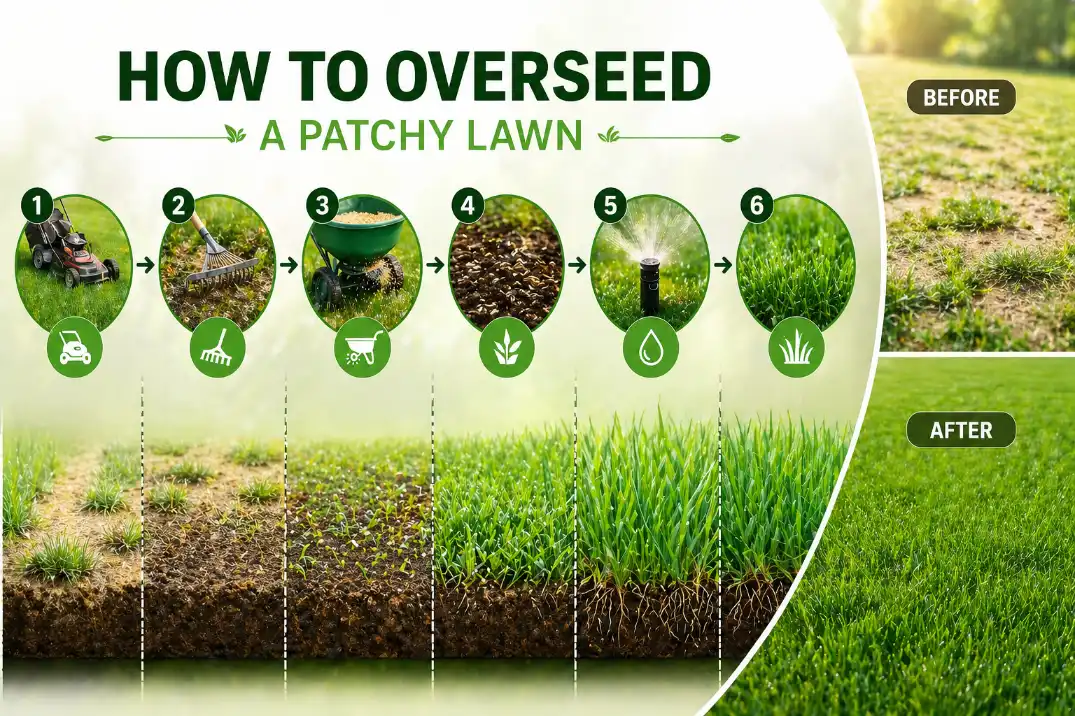
How to Overseed a Patchy Lawn — Step-by-Step
This is the part that matters most. Follow these steps in order and you’ll give your seed the best possible chance of establishing into healthy, dense grass.
Step 1 — Mow Low and Remove Debris
Start by mowing your lawn shorter than usual — drop to about 1.5 to 2 inches. Shorter grass means more sunlight and airflow reaching the soil, which seeds need to germinate.
After mowing, rake up all the clippings, dead grass, and any thatch buildup. Thatch is that spongy layer of decomposing organic matter sitting between the grass and soil — too much of it acts like a barrier that prevents seeds from reaching the dirt.
Step 2 — Loosen the Soil (Aerate or Rake the Patches)
Here’s the thing: seeds that sit on top of compacted soil germinate poorly or not at all. You need good seed-to-soil contact.
For patchy areas specifically:
- Use a garden rake to scratch and loosen the top ¼ to ½ inch of bare soil
- For larger areas or heavily compacted lawns, use a core aerator to pull small plugs from the ground, creating channels for seed and water
Aerating the whole lawn before overseeding dramatically improves results. Most hardware stores rent aerators for under $80/day — well worth it.
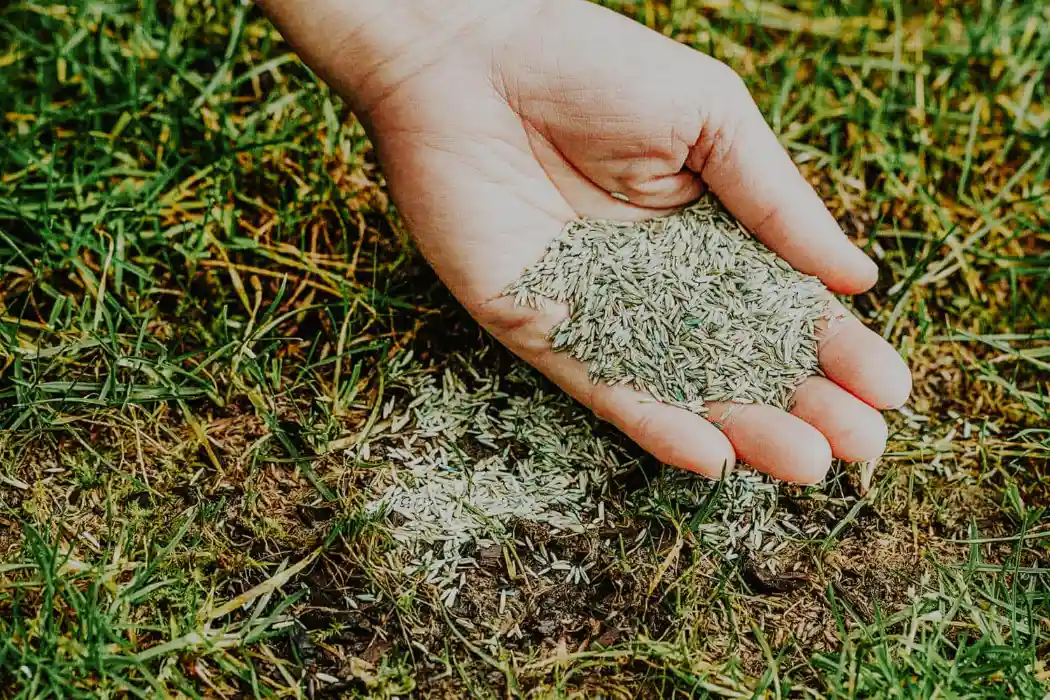
Step 3 — Choose and Apply the Right Grass Seed
Matching your seed variety to your existing lawn is non-negotiable. A mismatched seed will grow, but it will look different — creating a lawn that looks patchier than before.
Apply seed using one of these methods:
- Hand spreading for small patches
- Drop spreader for precise, even coverage on larger areas
- Broadcast/rotary spreader for whole-lawn overseeding
For bare patches, apply seed at a higher rate than the bag recommends for overseeding — you need density in those areas to compete with weeds and establish quickly.
Step 4 — Add a Thin Layer of Topsoil or Compost
This step gets skipped constantly — don’t skip it.
Spread a thin layer (¼ inch) of topsoil or compost over the seeded areas. This does two powerful things:
- Locks moisture around the seeds so they don’t dry out
- Improves seed-to-soil contact, dramatically increasing germination rates
You don’t need to go deep. A light, even topdressing is all it takes.
Step 5 — Apply Starter Fertilizer
New grass seed needs phosphorus to develop strong roots. Regular lawn fertilizers are high in nitrogen — that’s great for established grass, but it’s not what seedlings need.
Use a starter fertilizer specifically designed for new seed. Apply it right after seeding, following the package rate. Scotts, Pennington, and Jonathan Green all make reliable starter formulas widely available at garden centers.
Step 6 — Water Correctly (The Most Critical Step)
Watering is where most overseeding attempts succeed or fail. New seeds need consistent moisture, but they can’t be drowned.
The golden rule: Keep the top inch of soil consistently moist until seeds germinate.
In practical terms, that usually means:
- 2–3 light waterings per day for the first 1–2 weeks (mornings and late afternoon work well)
- Once seeds sprout and reach about 1 inch tall, shift to deeper, less frequent watering (every 2–3 days)
- Avoid watering in the evening — wet grass overnight invites fungal disease
A gentle spray setting or oscillating sprinkler works best. Heavy streams wash seeds away before they can germinate.
Step 7 — Stay Off the Lawn While Seeds Germinate
This one’s simple but critical. Keep foot traffic, pets, and lawn equipment off the overseeded areas while seeds are germinating.
Most grass seed varieties germinate in 7–21 days depending on species, temperature, and moisture. Resist the urge to check on it constantly — just water consistently and let it do its thing.
How to Care for Your Lawn After Overseeding
Getting seeds to sprout is only half the battle. Proper aftercare determines whether those seedlings survive or die off.
Watering Schedule for New Grass Seed
Once your new grass reaches about 1–2 inches tall, scale back the frequency but increase depth. You want roots chasing water deeper into the soil — that’s what builds a drought-resilient lawn.
A good post-germination watering schedule:
- Water deeply 2–3 times per week (rather than light daily watering)
- Aim for about 1 inch of water per week total (rainfall counts)
- Always water in the morning when possible to reduce disease risk
When Can You Mow After Overseeding?
Wait until your new grass reaches 3 to 3.5 inches tall before mowing. Mowing too soon rips out seedlings before their roots are established.
When you do mow for the first time:
- Use a sharp blade (dull blades tear instead of cut)
- Never remove more than ⅓ of the blade height in a single mow
- Keep foot traffic light for the first few mows
What to Do If Patches Still Won’t Grow
Don’t panic if some areas are slow to fill in. Here’s what to check:
- Soil compaction — did you loosen it enough before seeding?
- Shade — some areas may need a shade-tolerant seed variety
- Watering inconsistency — seeds that dry out between waterings won’t survive
- Seed-to-soil contact — were seeds sitting on thatch instead of soil?
- Underlying problem — grubs or disease may need to be addressed before reseeding
Give it a full 30 days before deciding a spot has failed. Some varieties are simply slower germinators.
Frequently Asked Questions About Overseeding a Patchy Lawn
How long does it take for overseeded patches to fill in?
Most grass seed germinates in 7–21 days, but visible patch coverage takes longer. Expect a noticeably fuller lawn within 3–6 weeks under ideal conditions. Full, dense fill-in can take one full growing season for severely bare areas.
Can I overseed without aerating?
Yes, but your results will be noticeably weaker. Aeration dramatically improves seed-to-soil contact and germination rates. If you skip it, at minimum use a metal rake to aggressively scratch the bare soil before seeding — it makes a real difference.
What’s the best grass seed for patchy lawns?
It depends entirely on your existing grass type and your region. That said, Perennial Ryegrass is popular for patches because it germinates fast (5–10 days) and establishes quickly. Tall Fescue blends are excellent for high-traffic, mixed-sun lawns in the transition zone. Always match seed to your existing lawn variety first.
Should I water every day after overseeding?
Yes — during the germination phase (first 1–2 weeks), light daily watering (2–3 times per day in short sessions) keeps the soil surface consistently moist. Once seedlings are established, shift to deeper, less frequent watering.
Can I overseed over dead grass?
Yes, but remove as much dead material as possible first. Dead grass and thick thatch prevent seed from reaching soil. Rake aggressively or dethatch before seeding. If the dead area is large and the underlying cause (disease, grubs) hasn’t been addressed, treat that first or you’ll lose the new seed too.
The Bottom Line on Overseeding a Patchy Lawn
A patchy lawn isn’t a lost cause — it’s a project. And with the right approach, it’s one of the most satisfying lawn wins you can pull off on a weekend.
Here’s what to remember:
- Timing matters — fall for cool-season grass, late spring for warm-season
- Soil contact is everything — aerate or rake before you seed
- Match your seed to your existing grass type
- Water consistently — moisture is what turns seed into grass
- Be patient — full fill-in takes weeks, not days
About Author
Khalid Fazal is a seasoned lawn care specialist and horticultural researcher with over 15 years of hands-on experience transforming challenging landscapes into lush, resilient green spaces. His journey didn’t start in a lab, but in a backyard full of stubborn, cracked clay that “experts” said would never grow a healthy blade of grass. Refusing to accept a yard full of dust, Khalid spent years experimenting with organic soil restoration and precise mulching—eventually turning that wasteland into a neighborhood showpiece on a shoestring budget.
From mastering core aeration techniques to optimizing soil pH for specialized turf varieties, Khalid’s approach combines old-school grit with modern agronomic science. He founded Gen Lawn to provide homeowners with honest, research-backed advice that prioritizes long-term soil health over quick-fix chemical solutions. When he isn’t analyzing soil profiles, he’s developing precision tools to help others achieve professional results without the professional price tag.
Start this weekend. In 3–6 weeks, those bare patches will be a memory.
Have a question about your specific lawn situation? Drop it in the comments — happy to help you troubleshoot.
References & Sources
- Penn State Extension — Lawn Renovation and Overseeding
- Purdue University Turfgrass Science — Overseeding Cool-Season Lawns
- Scotts Miracle-Gro — How to Overseed a Lawn
- Pennington Seed — Grass Seed Germination Guide

Lawn Winterizer: When to Apply by Grass & Region [2026]
Table of Contents Home / By Khalid Fazal | Updated:...
Read More
Spring Lawn Care: What to Do and When in Every US Region
Table of Contents Home / By Khalid Fazal | Updated:...
Read More
Lawn Maintenance Checklist by Season and Grass Type (2026)
Table of Contents Home / By Khalid Fazal | Updated:...
Read More
Liquid Fertilizer vs Granular Fertilizer: Which Wins?
Table of Contents Home / By Khalid Fazal | Updated:...
Read More