
Lawn Care and Pest Control: The Complete Homeowner’s Guide to a Healthy, Pest-Free Yard
Intro
You walk outside one morning, coffee in hand, and something’s off. A patch of grass that was green last week is now brown and thinning. You pull at it — and it lifts right out of the ground like a loose carpet.
Sound familiar? You’re not alone. Millions of American homeowners deal with lawn pest damage every single year. And here’s the frustrating part: most of them don’t realize the problem started long before any bug showed up.
Here’s the thing — poor lawn care habits and pest infestations aren’t separate problems. They’re directly connected. A stressed, poorly maintained lawn is basically a welcome sign for insects and disease.
This guide brings both worlds together. You’ll learn how to identify the most common US lawn pests, which lawn care habits naturally repel them, how to build a seasonal pest control schedule, and when it’s time to stop DIYing and call a professional.
Let’s get into it.
Why Lawn Care and Pest Control Go Hand in Hand
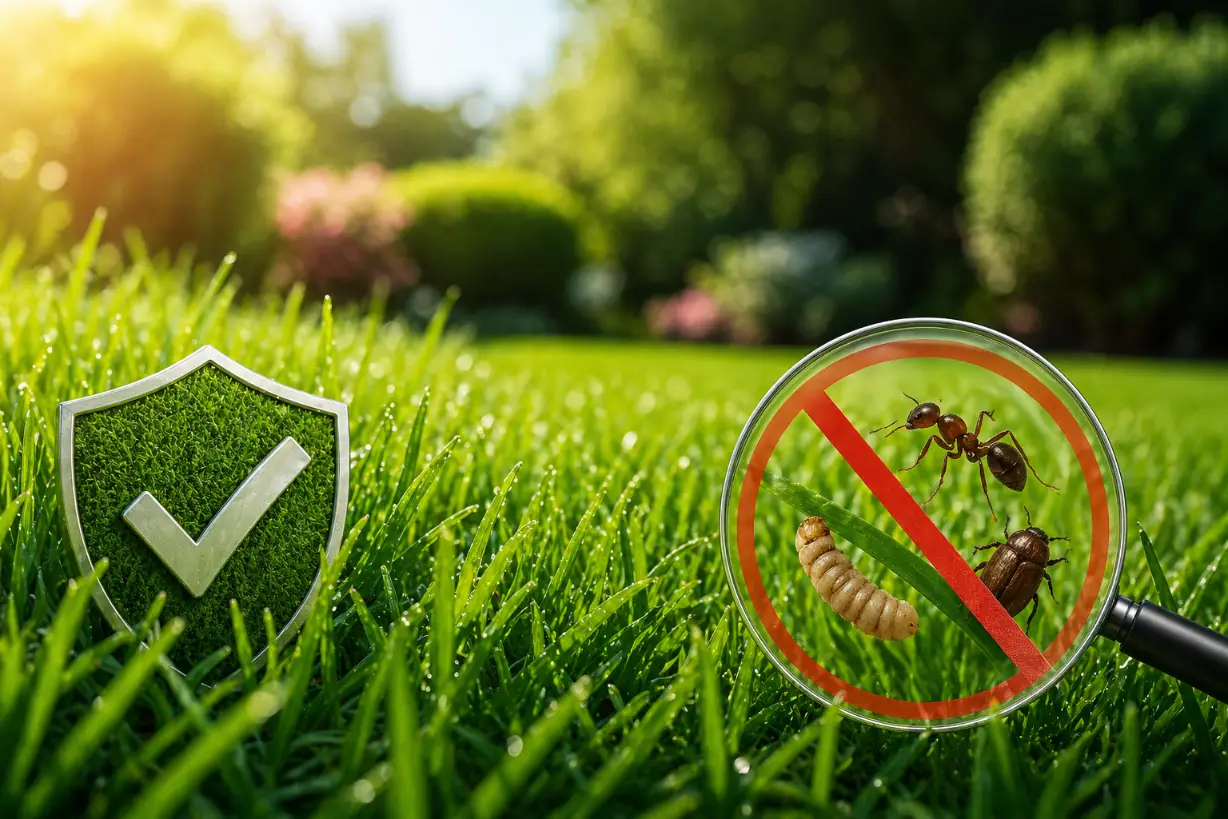
Most homeowners treat lawn care and pest control as two separate to-do list items. Fertilize in spring. Call the exterminator if something goes wrong. But that reactive approach costs more money, more time, and more lawn damage every single season.
The truth is simpler and more powerful: a healthy lawn is its own best defense against pests.
How a Weak Lawn Invites Pests In
Certain everyday mistakes quietly turn your yard into prime pest real estate. Overwatering creates the constantly moist soil that insects thrive in. Mowing too short stresses grass and produces shallow roots. Too much nitrogen fertilizer makes grass look lush on top but weak underneath — easy pickings for surface-feeding insects.
Steve Rice, owner of Lawn Kings and a widely cited turf management expert, puts it plainly: “The biggest cultural mistakes I see homeowners make are overwatering, mowing too short, and pushing too much nitrogen. Those practices create shallow roots and constantly moist soil — which is basically an open invitation for insects and disease.”
Correcting these habits alone, he says, can show visible improvement within two to four weeks.
The Prevention-First Philosophy
The US Environmental Protection Agency (EPA) endorses an approach called Integrated Pest Management (IPM) — a strategy that prioritizes prevention, monitoring, and targeted treatment over routine chemical spraying.
Think of IPM as a pyramid. Healthy lawn practices form the base. Mechanical and biological controls sit in the middle. Chemical treatments are used only as a last resort. This approach protects beneficial insects like ladybugs and ground beetles that naturally keep pest populations in check — while still giving you a clean, green yard.
Common Lawn Pests in the US (And How to Spot Them)
Before you can control a pest, you need to know what you’re dealing with. Here are the most common lawn pest culprits across the United States.
Grubs
Grubs are the white, C-shaped larvae of beetles — most often Japanese beetles or June bugs. They live underground and feed on grass roots, which is why the damage they cause is so severe and often invisible until it’s too late.
Signs of grubs: Dead patches that peel back easily from the soil, increased digging activity from birds, raccoons, or skunks (they’re hunting the grubs), and visible white larvae just below the turf surface.
Peak damage window: Late summer, when larvae are young and actively feeding near the surface.
Chinch Bugs
These tiny insects — barely visible to the naked eye — pierce grass blades and suck out moisture while injecting a toxin that blocks water uptake. The result looks like drought stress, which is why chinch bug damage is frequently misdiagnosed.
Signs of chinch bugs: Yellowing, irregular patches in sunny areas that don’t recover after watering. Most common in warm-season grass regions like the Southeast and Southwest.
Peak season: Summer, particularly during hot and dry conditions.
Sod Webworms and Armyworms
Sod webworms are the larvae of lawn moths. They feed on grass blades at night, leaving behind close-cropped, ragged patches. Armyworms are more aggressive — they move in large groups and can devastate a lawn within days.
Signs: Chewed grass blades close to the soil line, moths flying low over the lawn at dusk, and birds pecking aggressively at the turf.
Peak season: Late summer through early fall. Fall armyworms are a major threat across the Southern US in September and October.
Mole Crickets
Primarily a Southeastern US pest, mole crickets tunnel through soil and feed on grass roots. Their underground activity creates a spongy, uneven turf surface.
Signs: Raised tunnels near the soil surface, spongy feel underfoot, and thinning or dying grass in irregular patterns.
Lawn Care Practices That Naturally Control Pests
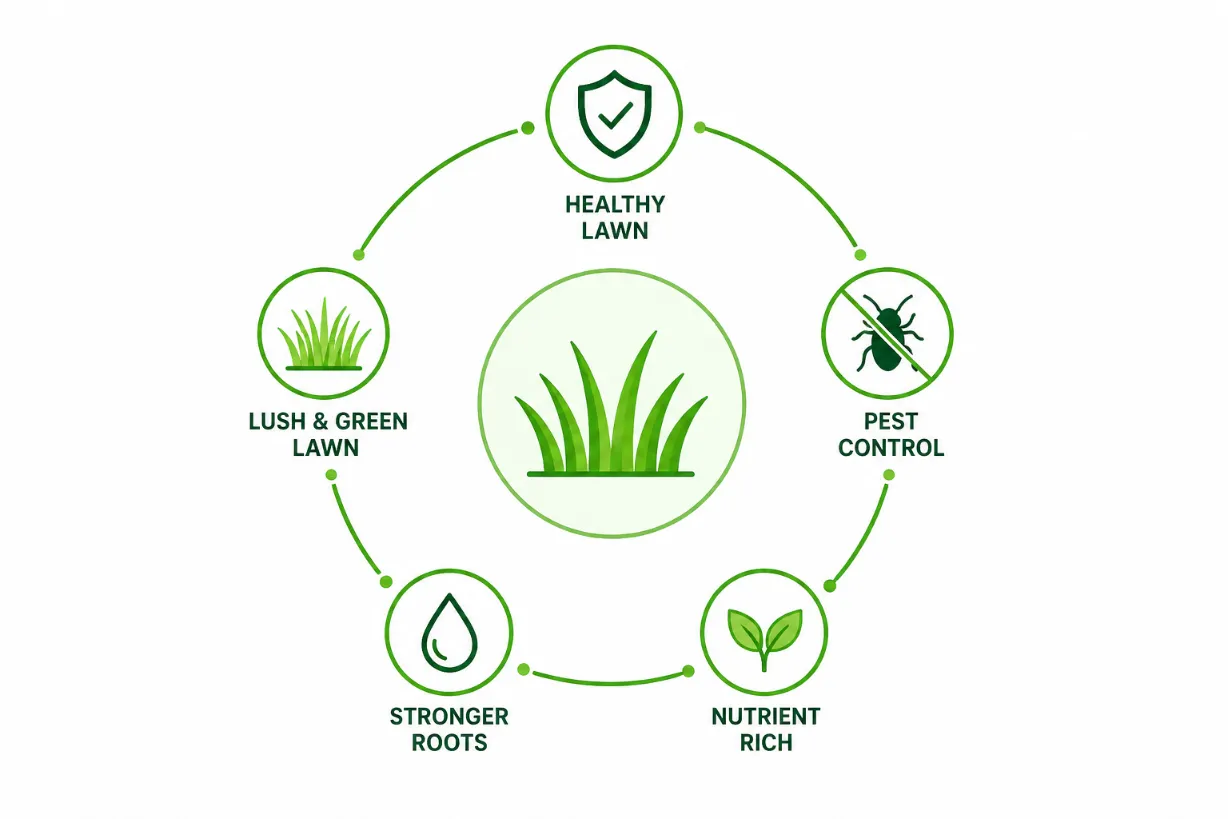
Here’s where most guides stop at “spray this product.” But the most effective pest control strategy you have isn’t in a bottle — it’s in your weekly lawn care routine.
Mowing at the Right Height
Cutting grass too short is one of the most common — and most damaging — mistakes homeowners make. Short grass stresses roots, reduces shade at the soil level, and creates warmer, drier conditions that surface pests love.
Best practice: Maintain cool-season grasses like fescue at 3.5 to 4 inches. Warm-season grasses like Bermuda and Zoysia perform well at 0.75 to 1.5 inches. Never remove more than one-third of the blade in a single mow. Keep blades sharp — dull blades tear grass rather than cut it cleanly, increasing disease vulnerability.
Watering Smart, Not Often
More water is not better. Frequent, shallow watering encourages shallow root systems — the exact conditions that make lawns pest-prone and drought-sensitive.
Best practice: Apply 1 inch of water per week, deeply and infrequently. Water before 10 a.m. so the grass surface dries before nightfall, reducing the fungal disease risk that often accompanies pest damage. Skip watering weeks with significant rainfall.
Fertilizing on a Smart Schedule
Fertilization is essential for a healthy, thick lawn — but timing and balance matter enormously. Too much nitrogen too fast creates rapid, lush top growth with weak roots underneath.
Best practice: Fertilize 4 to 5 times per year — early spring, late spring, late summer, and fall. Use a balanced fertilizer appropriate for your grass type and region. Consult your local Cooperative Extension Service for region-specific recommendations, as grass varieties and nutrient needs vary widely across the US.
Aeration and Dethatching
Thatch — the layer of dead grass and organic matter between the soil and living grass — is one of the most overlooked pest habitats on residential lawns. When thatch exceeds half an inch thick, it creates the perfect moist, sheltered environment for insects to overwinter and multiply.
Best practice: Dethatch annually or as needed. Aerate in spring or fall to loosen compacted soil, allowing water, oxygen, and nutrients to reach roots more effectively. This simple practice can dramatically reduce pest pressure over time.
Seasonal Lawn Care and Pest Control Schedule
Pest activity follows the seasons. So should your response to it. Here’s a practical season-by-season framework.
Spring Pest Control (March – May)
Spring is your most important prevention window. Pests are emerging from dormancy, and the decisions you make now determine how much pest pressure you face all summer.
- Apply pre-emergent herbicide to block weed growth that harbors insects
- Begin preventive fertilization to build root strength
- Inspect for early signs of grub activity and surface pest emergence
- Aerate if soil compaction is an issue
Summer Pest Control (June – August)
Summer is peak season for chinch bugs, grubs, armyworms, and sod webworms. This is the time to monitor closely and act fast.
- Watch for yellowing patches, chewed blades, and increased bird activity
- Treat surface pests like chinch bugs and armyworms as soon as activity is noticed — they move quickly
- Apply grub control treatments in mid-to-late summer when larvae are young and close to the surface
- Maintain mowing height and watering discipline to avoid additional stress
Fall Pest Control (September – November)
Fall armyworms can devastate Southern lawns through October. Grubs that escaped summer treatment are still active in early fall.
- Apply insecticide for fall armyworms immediately if activity is spotted
- Use a winterizing fertilizer to strengthen roots heading into dormancy
- Continue mowing but gradually reduce height as temperatures drop
- Remove leaf piles promptly — they shelter overwintering insects
Winter Lawn Protection (December – February)
Pest activity slows dramatically in winter, but your decisions now set up next spring.
- Minimize foot traffic on dormant grass to prevent compaction
- Clean and maintain lawn equipment before storing
- Eliminate standing water and debris that create overwintering pest habitat
DIY vs. Professional Lawn Care and Pest Control
Not every pest problem requires a professional. But not every problem can be solved with a trip to the hardware store either.
When DIY Works Well
DIY pest control is a solid choice when you’re dealing with small, early-stage infestations or maintaining a preventive routine. Products like granular insecticides for surface pests, beneficial nematodes for grub control, and pre-emergent herbicides are widely available and effective when applied correctly and on time.
The key with DIY: correct identification first. Using the wrong product at the wrong time not only wastes money — it can kill beneficial insects and make the underlying problem worse.
When to Call a Professional
Some situations are simply beyond DIY scope. Consider calling a professional when:
- Damage is widespread or spreading rapidly despite treatment
- You can’t identify the pest with confidence
- The same infestation returns season after season
- You’re dealing with a pest like mole crickets or large-scale grub infestations that require precise timing and targeted products
A good lawn care professional will start with an inspection and identification, build a custom treatment plan for your lawn’s specific conditions, and apply treatments at the right point in the pest’s life cycle — which is often the difference between a treatment that works and one that doesn’t.
Frequently Asked Questions About Lawn Care and Pest Control
What are the most common lawn pests in the United States?
The most widespread US lawn pests include grubs, chinch bugs, sod webworms, armyworms, and mole crickets. The specific pests in your yard depend heavily on your region, grass type, and season. Check with your local Cooperative Extension Service for region-specific pest guides.
How often should I apply pest control treatments to my lawn?
For most lawns, a preventive treatment schedule of two to four applications per year — timed to seasonal pest activity windows — is sufficient. Professional lawn care programs typically apply treatments several times a year to break pest life cycles and maintain protection. Frequency increases for lawns with active or recurring infestations.
Can lawn care practices alone prevent pest infestations?
In many cases, yes — especially for common, lower-severity pest pressure. Proper mowing height, smart watering, balanced fertilization, and thatch management significantly reduce the conditions that attract and sustain pests. However, some pest pressures — particularly in high-risk regions or during peak seasons — will require targeted treatment in addition to good lawn care habits.
What is Integrated Pest Management (IPM) for lawn care?
IPM is an EPA-endorsed pest management approach that prioritizes prevention, monitoring, and using the least-toxic effective treatment available. It combines cultural practices (mowing, watering, fertilizing), mechanical controls (dethatching, barriers), biological controls (beneficial insects, nematodes), and chemical treatments only as a last resort. It’s both more environmentally responsible and more effective long-term than routine chemical spraying.
Is lawn pest control safe for kids and pets?
Safety depends on the product and application. Many modern lawn pest treatments are safe once dry or after a waiting period stated on the label. Organic and biological options like beneficial nematodes pose no risk to children or pets. Always read product labels carefully, follow re-entry intervals, and inform your lawn care provider if you have children or pets so they can select appropriate products.
Conclusion
Here’s what it comes down to:
- Healthy lawn practices are your first line of pest defense — mowing height, watering frequency, fertilization balance, and thatch removal matter more than most homeowners realize
- Know your pests — grubs, chinch bugs, armyworms, and mole crickets all show different signs and require different responses
- Follow the seasons — spring prevention, summer monitoring, fall treatment, and winter preparation create a complete year-round defense system
- Use the IPM framework — prevention first, chemical treatments as a last resort
- Know when to call a pro — widespread, recurring, or unidentified infestations deserve professional attention
Start by auditing your current lawn care routine against the practices in this guide. Small adjustments — raising your mowing height, watering less frequently, dethatching once a year — can reduce pest pressure dramatically before you ever open a can of insecticide.
Ready to take it further? Consult your local Cooperative Extension Service for a region-specific lawn and pest management plan tailored to your grass type and climate.
About the Author
Khalid Fazal is a seasoned lawn care specialist and horticultural researcher with over 15 years of hands-on experience transforming challenging landscapes into lush, resilient green spaces. His journey didn’t start in a lab, but in a backyard full of stubborn, cracked clay that “experts” said would never grow a healthy blade of grass. Refusing to accept a yard full of dust, Khalid spent years experimenting with organic soil restoration and precise mulching—eventually turning that wasteland into a neighborhood showpiece on a shoestring budget.
From mastering core aeration techniques to optimizing soil pH for specialized turf varieties, Khalid’s approach combines old-school grit with modern agronomic science. He founded Gen Lawn to provide homeowners with honest, research-backed advice that prioritizes long-term soil health over quick-fix chemical solutions. When he isn’t analyzing soil profiles, he’s developing precision tools to help others achieve professional results without the professional price tag.
References & Sources
- US EPA — Lawn and Garden Pest Management
- Lawn Love — Integrated Pest Management for the Lawn
- ExperiGreen — How Lawn Pest Control Works
- Angler Lawn & Landscape — How Often Should You Schedule Lawn Pest Control
- USDA Cooperative Extension Service (link to your state-specific resource)

Lawn Winterizer: When to Apply by Grass & Region [2026]
Table of Contents Home / By Khalid Fazal | Updated:...
Read More
Spring Lawn Care: What to Do and When in Every US Region
Table of Contents Home / By Khalid Fazal | Updated:...
Read More
Lawn Maintenance Checklist by Season and Grass Type (2026)
Table of Contents Home / By Khalid Fazal | Updated:...
Read More
Liquid Fertilizer vs Granular Fertilizer: Which Wins?
Table of Contents Home / By Khalid Fazal | Updated:...
Read More