You walk outside with your morning coffee, glance down at the lawn — and stop.
There they are. Dozens of tiny white flowers scattered across your grass like someone tossed confetti overnight. Some clustered in little pom-poms. Others forming a creeping mat you somehow didn’t notice until now.
Here’s the thing: this happens to millions of US homeowners every spring. And the good news? Once you know what you’re looking at, you’ll know exactly whether to pull it, treat it, or — in some cases — leave it completely alone.
This guide covers the seven most common small white flowers found on US lawns, why they keep showing up, and your clearest path forward.
The 60-Second Identification Shortcut for Small White Flowers on Your Lawn
Before scrolling through a species list, answer these three quick questions. They’ll narrow it down fast.
Question 1: Do the leaves come in groups of three, like a clover shape? → You’re almost certainly looking at White Clover.
Question 2: Is the plant spreading in a flat, dense mat close to the ground — almost like a carpet? → That’s likely Chickweed (common or mouse-ear variety).
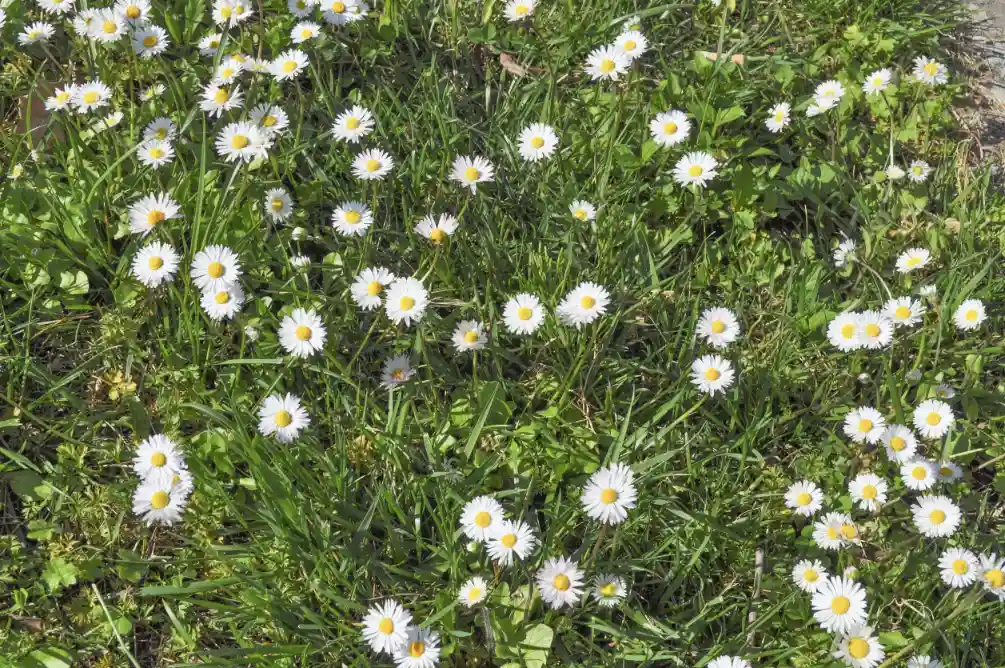
Question 3: Does the white flower have a bright yellow center? → You’ve got either a Common Daisy or Mayweed.
Still not sure? The full breakdown is right below.
The 7 Most Common Small White Flowers Found on US Lawns
1. White Clover (Trifolium repens)
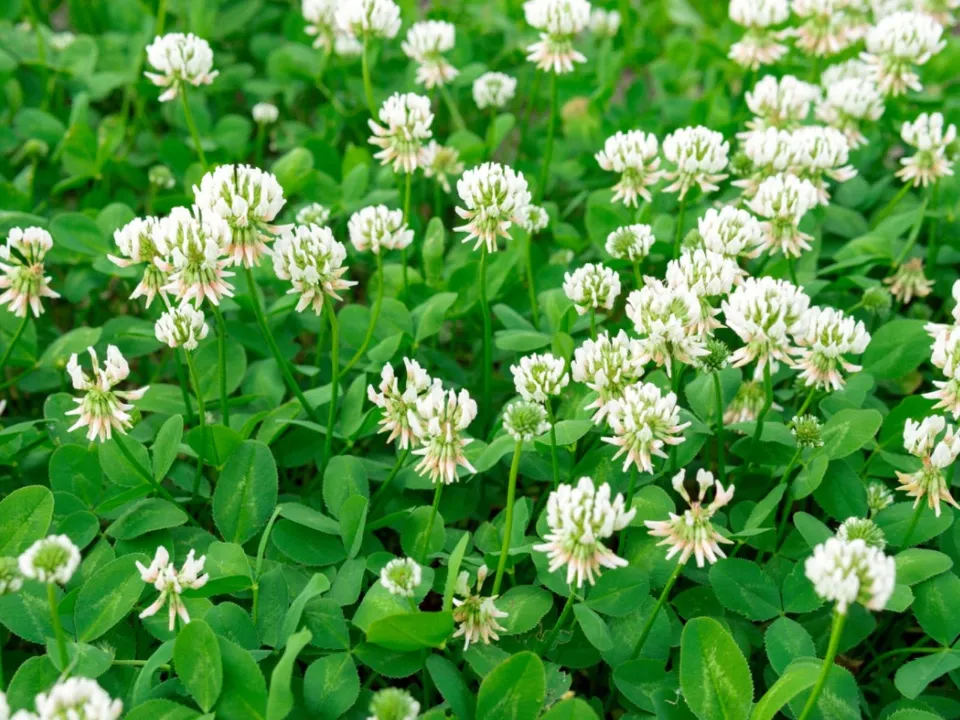
White clover is the most frequent culprit. It’s a low-growing perennial weed that spreads through creeping stems called stolons — underground runners that root themselves into the soil as they travel.
Here’s what to look for:
- Leaves: Three rounded leaflets, usually with a pale chevron or crescent marking in the center
- Flowers: Round, globe-shaped white or pinkish-white clusters on long stems
- Height: Typically stays 2–4 inches tall in a mowed lawn
- Season: Most active from late spring through early autumn
Why does it appear? White clover thrives specifically in nitrogen-deficient soil. If it’s concentrated in one area, that patch almost certainly needs fertilizing.
2. Common Chickweed (Stellaria media)
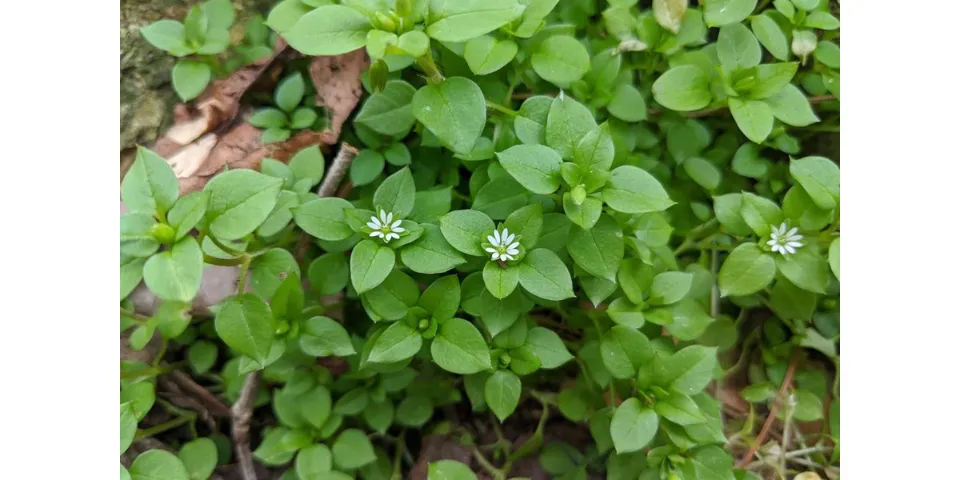
Chickweed is considered a moderately invasive annual weed across much of the US. It’s a cool-season plant — hitting hardest in spring and fall when temperatures are mild.
Look for:
- Leaves: Small, oval, bright green, ending in a slight point
- Flowers: Tiny star-shaped white blooms; each has five petals so deeply notched they look like ten
- Growth habit: Low, spreading mat that hugs the ground
- Spread: Each plant releases thousands of seeds before dying
The tricky part? Chickweed often goes unnoticed until it’s already blanketed a thin or shaded patch of your lawn. Early action makes a real difference here.
3. Mouse-Ear Chickweed (Cerastium fontanum)
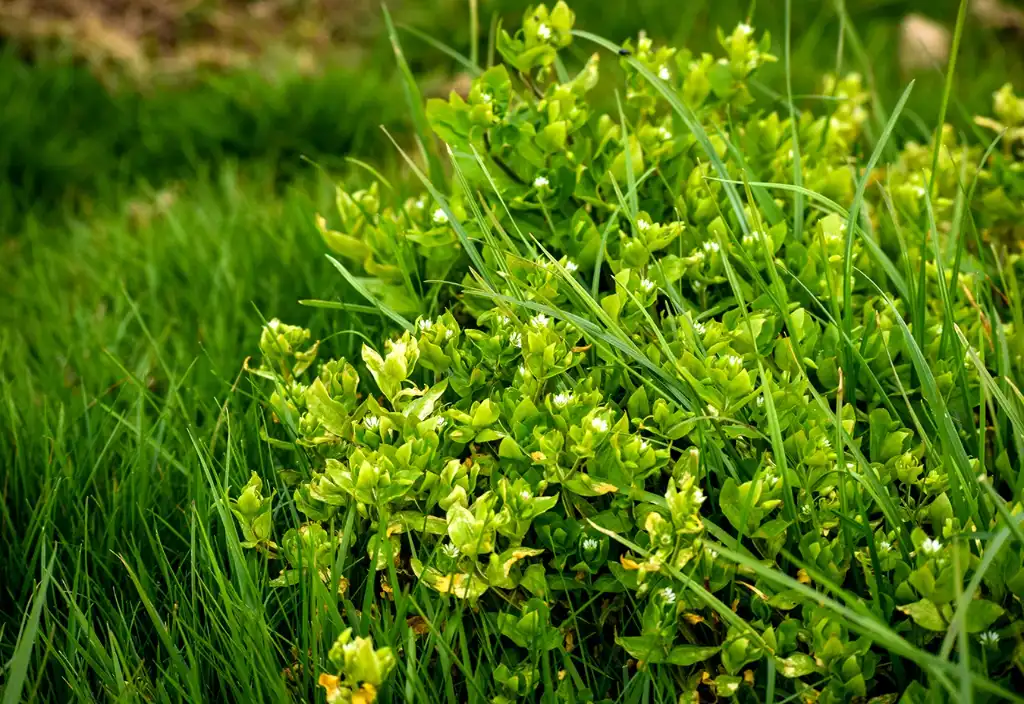
Not the same as common chickweed — though they’re often confused.
Mouse-ear chickweed gets its name from its small, oval, dark green leaves covered in fine white hairs (like a mouse’s ears). It forms an even denser, lower mat than common chickweed — and unlike its relative, it can tolerate very close mowing, which is what makes it so stubborn on well-kept lawns.
It flowers from April right through November, giving it one of the longest active seasons of any white-flowering lawn weed in the US. It spreads both by seed and through rooting nodes on its stems. You can cross-reference your sighting with the USDA PLANTS Database for visual confirmation.
4. Hairy Bittercress (Cardamine hirsuta)
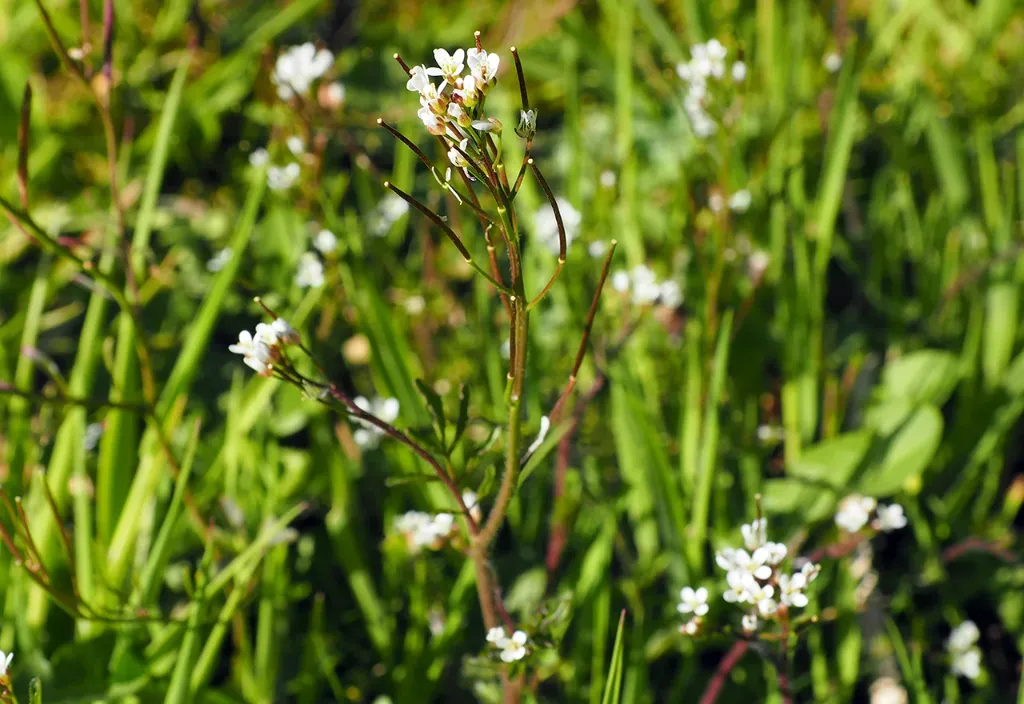
This one surprises most homeowners — because it seems to appear overnight. That’s because, in a way, it does.
Hairy bittercress grows a flat basal rosette of small rounded leaves at ground level, then sends up upright stems with tiny four-petaled white flowers. Once those seed pods form, they’re spring-loaded. Touch them, mow over them, or even brush past them — and they explode, scattering seeds up to three feet away.
That’s how it spreads so fast across a lawn without warning.
The silver lining? It’s actually edible. Hairy bittercress is in the same family as watercress and has a peppery flavor, making it a legitimate garnish or salad green if you’d rather use it than trash it.
5. Pearlwort (Sagina procumbens)
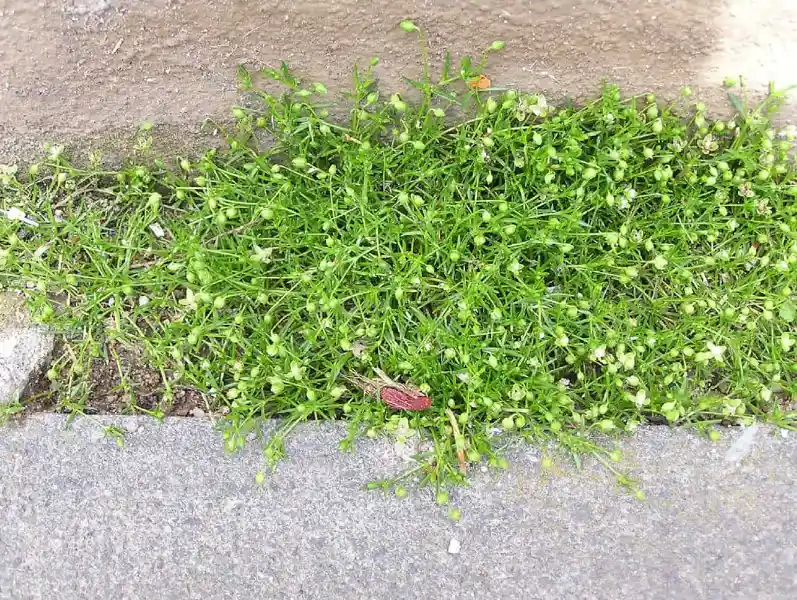
Pearlwort is easy to misidentify because it looks like moss. It forms dense, thread-like mats of fine green stems at ground level, with tiny white flowers appearing at the tips of each branch — so small they’re nearly invisible at a glance.
It thrives in compacted, moist soil and shows up most in shaded, damp areas of your lawn where grass is already struggling. If you’re seeing a low green film in a wet, poorly-drained spot — check for pearlwort before assuming it’s moss.
The bigger problem: it spreads by seed and mowing actively disperses those seeds across the lawn. Once established in good conditions, it’s difficult to fully eradicate without also addressing the drainage and compaction issues underneath.
6. Common Daisy (Bellis perennis)
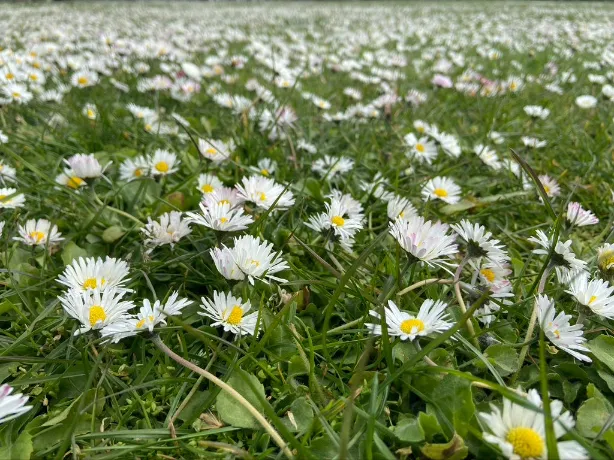
Common daisies are a bit different from the others on this list — many homeowners don’t actually mind them.
They’re the classic white-petals-yellow-center flower, spreading through both seeds and underground rhizomes. They tend to appear in cooler US climates, particularly in the Pacific Northwest, and in lawns that aren’t mowed frequently enough.
Here’s the honest take: if you have a few daisies that aren’t spreading aggressively, doing nothing is a legitimate option. They attract pollinators and add a natural look to a lawn. But if they’re taking over, consistent mowing at the correct height usually keeps them in check without any chemicals needed.
7. Mayweed / Stinking Chamomile (Anthemis cotula)
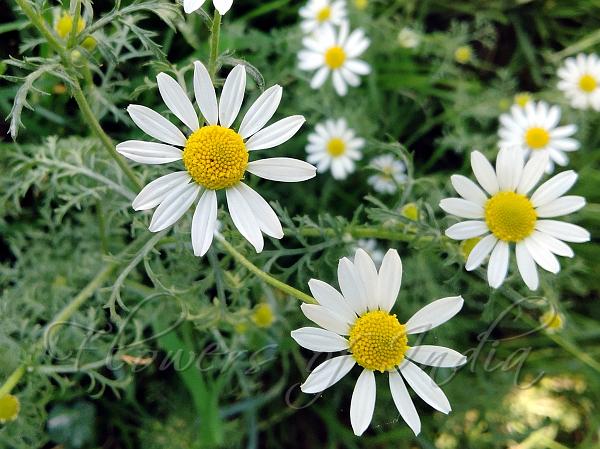
Mayweed fools a lot of people because its white-petaled, yellow-centered flowers look like chamomile or daisies. The difference is in the leaves (fern-like and feathery, not rounded) and the smell. Crush a leaf between your fingers and you’ll know immediately — it has a sharp, unpleasant odor.
It’s classified as a noxious weed in several US states due to how aggressively it spreads by seed. Left unmowed, it can grow 12–24 inches tall and dominate bare patches of lawn quickly.
Unlike daisies, mayweed is one you want to remove before it sets seed. Don’t wait on this one.
Why Do Small White Flowers Keep Appearing on Your Lawn?
You pulled them last season. They’re back. This is the part most guides skip — and it’s actually the most useful thing you can know.
White-flowering weeds don’t appear randomly. They appear because your lawn has created an opening for them.
- Thin or bare grass patches are the #1 entry point. Dense, healthy grass physically leaves no room for weed seeds to germinate.
- Low nitrogen levels specifically invite white clover. Clover fixes its own nitrogen through a biological process called nitrogen fixation — which gives it a competitive advantage in nutrient-poor soil.
- Compacted or waterlogged soil creates ideal conditions for pearlwort and chickweed, both of which thrive where grass struggles.
- Scalping — mowing your lawn too short — stresses grass, thins the turf, and opens gaps that weeds fill almost immediately. Learn more about correct mowing heights by grass type.
Bottom line: if the white flowers keep returning season after season, the lawn itself is the problem — not just the weeds.
Should You Remove Small White Flowers From Your Lawn — or Keep Them?
This is where it gets interesting. Not every small white flower is a problem that needs fixing.
Reasons to Remove Them
- Aggressive spreading. Chickweed, mayweed, and hairy bittercress can overtake large sections of lawn quickly if ignored.
- Bee attraction and family safety. White clover is a major draw for bees. If children or pets play barefoot on the lawn, this is a real consideration worth addressing.
- HOA compliance. Many US homeowners’ associations classify clover and daisy growth as a lawn appearance violation — worth checking your rules before you decide.
- Competing with grass. Dense mats of chickweed or pearlwort smother grass in already-thin areas, making the problem self-reinforcing.
Reasons to Keep Them (The Eco-Lawn Case)
Here’s something that doesn’t get enough attention: there’s a growing movement in the US toward intentional clover lawns — and for good reason.
White clover naturally adds nitrogen to the soil, reducing your fertilizer needs. It stays green through summer droughts when traditional grass browns out. It requires less mowing. And it provides critical support for pollinators — bees, butterflies, and other beneficial insects.
The American Bee Conservancy has highlighted clover lawns as one of the most impactful things a homeowner can do for local pollinator health. That’s not a fringe view anymore — it’s becoming mainstream lawn care thinking.
If you’re eco-conscious, or just tired of fighting clover every single season, embracing it as part of your lawn might genuinely be worth exploring.
How to Get Rid of Small White Flowers on Your Lawn
Decided removal is the right call? Here are the three most effective approaches.
Hand Removal (Best for Small Patches)
For isolated areas, pulling by hand is still the most reliable method — especially for chickweed and hairy bittercress, which have relatively shallow root systems.
A few rules to follow:
- Pull after rain when the soil is loose. Roots come out cleanly instead of snapping off.
- Act early — before the plants flower and set seed. With hairy bittercress especially, speed matters.
- Don’t compost pulled weeds. Bag them and put them in the trash. Compost piles don’t reliably reach temperatures high enough to kill weed seeds.
A quality hand weeder tool makes the job significantly easier, particularly for weeds with rooting nodes along their stems like chickweed.
Selective Broadleaf Herbicides (For Larger Infestations)
When the infestation is widespread, a selective broadleaf herbicide is your most efficient option. The key word is selective — these products are formulated to target broadleaf plants without harming your grass.
Look for active ingredients like:
- 2,4-D — effective on clover, daisy, and mayweed
- Dicamba — broad coverage for most broadleaf weeds
- MCPP (Mecoprop) — specifically effective on chickweed
Many products combine two or three of these, often labeled as “3-way” or “4-way” lawn herbicides. Always follow EPA label instructions precisely and verify the product is safe for your specific grass type before applying. Timing matters too — spring and fall applications, when weeds are actively growing, deliver the best results.
Prevention Through Lawn Health (The Long-Term Fix)
This is the step most people skip. It’s also the most important.
- Mow at the right height. Aim for 2.5–3 inches for most US lawn grass types. Taller grass shades the soil and blocks weed seed germination naturally.
- Fertilize on a schedule. A proper lawn fertilization plan keeps nitrogen levels up — which directly suppresses white clover.
- Overseed bare patches. Bare soil is an open invitation. Fill thin spots with grass seed matched to your climate region.
- Aerate annually. Core aeration relieves compaction, improves drainage, and creates growing conditions that favor grass over weeds. It’s especially important if pearlwort or chickweed keeps returning to the same damp spots.
Frequently Asked Questions About Small White Flowers on Lawns
What are the tiny white flowers spreading across my lawn?
The most likely culprits are white clover, common chickweed, or mouse-ear chickweed — all extremely common across the US. Use the 60-second shortcut at the top of this guide to narrow it down fast. If you still can’t identify it, the USDA PLANTS Database has a full visual library organized by region.
Are small white lawn flowers safe for dogs and kids?
Most species — including white clover, chickweed, and daisies — are non-toxic to pets and children. That said, white clover strongly attracts bees, which poses a stinging risk for barefoot play. Mayweed can also cause mild skin irritation on contact. Always verify with the ASPCA Toxic Plants Database if you’re unsure about a specific species.
Will white clover spread and kill my grass?
Clover competes with grass for space, but it doesn’t kill it outright. In nitrogen-poor areas, it can outperform thin grass — but in a healthy, well-fertilized lawn, dense grass will naturally suppress it. Some homeowners now intentionally mix clover into their lawns for its soil-building benefits, which is a growing trend worth considering.
What kills small white flowers without harming my grass?
Selective broadleaf herbicides containing 2,4-D, dicamba, or MCPP are specifically designed to eliminate broadleaf weeds while leaving grass unharmed. Always check that the product label confirms compatibility with your specific grass type before applying.
Is it okay to just mow over the white flowers?
Mowing can slow some species, but it won’t eliminate them. Mouse-ear chickweed tolerates very close mowing entirely. For hairy bittercress, mowing is actually counterproductive — the mower blades can trigger the explosive seed pods and spread them further across your lawn. Hand removal or targeted herbicide is significantly more reliable than mowing alone.
Conclusion
Small white flowers on your lawn aren’t always a crisis — but they’re always a signal.
Whether it’s white clover pointing to a nitrogen problem, chickweed filling a bare patch, or pearlwort flagging compacted, waterlogged soil — these plants are telling you something about what’s happening beneath the surface of your lawn.
Here’s the quick version:
- Identify first using the leaf shape, flower structure, and growth habit
- Diagnose why — thin grass, low nitrogen, compaction, or drainage issues
- Decide intentionally — remove, treat, or embrace (especially if it’s clover)
- Prevent long-term by building a healthier, denser lawn that doesn’t give weeds room to establish
The goal isn’t just a weed-free lawn this season. It’s a lawn that’s strong enough to stop weeds from taking hold in the first place.
Still unsure what’s growing in your yard? Drop a photo in the comments or reach out to a local lawn care professional — sometimes the fastest answer comes from someone who can see it in person.
References & Sources
- USDA PLANTS Database — Species identification and US distribution maps
- Michigan State University Extension — Spring weed identification and management
- EPA Pesticide Guidelines — Safe herbicide use and label compliance
- University of Minnesota Extension — Lawn Nitrogen — Fertilization and nitrogen management
- Penn State Extension — Core Aeration — Lawn aeration and health practices
- ASPCA Toxic Plants Database — Pet and child safety reference
- American Bee Journal — Clover Lawns — Pollinator health and eco-lawn benefits
- Gardening Know How — White Clover Control — Clover removal strategies
- NRCS — Nitrogen Cycle — Nitrogen fixation explained
- Invasive Species Info — Noxious Weeds — US noxious weed classifications
About Author
Khalid Fazal is a seasoned lawn care specialist and horticultural researcher with over 15 years of hands-on experience transforming challenging landscapes into lush, resilient green spaces. His journey didn’t start in a lab, but in a backyard full of stubborn, cracked clay that “experts” said would never grow a healthy blade of grass. Refusing to accept a yard full of dust, Khalid spent years experimenting with organic soil restoration and precise mulching—eventually turning that wasteland into a neighborhood showpiece on a shoestring budget.
From mastering core aeration techniques to optimizing soil pH for specialized turf varieties, Khalid’s approach combines old-school grit with modern agronomic science. He founded Gen Lawn to provide homeowners with honest, research-backed advice that prioritizes long-term soil health over quick-fix chemical solutions. When he isn’t analyzing soil profiles, he’s developing precision tools to help others achieve professional results without the professional price tag.

Lawn Winterizer: When to Apply by Grass & Region [2026]
Table of Contents Home / By Khalid Fazal | Updated:...
Read More
Spring Lawn Care: What to Do and When in Every US Region
Table of Contents Home / By Khalid Fazal | Updated:...
Read More
Lawn Maintenance Checklist by Season and Grass Type (2026)
Table of Contents Home / By Khalid Fazal | Updated:...
Read More
Liquid Fertilizer vs Granular Fertilizer: Which Wins?
Table of Contents Home / By Khalid Fazal | Updated:...
Read More