
How to Water Your Lawn by Hand the Right Way (Most People Get This Wrong)
You’ve got a hose in your hand, a lawn that’s looking tired, and no idea if you’re actually helping — or making things worse.
Sound familiar? Most US homeowners assume that watering a lawn by hand is simple. Just point and spray, right? But here’s the problem: incorrect hand watering is one of the top reasons lawns develop brown patches, shallow roots, and stubborn fungal issues — even when owners are watering consistently.
The good news? It doesn’t have to be that way. Whether you’re skipping an irrigation system to save money, managing a small yard, or just prefer the hands-on approach, watering your lawn by hand can be just as effective as any sprinkler — if you do it correctly.
This guide covers everything: when to water, how long to water, the right technique, and the most common mistakes costing you a healthy lawn. Let’s get into it.
3 Signs Your Lawn Needs Water Before You Pick Up the Hose
Don’t water on autopilot. Your lawn signals thirst long before it turns brown — you just need to know what to look for.
The Footprint Test
Walk across your lawn. If your footprints remain visible for more than 30 seconds, the grass blades don’t have enough moisture to spring back up. That’s your cue to water — today, not tomorrow.
Blue-Grey Colouring — Your Lawn’s SOS Signal
Healthy grass is vivid green. When it starts to shift toward a blue-grey or silvery tint, that’s drought stress setting in at a cellular level. Don’t wait for yellow — act at the first sign of colour change.
Blade Curl
Grass blades curl inward along their edges to reduce surface area and slow moisture loss — it’s a survival mechanism. If you notice flat blades beginning to roll or wilt, your lawn is telling you it’s thirsty.
The Best Time to Water Your Lawn by Hand
Timing is not just a preference. It directly determines how much of your water actually reaches the roots versus how much disappears into the air.
The 6–10 AM Window — Why Morning Is Non-Negotiable
The best time to water your lawn by hand is early morning, between 6 AM and 10 AM. Temperatures are cooler, winds are calmer, and your grass has the entire day to dry before nightfall. This combination dramatically reduces the risk of fungal lawn diseases, which thrive when grass stays wet overnight.
Here’s the thing: watering during peak midday heat can cause up to 30% of your applied water to evaporate before it even penetrates the soil. That’s nearly a third of your effort — and your water bill — gone before the roots get a single drop.
Evening Watering — When You Have No Choice
Life happens. If mornings don’t work, water in the late afternoon, no later than 4 PM. This gives the grass blades a few hours to dry before dark. Avoid watering at night — grass that stays wet for 8+ hours overnight creates ideal conditions for fungal infection, pests, and root disease.
Never Water at Midday
This is the single worst time to water. Evaporation is highest, soil absorption is slowest, and you’ll waste a significant portion of the water you apply. If you’ve been doing this, stop immediately.
How to Water Your Lawn by Hand — Step-by-Step
Here’s where most people go wrong: they grab the hose and spray randomly. Effective hand watering of a lawn is a repeatable system — not a spray-and-hope routine.
The Right Equipment
You don’t need expensive gear — but what you use matters:
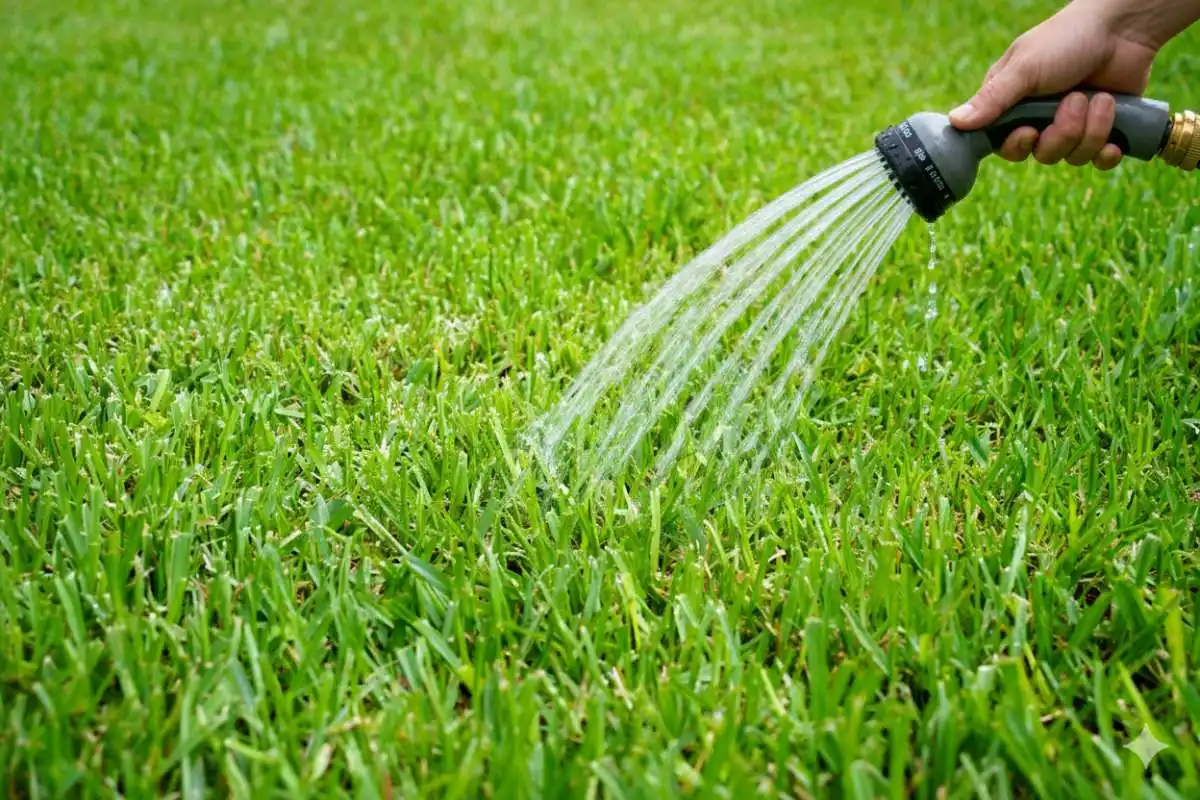
- Adjustable spray nozzle: Always use a fan or mist setting — never a jet stream. A jet stream compacts soil, erodes the surface, and damages grass blades. Look for one with a shut-off valve so water only flows when you need it.
- Garden hose: A standard ⅝-inch garden hose delivers around 5–7 gallons per minute (GPM) at typical home water pressure. That’s your baseline for all time calculations below. (Not sure of your hose’s actual flow rate? Use this free hose flow rate calculator.)
- Tuna can: Place an empty tuna can on your lawn while watering. When it holds an inch of water, you’ve hit your depth target for that section. No fancy tool required.
- Screwdriver: Used for a post-watering soil depth check — explained below.
How Much Water Does Your Lawn Actually Need?
The standard recommendation for most US lawns is 1 to 1.5 inches of water per week. But what does that actually mean in practice?
1 inch of water = 623 gallons per 1,000 square feet.
(Source: University of Missouri Extension — Lawn and Garden Care)
The critical rule: split that across 2–3 sessions per week, not one long daily watering. Deep, infrequent watering forces roots to grow downward in search of moisture — building drought-resistant, resilient grass. Daily shallow watering keeps roots near the surface, making your lawn fragile and entirely dependent on you.
Your grass type matters:
- Warm-season grasses (Bermuda, Zoysia, St. Augustine, Centipede): More heat-tolerant and can go longer between waterings. Need more frequent watering during summer peak, but can handle short dry spells.
- Cool-season grasses (Kentucky Bluegrass, Tall Fescue, Perennial Ryegrass): Actively grow in spring and fall — they may go partially dormant in summer and actually need less water during that period.
Applying the same schedule to both grass families is one of the most common hand-watering errors in the US.
The Right Technique for Watering Lawn by Hand
Follow this process every session:
- Start slow. Open the nozzle to a gentle fan spray to avoid disturbing topsoil or washing away grass seed.
- Sweep — don’t soak. Move the nozzle in overlapping arcs across the section. Never hold the spray on one spot for more than 7–14 seconds — that saturates one area while the rest stays dry.
- Watch for runoff. The moment water starts puddling on the surface or running off the edge, stop. Let it absorb for 10–15 minutes, then resume. Runoff means your soil has hit its absorption capacity — you’re no longer watering the lawn, just the sidewalk.
- Target the soil, not the blades. Water hitting the grass blades mostly evaporates. Aim the spray low, toward the base of the grass.
The Zone Method for Bigger Lawns
If your lawn is larger than 500 square feet, watering the whole area in one go is inefficient and exhausting. Instead, divide it into 4–6 manageable zones.
Water one zone per session, rotating through them across the week. This gives each section proper depth, prevents oversaturation, and makes hand watering a genuinely sustainable routine rather than an hour-long chore.
How Long Should You Actually Hand Water Your Lawn?
This is the question most guides avoid — they give you the theory but not the numbers. Here’s a practical reference based on a standard hose at 5 GPM:
| Lawn Size | Water Needed (1 inch) | Weekly Time at 5 GPM | Sessions Per Week |
|---|---|---|---|
| 250 sq ft | ~156 gallons | ~31 minutes | 2 (15 min each) |
| 500 sq ft | ~312 gallons | ~62 minutes | 2 (30 min each) |
| 1,000 sq ft | ~623 gallons | ~124 minutes | 3 (~41 min each) |
| 1,500 sq ft | ~935 gallons | ~187 minutes | 3 (~62 min each) |
Your actual time will vary based on hose diameter, water pressure, and nozzle setting. These figures are estimates based on a ⅝-inch hose at standard US residential pressure (40–60 PSI). Check your hose specs or test your own flow rate for precision.
The Screwdriver Test — The Best Stop Signal You’re Not Using
After each watering session, push a standard flathead screwdriver straight into the soil. If it slides in to 6–8 inches with minimal resistance, you’ve watered to the right depth — roots will follow. If it stops at 2–3 inches, the water hasn’t penetrated far enough. Water more.
This method, recommended by the University of Arizona Cooperative Extension, is more reliable than any timer and takes five seconds to run.
Common Mistakes When Watering Your Lawn by Hand
Watering Every Day
Daily watering is the number one enemy of strong grass roots. Roots grow where water exists. If moisture only ever reaches the top inch of soil, roots stay there — shallow, fragile, and vulnerable to any dry spell. Force them deeper by watering less often but more thoroughly. For more on root depth and lawn health, see this resource from Penn State Extension.
Using a Jet Spray Instead of Fan/Mist
A jet stream feels powerful but compacts soil, strips away topsoil, and physically damages grass blades. Always use a fan or mist setting on your adjustable nozzle.
Ignoring Your Grass Type
Warm-season and cool-season grasses have meaningfully different watering schedules. Applying a one-size-fits-all routine to both is why many homeowners never see the results they want. Find your grass type here before setting any schedule.
Forgetting That Rainfall Counts
If your region received half an inch of rain this week, you only need to manually supply another half inch. Use a simple rain gauge — or your tuna can left outside — to track what nature already provided. Don’t double up and overwater.
Not Aerating Compacted Soil
If your lawn has compacted soil, even perfect hand watering technique won’t help much — water will run off rather than penetrating. An annual aeration solves this and makes every watering session more effective.
Frequently Asked Questions About Watering Lawn by Hand
How long should I hand water my lawn each session?
For most lawns, each session should run 30–45 minutes per 500 sq ft using a standard 5 GPM hose. Aim for 2–3 sessions per week rather than one long daily run. Refer to the table above for your specific lawn size.
How do I know if I’ve watered my lawn enough by hand?
Use the screwdriver test after each session. If a screwdriver pushes 6–8 inches into the soil with light pressure, you’ve achieved the right depth. For a more precise reading, a soil moisture meter is an inexpensive tool worth having.
Is watering your lawn by hand as effective as a sprinkler?
For lawns under 500 sq ft, yes — absolutely. Hand watering gives you more precision and eliminates the waste common with automatic systems. For larger lawns, a soaker hose or oscillating sprinkler can deliver similar results with less time investment.
How often should I water my lawn by hand in summer?
In peak summer heat, increase to 3 sessions per week for warm-season grasses. Cool-season grasses may enter dormancy — reduce watering during this period and let them rest. Never water at midday regardless of season.
Can you overwater a lawn by hand?
Yes — and it’s more common than underwatering. Overwatered lawns develop root rot, fungal disease, and waterlogged soil that suffocates roots. If you’re seeing yellow patches, a spongy underfoot feeling, or persistent puddles after watering — you’re overdoing it.
Key Takeaways
- Watch before you water — footprints, blade curl, and blue-grey tint are your early warning signals
- 6–10 AM is the optimal watering window — never midday, never night
- 1–1.5 inches per week, split into 2–3 deep sessions
- Sweep, don’t soak — no more than 7–14 seconds in one spot
- The screwdriver test is the most reliable way to know when you’ve watered enough
- Know your grass type — warm-season and cool-season lawns need different schedules
- Rainfall counts — track it and adjust manually
Hand watering your lawn doesn’t have to be guesswork. Follow this system, stay consistent, and your lawn will show you the difference within a few weeks.
References
- FreshWaterSystems.com — A Guide to Watering Your Lawn
- Regional Water Providers Consortium — Watering by Hand
- Garden Style San Antonio — Hand Watering Tips
- University of Missouri Extension — Lawn and Garden Care (G6705)
- EPA WaterSense — Watering Your Lawn and Garden
- DIY Lawn Expert — How to Water Your Lawn
- The Lawn Institute — Grass Types
- University of Arizona Cooperative Extension — Water Use in the Landscape
- Pennington — Signs of Overwatering a Lawn
- Missouri Botanical Garden — Fungal Lawn Diseases
About Author
Khalid Fazal is a seasoned lawn care specialist and horticultural researcher with over 15 years of hands-on experience transforming challenging landscapes into lush, resilient green spaces. His journey didn’t start in a lab, but in a backyard full of stubborn, cracked clay that “experts” said would never grow a healthy blade of grass. Refusing to accept a yard full of dust, Khalid spent years experimenting with organic soil restoration and precise mulching—eventually turning that wasteland into a neighborhood showpiece on a shoestring budget.
From mastering core aeration techniques to optimizing soil pH for specialized turf varieties, Khalid’s approach combines old-school grit with modern agronomic science. He founded Gen Lawn to provide homeowners with honest, research-backed advice that prioritizes long-term soil health over quick-fix chemical solutions. When he isn’t analyzing soil profiles, he’s developing precision tools to help others achieve professional results without the professional price tag.

Lawn Winterizer: When to Apply by Grass & Region [2026]
Table of Contents Home / By Khalid Fazal | Updated:...
Read More
Spring Lawn Care: What to Do and When in Every US Region
Table of Contents Home / By Khalid Fazal | Updated:...
Read More
Lawn Maintenance Checklist by Season and Grass Type (2026)
Table of Contents Home / By Khalid Fazal | Updated:...
Read More
Liquid Fertilizer vs Granular Fertilizer: Which Wins?
Table of Contents Home / By Khalid Fazal | Updated:...
Read More