
You step off your lawn and look down — your shoes are orange.
Or maybe your grass has that weird, dusty, yellowish glow in patches. Either way, something’s off — and your first instinct is to worry.
Here’s the good news: what you’re seeing is likely rust on lawn grass, one of the most common and most fixable lawn diseases out there. With the right steps, most lawns bounce back in 2–3 weeks.
This guide covers everything you need — how to identify it, what’s causing it, how to treat it step by step, and how to make sure it doesn’t come back.
Let’s get into it.
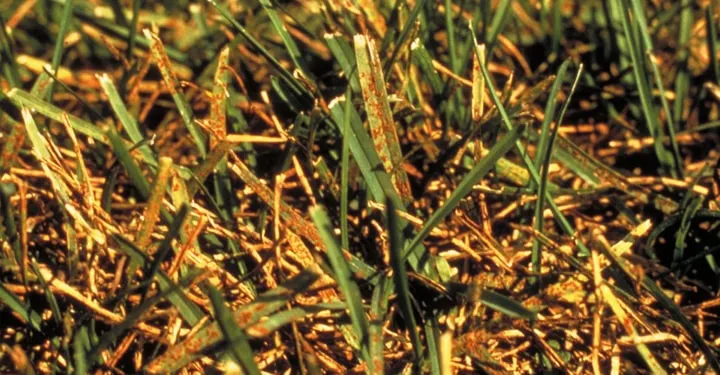
What Does Rust on Lawn Grass Look Like?
Rust on lawn grass doesn’t announce itself all at once. It builds gradually, so knowing what to look for at each stage helps you catch it early — before it spreads.
Early Signs vs. Advanced Infection
In the early stage, small yellow or orange flecks appear on individual grass blades. They look almost like tiny freckles running parallel to the veins of the leaf. The grass might look a little pale or off-color from a distance, and it’s easy to mistake this for drought stress.
As the disease moves into the middle stage, those flecks grow into raised, orange-to-brown blisters called pustules. These rupture easily, releasing the powdery orange spores that give this disease its name. At this point, your shoes and clothes will pick up the orange powder when you walk through the lawn.
In severe cases, the grass blades start to look shredded, pointing downward instead of standing upright. The lawn looks thin, weak, and genuinely sick. If you’re here, you’ll want to move quickly.
The DIY White Cloth Test
Not sure if it’s rust? Here’s a quick 10-second test.
Press a white piece of cloth or a paper towel against a suspect patch of grass and give it a swipe. If an orange-yellow powder transfers onto the cloth, that’s lawn rust — confirmed. No other common lawn disease produces this powdery orange residue, which makes rust one of the easiest diseases to self-diagnose at home.
If you’re dealing with a severe or recurring infection that doesn’t respond to treatment, you can send a sample to a plant pathology lab for a professional diagnosis.
Lawn Rust vs. Similar Lawn Diseases
Rust is easy to confuse with a few other common problems, especially from a distance. Here’s a quick comparison:
| Problem | Color | Texture | Key Difference |
|---|---|---|---|
| Lawn rust | Orange-yellow | Powdery, rubs off easily | Spores coat shoes and hands |
| Dollar spot | Tan/straw | Web-like mycelium | White cottony threads visible on dewy mornings |
| Brown patch | Brown | Circular patches | Distinct rings, no orange powder |
| Drought stress | Yellow-brown | Dry, brittle | Affects entire lawn evenly; no powder or spores |
The orange powder is your clearest tell. If you don’t see it on your hands after touching the grass, look for other causes.
What Causes Rust on Lawn Grass?
Understanding the “why” makes treatment far more targeted. Rust isn’t random — it strikes under very specific conditions.
The Fungus Behind It
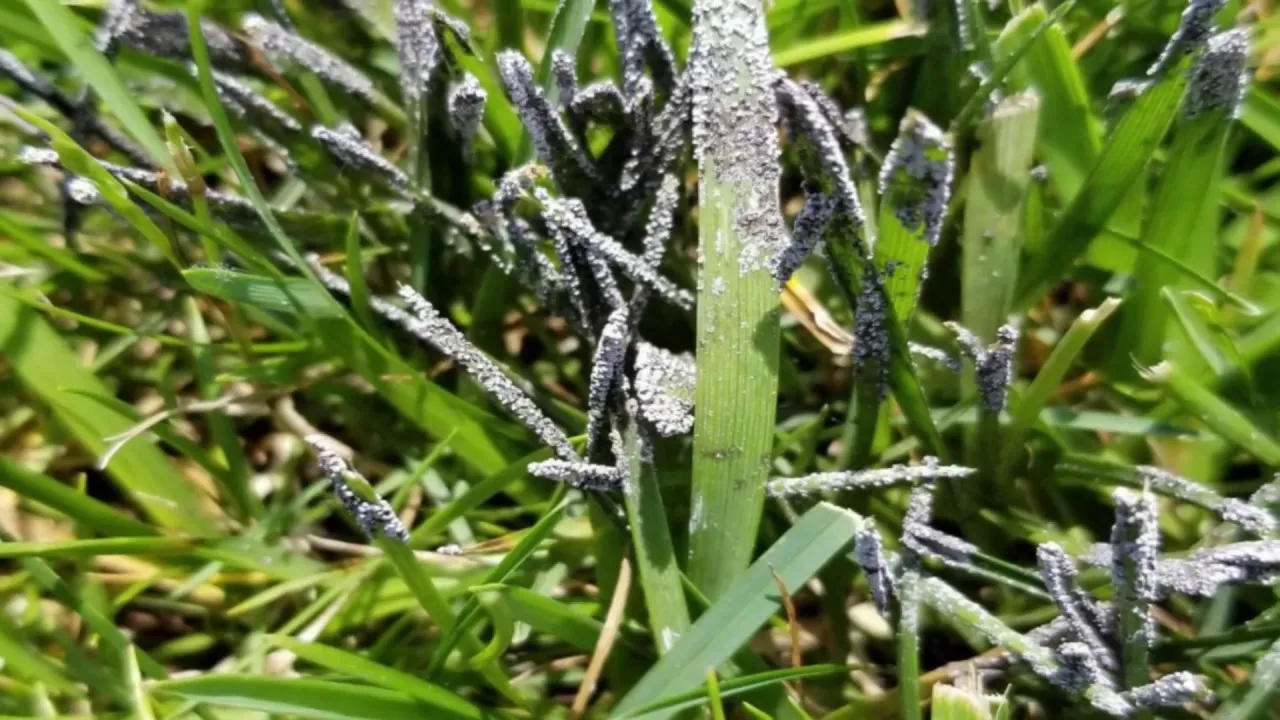
Lawn rust is caused by fungi in the Puccinia and Uromyces families — among the most widespread plant pathogens in the world. These fungi produce spores that are incredibly light. They travel by wind, stick to shoes and pets, and hitch rides on your lawn mower from one section of the yard to another.
The fungus doesn’t need a dramatic event to take hold. All it needs is the right combination of temperature and moisture — and a lawn that isn’t growing vigorously enough to fight back.
The Conditions That Trigger It
According to New Mexico State University’s turfgrass research, rust fungi need temperatures between 60–86°F and moisture on grass blades for at least 10–12 hours to infect the turf. That’s why late summer and early fall are peak rust season across the US — warm days, cool nights, and heavy morning dew create the perfect window.
Here’s what makes your lawn specifically vulnerable:
- Low nitrogen — the number one trigger. Slow-growing, underfed turf is rust’s favorite target.
- Evening or nighttime watering — wet blades that don’t dry before morning are a breeding ground for spores.
- Shade and poor airflow — areas under trees or near shrubs where moisture lingers.
- Thatch buildup — a thatch layer thicker than ½ inch traps moisture and creates ideal conditions for fungal growth.
- Soil pH imbalance — grass growing in soil that’s too acidic or too alkaline grows more slowly and becomes far more susceptible.
Which grass types are most at risk? Kentucky bluegrass, perennial ryegrass, and tall fescue are the most vulnerable cool-season grasses. Zoysia and bermuda can be affected too, particularly in warm, humid climates.
Is Rust on Lawn Grass Dangerous?
The short answer: not really — but don’t ignore it.
Lawn rust fungus is not toxic to humans, kids, or pets. Your dog rolling in a rusty lawn is going to be fine. Just know that the orange spores will stain light-colored clothing and can track onto carpets indoors, so a quick rinse-off before coming inside isn’t a bad idea.
The danger of lawn rust is indirect. It doesn’t kill a healthy lawn outright, but it weakens the grass significantly. Infected blades struggle to photosynthesize efficiently — meaning less energy for growth, less resistance to stress, and a lawn that’s wide open to other, more serious diseases like dollar spot, red thread, and brown patch.
A thin, rust-weakened lawn is also an open invitation for weeds to move in.
Here’s a simple rule: if rust has been present for less than a month and covers a limited area, you can treat it yourself with the steps below. If it’s recurring every year or covering most of your lawn, it’s time to get more aggressive — or call in a professional.
How to Get Rid of Rust on Lawn Grass (Step by Step)
Most cases of lawn rust respond well to improved lawn care — no fungicide required. Work through these steps in order.
Step 1 — Apply a Nitrogen Fertilizer (the Fastest Fix)
Nitrogen is your best weapon against lawn rust. It stimulates active growth, and fast-growing grass quite literally grows out of the infection — new, healthy blades push past the affected ones.
Apply a slow-release nitrogen fertilizer at a rate of 0.2–0.5 pounds of nitrogen per 1,000 square feet. Slow-release formulas keep nitrogen levels steady over several weeks rather than delivering a surge that fades fast.
Critical warning: Don’t over-fertilize in late fall. Warm-season grasses are heading into dormancy, and cool-season grasses are slowing down — excessive nitrogen at this stage can leave your turf vulnerable to diseases like fusarium patch and red thread. If it’s past mid-October in most of the US, hold off until spring. Check our complete lawn fertilizing guide for timing by grass type.
Step 2 — Fix Your Watering Schedule
Rust thrives on wet grass blades. The goal is simple: reduce how long your grass stays damp.
- Water in the morning only — this gives blades time to fully dry during the day
- Water deeply but infrequently — aim for 1–1.5 inches per week across 2–3 sessions, not daily
- Never water in the evening — blades that stay wet through the night for 10+ hours are essentially an open invitation for rust spores
If you’ve been running automatic sprinklers at night, switching to morning watering alone can make a noticeable difference within a week.
Step 3 — Mow Regularly and Remove Clippings
Mowing physically removes infected leaf tips from the plant, reducing the fungal load across your lawn. The Iowa State University Extension recommends mowing frequently but never removing more than one-third of the blade height at once. For example, if your target height is 3 inches, mow when the grass reaches 4.5 inches.
After mowing a rust-infected lawn, rake up and bag the clippings. Do not leave them on the lawn or put them in a compost pile — the spores will spread right back into the turf. Clean your mower blades before moving to a clean section of the yard.
Step 4 — Improve Airflow (the Step Most People Skip)
Poor air circulation keeps grass damp and gives rust spores exactly what they need. Here’s how to open things up:
- Prune trees and shrubs that overhang the lawn — let sunlight and breezes reach the turf directly
- Dethatch if your thatch layer exceeds ½ inch — use a thatching rake or rent a dethatching machine from a hardware store
- Aerate compacted soil — core aeration creates small holes that improve water drainage and air movement down to the root zone. See our lawn aeration guide for timing and technique.
The Illinois Extension specifically highlights airflow and light penetration as key cultural controls for rust — yet most homeowners overlook this step entirely.
Step 5 — Use a Fungicide (Last Resort Only)
In most cases, steps 1–4 are all you need. Fungicides are rarely necessary for home lawns and won’t reverse discoloration that’s already happened — they only stop the disease from spreading further.
If you’re dealing with a severe or recurring infection that hasn’t responded to cultural controls, look for a fungicide with one of these active ingredients:
- Azoxystrobin — a broad-spectrum systemic fungicide; works both preventively and curatively
- Propiconazole — effective against rust, applied as a foliar spray
- Myclobutanil — another systemic option with solid rust control
Always check the product label to confirm rust is listed as a target disease. Follow the application rate precisely — more is not better. When in doubt, consult your local county Extension office for current recommendations specific to your region.
Post-Treatment Recovery — What to Do About Bare or Thin Spots
Here’s what most guides miss: what happens after you treat the rust?
Once the infection is under control, you may be left with thin or bare patches where the disease was most severe. Don’t leave those areas empty — bare turf is an open invitation for weeds.
Overseed thin areas with a rust-resistant grass variety. A diverse turf stand — mixing compatible species rather than planting one cultivar — is significantly more resilient. For bare spots, use a quality seed-and-mulch mix and water lightly but consistently until the new seedlings establish.
Most lawns show visible improvement within 2–3 weeks of starting treatment. Full recovery from a severe case can take 4–6 weeks.
How to Prevent Rust on Lawn Grass From Coming Back
Treating rust is straightforward. Keeping it from returning is even easier — it mostly comes down to consistency.
Year-Round Lawn Habits That Block Rust
The best prevention is a lawn that never slows down enough for rust to gain a foothold. Here’s what that looks like in practice:
- Fertilize 4 times a year — spring, early summer, late summer, and early fall. The early fall application (around September 1–15) is especially important for cool-season lawns, per the Illinois Extension.
- Maintain proper mowing height — never scalp the lawn. Taller blades mean deeper roots and more stored energy to fight off disease.
- Aerate and dethatch annually — keeps soil loose, well-drained, and far less hospitable to fungal growth.
- Check your soil pH — most lawn grasses perform best between pH 6.0–7.0. Soil outside that range causes sluggish growth and much higher disease risk. Test your soil every 2–3 years and adjust with lime (to raise pH) or sulfur (to lower it). A soil test through your state’s cooperative extension service typically costs around $20 and is one of the best investments you can make for your lawn.
Seasonal Tips for US Homeowners
Lawn rust is most active from late summer through early fall — roughly August through October across most of the US. That’s when to pay the closest attention.
- Early August: do a quick lawn check using the white cloth test. Catching it early means minimal treatment.
- September 1–15: apply a nitrogen fertilizer to push growth before the season slows down.
- Fall overseeding: if you’re overseeding, choose rust-resistant cultivars. Ask your local garden center or check with your state’s cooperative extension service for recommended varieties in your region.
In most of the US, rust won’t survive a cold winter. If your lawn had a mild case, solid fall lawn care combined with a freeze cycle will often clear things up naturally — no treatment needed.
Frequently Asked Questions About Rust on Lawn Grass
Will rust on lawn grass go away on its own?
Sometimes — but don’t rely on it. In well-maintained lawns, rust often fades naturally when cooler fall temperatures arrive and the grass starts growing more vigorously again, as noted by the Illinois Extension. However, if your lawn is low in nitrogen or dealing with other stressors, it won’t clear up without help. A nitrogen application is the fastest way to speed recovery.
How long does it take to get rid of rust on lawn grass?
With proper treatment — nitrogen boost, corrected watering, and regular mowing — most lawns show visible improvement within 2–3 weeks. Severe infections may take 4–6 weeks for full recovery. A fungicide alone won’t speed this up; consistent cultural care is what actually resolves the problem.
Is rust on lawn grass harmful to dogs and kids?
No. The fungi responsible for lawn rust are not toxic to humans or animals. Kids and pets can play on a rusty lawn safely. Just be aware that the orange spores will stain light-colored clothing and pet fur and can track onto carpet indoors — a quick rinse before coming inside is a good habit.
Do I need a fungicide to treat lawn rust?
In most cases, no. University extension specialists from Iowa State and Illinois consistently note that fungicides are rarely necessary for home lawn rust control. Proper fertilizing, watering, mowing, and airflow improvements resolve the vast majority of cases. Reserve fungicides for rust that recurs year after year despite good lawn care, or for severe infestations.
Can rust on lawn grass spread to my garden plants or trees?
Rust fungi tend to be host-specific — the strains that infect turfgrass don’t typically jump to ornamental plants or trees. That said, certain plants can serve as alternate hosts for some rust species, and spores can travel easily. During an active outbreak, it’s wise to avoid dragging clippings or infected debris near ornamental garden beds as a precaution.
The Bottom Line
Rust on lawn grass looks worse than it is — but that doesn’t mean you should ignore it.
Here’s the simple version:
- Identify it fast using the white cloth test — orange powder means rust
- Start with nitrogen — the fastest, most effective first step
- Fix your watering and mowing habits — these two changes alone clear up most cases
- Give it 2–3 weeks — consistent care is what brings your lawn back to green
If you’re not sure where to start, a soil test is the most useful $20 you can spend on your lawn all year. It tells you exactly what your grass needs to grow thick, healthy, and resistant to rust and other diseases.
Have questions about your specific lawn situation? Contact Gen Lawn — we’re here to help.
References & External Sources
- UC IPM — Rust on Turfgrass
- Iowa State University Extension — Turf Grass Rust
- Illinois Extension — Preventing Rust Diseases on Home Lawns
- New Mexico State University — Rust on Turf (PDF)
- National Plant Diagnostic Network — Lab Directory
- LawnStarter — Dollar Spot Guide
- LawnStarter — Brown Patch Guide
About Author
Khalid Fazal is a seasoned lawn care specialist and horticultural researcher with over 15 years of hands-on experience transforming challenging landscapes into lush, resilient green spaces. His journey didn’t start in a lab, but in a backyard full of stubborn, cracked clay that “experts” said would never grow a healthy blade of grass. Refusing to accept a yard full of dust, Khalid spent years experimenting with organic soil restoration and precise mulching—eventually turning that wasteland into a neighborhood showpiece on a shoestring budget.
From mastering core aeration techniques to optimizing soil pH for specialized turf varieties, Khalid’s approach combines old-school grit with modern agronomic science. He founded Gen Lawn to provide homeowners with honest, research-backed advice that prioritizes long-term soil health over quick-fix chemical solutions. When he isn’t analyzing soil profiles, he’s developing precision tools to help others achieve professional results without the professional price tag.

Lawn Winterizer: When to Apply by Grass & Region [2026]
Table of Contents Home / By Khalid Fazal | Updated:...
Read More
Spring Lawn Care: What to Do and When in Every US Region
Table of Contents Home / By Khalid Fazal | Updated:...
Read More
Lawn Maintenance Checklist by Season and Grass Type (2026)
Table of Contents Home / By Khalid Fazal | Updated:...
Read More
Liquid Fertilizer vs Granular Fertilizer: Which Wins?
Table of Contents Home / By Khalid Fazal | Updated:...
Read More