
Hardscape Installation: What It Costs, What to Expect, and How to Get It Right
Quick answer: Most hardscape projects cost $5 to $25 per square foot installed, and a typical project lands around $9,000. Gravel paths can come in as low as $1 to $3 per square foot, while flagstone can reach $35. Whatever you build, the base layer underneath decides whether it lasts.
Your backyard has potential. But right now it might look like a mix of uneven ground, muddy patches between the lawn and the back door, and a patio that never quite came together. Sound familiar?
A well-planned hardscape installation changes all of that. It turns the most underused part of your property into the most-used one. A solid stone patio becomes your outdoor dining room. A clean walkway stops the mud from following you inside. A retaining wall reclaims a sloped, unusable yard and turns it into tiered garden space.
These are not luxury upgrades. They are functional investments that pay back in comfort, usability, and real property value.
This guide covers everything you need: what hardscape installation actually includes, what it costs in 2026, when to DIY versus hire a professional, and the exact questions that separate a reliable contractor from an expensive mistake.
What Is Hardscape Installation?
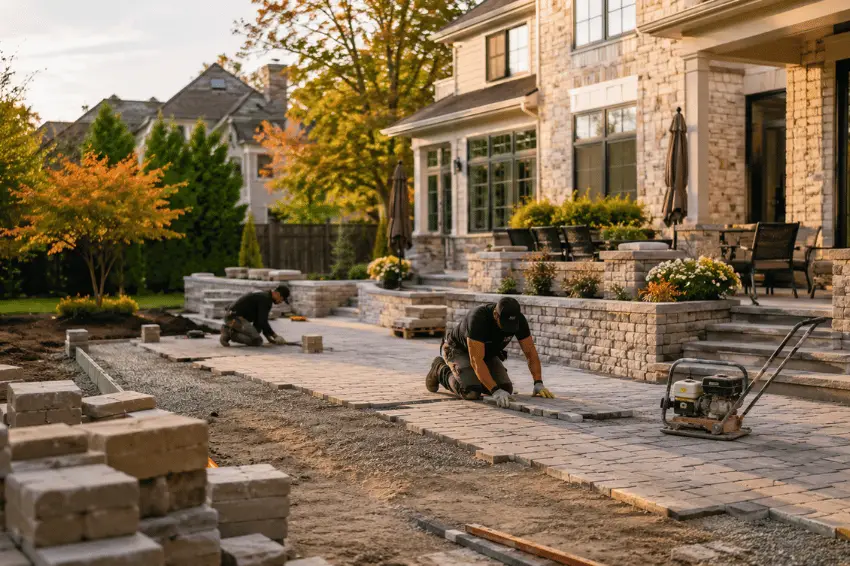
Hardscape installation is the process of designing and building the non-living, structural elements of your outdoor space. Think pavers, stone, concrete, brick, and gravel rather than grass, plants, and garden beds.
The term comes from the broader field of landscape design, where your outdoor space is split into two categories working together, not against each other.
Hardscape vs. Softscape: A Simple Breakdown
| Category | What It Includes |
|---|---|
| Hardscape | Patios, walkways, driveways, retaining walls, fire pits, outdoor kitchens, pool decks, garden borders |
| Softscape | Lawn, garden beds, shrubs, trees, flowers, mulch |
These two categories work best together. A stone patio looks finished when it sits beside clean garden beds. A retaining wall becomes a landscape feature when softscape fills in around it. If you are planning mulch beds to frame your hardscape elements, the Mulch Installation: DIY Steps, Costs and Mistakes to Avoid guide covers the process in full.
What a Typical Hardscape Installation Project Covers
Every project has its own scope, but most follow the same general process:
- Initial design and site planning
- Excavation and grading
- Base preparation (the structural foundation most homeowners never see but always feel the effects of)
- Material installation
- Edging, joint filling, and sealing
The materials and the scale change. The process stays the same.
Types of Hardscape Installation Projects
Not all hardscape projects carry the same cost, complexity, or purpose. Here is a breakdown of the most common types and what makes each one work.
Patio and Outdoor Living Space Installation
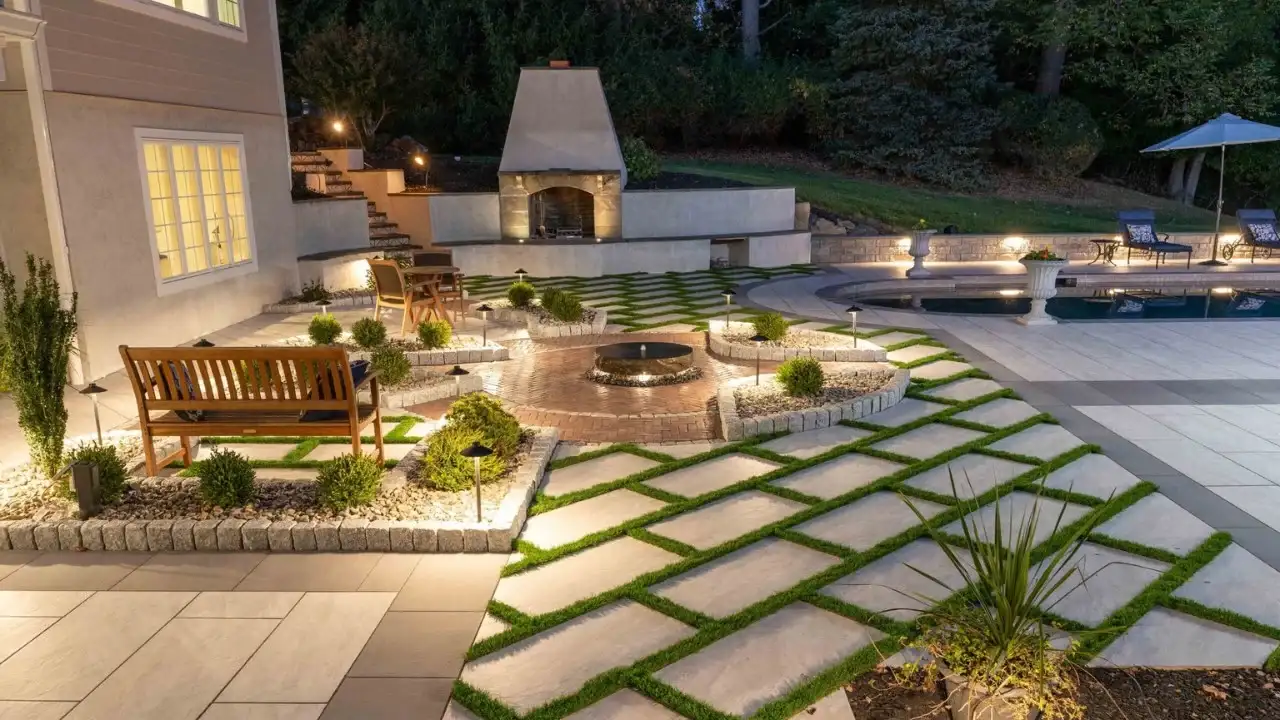
Patios are the most popular hardscape installation project in the US. They extend your indoor living space outdoors and create a defined area for dining, relaxing, or entertaining guests.
Common materials include concrete pavers, natural flagstone, brick, and poured concrete. Each has its own trade-offs. Pavers are durable and individually replaceable if one cracks. Poured concrete is the most affordable option. Flagstone delivers a premium, natural look but comes at a higher cost.
Walkway and Pathway Installation
A well-built walkway does two things at once: it guides foot traffic and sharpens the look of your entire landscape. Without one, people create their own path, which usually means worn-out grass and a muddy strip alongside the house.
Material options include stepping stones, clay brick pavers, decomposed granite, and gravel. One technical detail that matters here is drainage slope. Every walkway needs at least a 1-inch drop per 8 feet of run to prevent water from pooling on the surface and creating an icy hazard in winter.
Retaining Wall Installation
If your yard has a slope, a retaining wall might be the single most functional hardscape project you can invest in. It holds back soil, controls erosion, and creates flat, usable terraced areas where there was nothing usable before.
Common types include concrete block, natural stone, timber, and segmental retaining wall units. Important: most municipalities require a building permit for retaining walls over a certain height, typically 2 to 4 feet. Always check with your local building department before breaking ground.
Driveway and Curb Appeal Hardscaping
Your driveway is the first thing anyone sees when they pull up. A cracked or stained surface quietly drags down curb appeal and home value, while a clean, well-installed driveway does the opposite.
Material options include asphalt (affordable, needs periodic resealing), concrete (durable, mid-range cost), and pavers (premium look, highest cost, but individually replaceable if damaged). Curb-facing hardscaping consistently has a strong influence on property appraisals.
Hardscape Installation Cost: Real Numbers for 2026
Here is the thing most homeowners do not realize: hardscape pricing varies widely, and a single figure means very little without knowing the material, scope, and site conditions involved.
That said, you still need a real starting point. Here is what the current data shows.
Average Cost by Project Type
According to Angi’s 2026 Hardscaping Cost Guide and the Greenwish LLC Hardscaping Cost Guide, here are the current national averages including materials and professional labor:
| Project Type | Cost Per Sq Ft | Typical Total Range |
|---|---|---|
| Gravel pathway | $1 to $3 | $500 to $2,000 |
| Concrete patio | $6 to $15 | $2,000 to $6,000 |
| Paver patio | $12 to $25 | $4,000 to $12,000 |
| Flagstone patio | $18 to $35 | $6,000 to $15,000 |
| Retaining wall | $60 to $120 per linear ft | $3,000 to $10,000+ |
| National average (all project types) | $5 to $25 | Around $9,000 |
DIY material-only costs typically run 40 to 60 percent lower than the figures above, since you are eliminating labor from the equation.
What Drives Your Hardscape Installation Cost Up (or Down)
Several factors push your final number higher or lower than the averages:
- Material choice: Gravel versus flagstone can be a $30 per square foot difference on the exact same sized patio.
- Design complexity: Curves, multi-level layouts, and intricate patterns require significantly more labor time.
- Site preparation: A flat yard is far easier and cheaper to work with than a sloped or rocky one.
- Regional labor rates: Labor costs in California or New York run considerably higher than in Texas or the Midwest.
- Permits and demolition: Permits typically add $200 to $300. Removing existing concrete or old structures adds $2 to $6 per square foot.
- Contingency buffer: Always build in a 10 to 15 percent buffer. Surprises happen underground, and they are rarely cheap.
Is Hardscape Installation Worth the Investment?
The short answer is usually yes, especially for patios and fire features.
Some landscaping industry estimates put the value boost from well-executed hardscaping as high as 15 to 20 percent, though the real number depends on your market, the project, and how well it fits the home. Project-specific numbers are more useful. Here is what Angi reports:
- Patio installation: 55 to 70 percent ROI at resale
- Fire pit or fire feature: 67 to 80 percent ROI
- Outdoor kitchen: up to 80 percent ROI
Beyond resale value, you get to use and enjoy the space every single day. That is a return no spreadsheet fully captures.
DIY vs. Professional Hardscape Installation: Making the Right Call
This is where most homeowners get stuck. The honest answer depends entirely on the project type, not on ambition or willingness to work hard.
Projects You Can Realistically DIY
Some hardscape installations are genuinely approachable for a motivated homeowner with basic tools and a free weekend. These include:
- Stepping stone paths through garden areas
- Small gravel seating zones or fire pit surrounds
- Simple garden border edging with pavers or stone
- Basic raised garden bed borders
To do it right, you will need proper excavation tools, a good understanding of drainage slope, and enough time set aside (most small projects take one to two weekends). One step that is non-negotiable before any digging: call 811. This is the free national utility locate service in the US. They mark underground gas lines, water pipes, and electrical cables at no charge, usually within a few business days.
When Professional Hardscape Installation Is the Smarter Move
For anything beyond simple paths and garden borders, professional installation is typically the better investment.
Here is why. The most common reason hardscaping fails is not the surface material chosen. It is the base layer underneath it. A proper base requires excavation to the right depth (typically 7 to 9 inches for paver work), a layer of geotextile fabric to separate materials and prevent shifting, 4 to 6 inches of compacted gravel, and 1 inch of bedding sand. Get any of those steps wrong and you will have heaving pavers, a cracking patio surface, or water draining toward your foundation within a few seasons.
Hire a professional for:
- Patios larger than roughly 200 square feet
- Any retaining wall, especially those over 2 feet tall
- Driveway installations
- Outdoor kitchens and built-in fire features
- Any project that requires a permit
The Professional Hardscape Installation Process, Step by Step
Knowing the process helps you evaluate whether a contractor is doing the job correctly or cutting corners. Here is what a proper installation looks like from start to finish:
- Site assessment and design consultation to understand the space, slope, and drainage patterns
- Material selection and sourcing based on budget, climate, and intended use
- Excavation to the required depth, typically 7 to 9 inches for standard patio work
- Base preparation: geotextile fabric, 4 to 6 inches of compacted gravel, then 1 inch of leveling sand
- Installation of pavers or stone with consistent spacing and the correct drainage pitch (1-inch drop per 8 feet)
- Edging installation followed by joint filling with polymeric sand and plate compaction to lock everything in place
- Final walkthrough, cleanup, and optional sealing depending on the material used
If a contractor skips or glosses over step 4, that is a significant red flag. The base is everything.
How to Choose the Right Hardscape Installation Contractor
Finding a good contractor takes more than scrolling through reviews. Here is what actually matters when vetting someone for this kind of work.
Questions to Ask Before You Sign Anything
Go into every consultation with these questions ready:
- Are you licensed and insured in this state?
- Can you show me photos or references from similar projects you have completed locally?
- Do you pull the necessary permits for this type of work?
- Walk me through your base preparation process in detail.
- What does your workmanship warranty cover and for how long?
- Will your own crew handle the work, or will you use subcontractors?
A confident, experienced contractor will answer all six without hesitation. Vague answers to questions 3 or 4 are worth paying close attention to.
Red Flags That Should Stop You Cold
Watch out for these warning signs before signing any contract:
- Demanding a large upfront cash-only payment
- Providing pricing verbally with nothing written down
- No formal contract with a clear scope, timeline, and materials list
- Inability to explain the drainage and base preparation process in clear terms
- No portfolio of past work, or only a handful of very recent reviews with no history
The National Association of Landscape Professionals (NALP) maintains a directory of certified landscape professionals if you want a vetted starting point when searching for contractors in your area.
Frequently Asked Questions About Hardscape Installation
How long does hardscape installation typically take?
Most residential projects take 1 to 3 weeks from start to completion. A straightforward paver patio might wrap up in 3 to 5 working days. A full backyard renovation with a retaining wall, walkways, and an outdoor kitchen can stretch to 2 to 4 weeks. Weather delays and permit processing time can add additional days on top of the installation itself.
What is the best material for hardscape installation?
There is no single best material because the right choice depends on your budget, climate, and how the space will be used. Concrete pavers offer the best overall balance of cost, durability, and repairability for most homeowners. Natural flagstone delivers a premium look but costs more upfront. Gravel is the most budget-friendly starting point and works well for pathways and informal seating areas.
Does hardscape installation require a permit?
Sometimes. Retaining walls over 2 to 4 feet in height, driveways, drainage modifications, and built-in outdoor structures typically require a permit from your local municipality. The threshold varies by location. Always check with your local building department before starting work, or ask your contractor directly. A reputable professional handles permit applications as a standard part of their process.
How do I maintain my hardscape after installation?
Hardscape is low maintenance compared to grass or garden beds. Sweep regularly to prevent debris from settling into paver joints. Refill joints with polymeric sand every 3 to 5 years as it naturally settles over time. Reseal natural stone and paver surfaces every 2 to 3 years to protect against staining and weathering. Inspect retaining walls each spring for any visible movement, cracking, or leaning and address issues early before they grow.
Can hardscape installation increase my home’s value?
Yes, in most cases. Some industry estimates suggest quality hardscaping can raise property value by as much as 15 to 20 percent, though results vary by market and project. Patios typically return 55 to 70 percent of their installation cost at resale, and outdoor kitchens can return up to 80 percent. A well-designed outdoor space also makes a home more appealing to buyers when you decide to sell.
Key Takeaways Before You Start
Here is a quick recap of everything covered in this guide:
- Hardscape includes all non-living structural elements: patios, walkways, driveways, retaining walls, fire pits, and more
- National average costs range from $5 to $25 per square foot, with most complete projects landing around $9,000
- The right material depends on your budget, climate, and intended use of the space
- DIY is realistic for small, simple projects. Anything larger or requiring a permit is worth handing to a qualified professional
- Base preparation is the most critical part of any installation. A failed base means a failed surface
- Quality hardscaping can add real resale value, with patios returning 55 to 70 percent of their cost and outdoor kitchens up to 80 percent
Planning the mulch beds and softscape borders around your new hardscape? The Mulch Installation guide on GenLawn walks through the exact steps, costs, and common mistakes to avoid so the whole landscape comes together cleanly.
References and Sources
- Angi: Hardscaping Cost Guide 2026
- Greenwish LLC: Hardscaping Cost Per Sq Ft 2025
- Angi: Does Hardscaping Add Value to Your Home?
- MSE Hardscapes: The ROI of Hardscaping 2025
- BusinessWire: US Hardscaping Market Forecast to 2028
- 811.com: Call Before You Dig (US National Utility Locate Service)
- NALP: National Association of Landscape Professionals
- Belgard: What Is Polymeric Sand?
About Author
Khalid Fazal is a seasoned lawn care specialist and horticultural researcher with over 15 years of hands-on experience transforming challenging landscapes into lush, resilient green spaces. His journey didn’t start in a lab, but in a backyard full of stubborn, cracked clay that “experts” said would never grow a healthy blade of grass. Refusing to accept a yard full of dust, Khalid spent years experimenting with organic soil restoration and precise mulching, eventually turning that wasteland into a neighborhood showpiece on a shoestring budget.
From mastering core aeration techniques to optimizing soil pH for specialized turf varieties, Khalid’s approach combines old-school grit with modern agronomic science. He founded Gen Lawn to provide homeowners with honest, research-backed advice that prioritizes long-term soil health over quick-fix chemical solutions. When he isn’t analyzing soil profiles, he’s developing precision tools to help others achieve professional results without the professional price tag.

Lawn Winterizer: When to Apply by Grass & Region [2026]
Table of Contents Home / By Khalid Fazal | Updated:...
Read More
Spring Lawn Care: What to Do and When in Every US Region
Table of Contents Home / By Khalid Fazal | Updated:...
Read More
Lawn Maintenance Checklist by Season and Grass Type (2026)
Table of Contents Home / By Khalid Fazal | Updated:...
Read More
Liquid Fertilizer vs Granular Fertilizer: Which Wins?
Table of Contents Home / By Khalid Fazal | Updated:...
Read More