
Liquid Fertilizer vs Granular Fertilizer: Which One Your Lawn Actually Needs
You bought the fertilizer, followed the bag, and your lawn still let you down. Maybe it came up in yellow streaks a few days later. Maybe it greened up fast, then faded within a month.
Most of the time, the problem isn’t your effort. The fertilizer type simply didn’t match what your lawn needed at that moment.
Here’s the straight answer on liquid fertilizer vs granular fertilizer. Granular is the better pick for steady, season-long feeding on most US lawns. Liquid is the better pick when your grass needs a fast fix. And the detail that decides whether your lawn thrives or burns is printed on the label: how quickly the nitrogen releases.
Factor | Liquid | Granular |
|---|---|---|
Results | 1 to 3 days | 3 to 7+ days |
Feeds for | A few weeks | Weeks to months |
Season cost | Higher | Lower |
Tool | Sprayer | Spreader |
Best for | Quick fixes | Routine feeding |
Liquid Fertilizer vs Granular Fertilizer: What’s the Real Difference?
Both types deliver the same core nutrients. As Mississippi State turfgrass specialist Dr. Wayne Wells points out, grass can’t tell one nitrogen source from another once it becomes usable. What changes is how the nutrients get there and how long they last.
How Liquid Fertilizer Feeds Your Lawn
Liquid fertilizer comes as a concentrate or a water-soluble powder that you mix with water and spray. It coats the grass blades and soaks into the top layer of soil, so the lawn picks up nutrients almost right away.
That speed is the big selling point. The tradeoff is a short feeding window, because dissolved nutrients get used up fast. Plan on reapplying every few weeks if you want to hold that color.
How Granular Fertilizer Feeds Your Lawn
Granular fertilizer comes as small dry pellets that you spread with a broadcast or drop spreader, then water in. Moisture breaks the pellets down and releases nutrients into the root zone over time.
Here’s why so many lawn pros lean on it. One application of a slow-release granular can feed your lawn for weeks or even months. That means fewer applications and steadier growth.
Why Nitrogen Release Matters More Than Liquid vs Granular Form
This is the part most comparisons skip. UW-Madison Extension advises comparing products by the nitrogen sources listed on the label, not by their form. Both quick-release and slow-release nitrogen are sold in liquid and granular versions.
Quick-release sources like urea, ammonium sulfate, and ammonium nitrate dissolve fast and green up a lawn quickly. They also carry a high salt index, which simply means a greater chance of burning grass if you overapply. Slow-release sources like sulfur-coated urea, polymer-coated urea, and ureaform feed gradually with far less burn risk.
So yes, a cheap quick-release granular can scorch your lawn just as easily as a liquid. Before you buy, scan the label for terms like “slow-release,” “controlled-release,” or “water insoluble nitrogen (WIN).” If the numbers on the bag still confuse you, our guide to the NPK ratio for grass breaks them down.
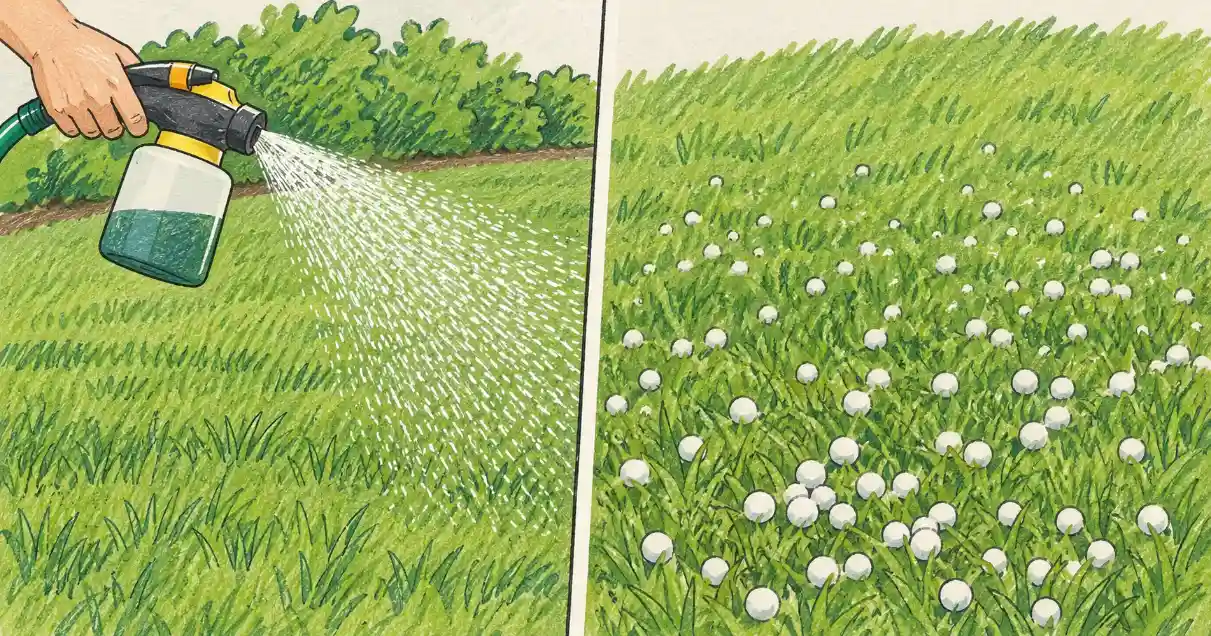
Liquid vs Granular Fertilizer Pros and Cons, Side by Side
Neither type wins every category. Here’s how they compare on the three things homeowners care about most: speed, cost, and safety.
Speed of Results: Liquid vs Granular Fertilizer
Liquid wins this one easily. Because the nutrients are already dissolved, most lawns show deeper color within one to three days. Quick-release granular usually catches up in three to seven days once it’s watered in, while slow-release granular takes longer but holds color for weeks. Our breakdown of how long fertilizer takes to work covers every type in detail.
But wait: faster isn’t always better. Quick bursts of nitrogen push fast top growth, which means more mowing and a color crash a few weeks later. Mississippi State Extension notes that slow-release products reduce those growth flushes, which can also invite disease.
Cost Per Season for Liquid and Granular Fertilizer
Per pound of nitrogen, quick-release products are generally the cheapest you can buy. Slow-release granular costs more per bag but keeps working much longer.
Here’s the thing: the price tag on one bottle or bag tells you very little. Liquid feeding needs more applications per season, so you spend more on product and more time spraying. Before you buy, check two numbers on the label: the square footage it covers and how many weeks it feeds. That gives you the real cost per season.
Storage matters too. Granular kept dry lasts for years, while liquids are more likely to separate or spoil if left in a hot or freezing garage.
Burn Risk and Environmental Impact
Fertilizer burn happens when fertilizer gets so concentrated around the roots that it pulls water out of the grass. University of Minnesota Extension says it most often happens in hot weather or when fertilizer isn’t watered in, and especially with fast-release products. That’s why a quick-release liquid sprayed during a heat wave is a common way to scorch a lawn.
Release speed also affects what ends up in local water. NC State Extension’s nitrogen carrier comparison rates ammonium nitrate high for both burn and leaching, which is when nitrogen washes down past the roots into groundwater. Coated slow-release sources like polymer-coated urea rate low on both.
Granular has one extra risk: pellets that land on driveways and sidewalks wash straight into storm drains. Sweep them back onto the grass after every application. Liquid avoids this problem as long as you don’t spray onto pavement.
When to Use Liquid Fertilizer vs Granular Fertilizer in the US
Where you live shapes this choice more than most people realize. Your grass type and local climate decide when your lawn actually uses nitrogen, and that tells you which product fits. For exact timing, follow our lawn fertilizer schedule for your region.
Liquid vs Granular Fertilizer for Cool-Season Lawns
Cool-season grasses like Kentucky bluegrass, tall fescue, and perennial ryegrass cover most of the North, Midwest, Northeast, and Pacific Northwest. They grow hardest in spring and fall and slow down in summer heat. NC State Extension’s seasonal nitrogen schedule puts 70 percent of the yearly nitrogen for these grasses into fall and late season, and only 10 percent into summer.
That makes slow-release granular the clear base for cool-season lawns, especially the fall feedings. Liquid earns its spot in spring if your lawn comes out of winter pale and thin. Skip heavy feeding of either type in midsummer, when stressed cool-season grass can’t use it.
Liquid vs Granular Fertilizer for Warm-Season Lawns
Warm-season grasses like Bermuda, zoysia, St. Augustine, and centipede dominate the South and Southwest. They do the opposite: they grow fastest in summer. NC State’s same schedule puts 55 percent of their yearly nitrogen into summer and 35 percent into spring.
Here’s the catch. Summer feeding in the South means feeding in serious heat, which is when quick-release products burn grass most easily. Slow-release granular makes a safer summer base. If you use liquid, spray in the early morning and stick to the label rate.
Florida homeowners have one more rule to know. Many Florida counties ban nitrogen and phosphorus fertilizer during the rainy season. Hillsborough County, for example, prohibits both from June 1 to September 30 and requires at least 50 percent slow-release nitrogen year-round. Iron-based “summer blends” are still allowed during the ban, so check your county’s rules before you buy anything.
Choosing Liquid or Granular Fertilizer by Lawn Size and Soil Type
Lawn size is a practical tiebreaker. Liquid with a hose-end sprayer is handy for small yards and spot treatments. On a large lawn, mixing and spraying gallons gets slow and expensive, and a broadcast spreader with granular covers ground much faster.
Soil type matters just as much. Sandy soils, common along the Atlantic and Gulf coasts, hold very little water, so nitrogen washes through quickly. NC State recommends slow-release nitrogen on sandy soil, or no more than 0.25 to 0.5 pounds of quick-release nitrogen per 1,000 square feet per application.
A struggling lawn is the one case where liquid clearly leads. After drought, disease, or a rough winter, a light liquid feeding brings color back fast. Just confirm the problem is really hunger first, because yellowing from soil pH or iron deficiency won’t respond to more nitrogen.
Can You Use Liquid and Granular Fertilizer Together?
Yes, and for most lawns it’s the smartest setup. Granular does the steady background feeding, while liquid handles quick fixes and touch-ups. You get long-lasting nutrition without giving up fast results when you need them.
Liquid also has a handy side job. NC State Extension suggests using iron for a greening response instead of extra nitrogen. A liquid iron spray darkens color in days without pushing more top growth.
A Simple Seasonal Plan Using Liquid and Granular Fertilizer
For cool-season lawns, Penn State turfgrass professor Peter Landschoot recommends feeding two or three times a year: mid-spring, around Labor Day, and late fall. Here’s how liquid and granular fit into that schedule:
- Late April to early May: Apply a slow-release granular. Add a light liquid feeding only if the lawn is still pale.
- Summer: Skip nitrogen. Use a liquid iron spray if you want color.
- Around Labor Day: Apply slow-release granular. This is the most important feeding of the year.
- Late fall: Apply a final granular feeding to strengthen roots before winter.
Warm-season lawns flip that calendar. Start granular once the grass has fully greened up in spring, keep slow-release granular as the base through summer, and use liquid for quick color between feedings.
Common Liquid and Granular Fertilizer Mistakes to Avoid
Skipping the soil test is the biggest one. Without it, you’re guessing which nutrients your lawn lacks. Illinois Extension has a clear guide on how to collect a soil sample, and Penn State notes results usually take two to three weeks, so test before the season starts.
With granular, most burn stripes come from the spreader, not the product. Landschoot’s advice is simple: “Always begin walking before you open the spreader.” Close it before you stop. For even coverage, Penn State suggests setting the spreader to half the label rate and going over the lawn twice in a crisscross pattern.
Timing around water trips people up with both types. Granular works best on dry blades with moist soil, then needs watering in. Liquid can go on damp grass but needs time to dry before rain. Our guide on applying fertilizer to wet grass covers the details.
Finally, don’t feed during hot, dry spells. Penn State warns that midsummer applications in that weather can damage turf and leave it more prone to summer disease. That goes double for quick-release liquids.
Frequently Asked Questions About Liquid vs Granular Fertilizer
Is liquid fertilizer better than granular fertilizer for lawns?
Not for routine feeding. Slow-release granular gives steadier growth, lasts longer, and costs less per season. Liquid is better for quick recovery, small yards, and fast color before an event.
Does liquid fertilizer burn grass more than granular fertilizer?
It can, but the form isn’t the real cause. Quick-release nitrogen burns grass more easily in either form, especially in hot weather or when overapplied. A slow-release product carries far less risk whether it’s liquid or granular.
How long does liquid fertilizer last compared to granular?
Liquid usually feeds for a few weeks. Slow-release granular can feed for several weeks to a few months, depending on the nitrogen source and the weather. See our guide on how long fertilizer takes to work for the full timeline.
Can you dissolve granular fertilizer to make liquid fertilizer?
Only if the product is labeled water-soluble. Coated slow-release granules aren’t designed to dissolve, so you lose the slow-release benefit and may clog your sprayer.
Which is cheaper, liquid or granular fertilizer?
Granular is usually cheaper over a full season. It covers more ground per dollar and needs fewer applications, while liquid often requires repeat feedings every few weeks.
Choose the Right Fertilizer for Your Lawn
The liquid fertilizer vs granular fertilizer debate gets simple once you know what to look for:
- Slow-release granular is the best base for routine feeding on most US lawns.
- Liquid is your fast fix for pale, stressed, or recovering grass.
- The nitrogen source on the label matters more than whether the product is liquid or granular.
- Your grass type, region, and local rules decide when to feed.
Start with a soil test this season. Then pick a product with slow-release nitrogen for your main feedings, keep a liquid on hand for quick touch-ups, and time every application with our lawn fertilizer schedule. Your lawn will stay greener and steadier, with no more guessing in the store aisle.
About Author
Khalid Fazal is a seasoned lawn care specialist and horticultural researcher with over 15 years of hands-on experience transforming challenging landscapes into lush, resilient green spaces. His journey didn’t start in a lab, but in a backyard full of stubborn, cracked clay that “experts” said would never grow a healthy blade of grass. Refusing to accept a yard full of dust, Khalid spent years experimenting with organic soil restoration and precise mulching, eventually turning that wasteland into a neighborhood showpiece on a shoestring budget.
From mastering core aeration techniques to optimizing soil pH for specialized turf varieties, Khalid’s approach combines old-school grit with modern agronomic science. He founded Gen Lawn to provide homeowners with honest, research-backed advice that prioritizes long-term soil health over quick-fix chemical solutions. When he isn’t analyzing soil profiles, he’s developing precision tools to help others achieve professional results without the professional price tag.

Lawn Winterizer: When to Apply by Grass & Region [2026]
Table of Contents Home / By Khalid Fazal | Updated:...
Read More
Spring Lawn Care: What to Do and When in Every US Region
Table of Contents Home / By Khalid Fazal | Updated:...
Read More
Lawn Maintenance Checklist by Season and Grass Type (2026)
Table of Contents Home / By Khalid Fazal | Updated:...
Read More
Liquid Fertilizer vs Granular Fertilizer: Which Wins?
Table of Contents Home / By Khalid Fazal | Updated:...
Read More