
Lawn Fertilizer Schedule: When to Feed Your Grass in Every US Region
You fed the lawn in early spring, fed it again in July, and it still looks thin. Maybe it came back with yellow stripes or scorched brown patches instead. That hurts when you paid good money for the bag.
Here’s the thing: the product is rarely the problem. The timing is. A lawn fertilizer schedule only works when it matches your grass type, because cool-season and warm-season grasses get hungry at opposite times of the year.
The short answer is simple. Feed cool-season lawns mostly in late summer and fall. Feed warm-season lawns from late spring through summer. Find your starting point below.
Grass type | Where it grows | Main feeding window | Feedings per year |
|---|---|---|---|
Cool-season (Kentucky bluegrass, tall fescue, ryegrass, fine fescue) | North, Midwest, Pacific Northwest, transition zone | Late summer through late fall | 1 to 4 |
Warm-season (Bermuda, zoysia, St. Augustine) | South, Southwest, Gulf Coast | Late spring through late summer | 2 to 4 |
Low-input warm-season (centipede, bahia) | Southeast, Florida | Late spring and summer | 1 to 2 |
How to Build a Lawn Fertilizer Schedule That Fits Your Grass
Every good schedule starts with three answers: what grass you have, how thick you want it, and what your soil already holds. Get these right and the calendar almost writes itself.
Cool-Season vs Warm-Season Grass in Your Lawn Fertilizer Schedule

Cool-season grasses like Kentucky bluegrass, tall fescue, and perennial ryegrass grow best when temperatures sit around 60 to 75°F. That means they do most of their growing in spring and fall, then slow down in summer heat.
Warm-season grasses like Bermuda, zoysia, St. Augustine, and centipede are the opposite. They thrive at 80 to 95°F, peak in summer, and turn brown and dormant in winter.
Then there’s the transition zone, a band across states like Virginia, Kentucky, Tennessee, and Missouri where both types grow. Not sure which one you have? Look at your lawn after the first hard frost. If it stays green, it’s cool-season. If it turns straw brown, it’s warm-season.
Pick Your Lawn Fertilizer Schedule by Effort Level
Here’s something most guides skip: you don’t have to feed four times a year. Illinois Extension builds its cool-season schedule around how dense a lawn you want, and that approach works for almost everyone.
Feedings per year | Best for | When to apply (cool-season) |
|---|---|---|
1 | Low effort, fine with a less dense lawn | Late summer to early fall |
2 | A healthy everyday lawn | Spring, then late summer to early fall |
3 | A thick, dense lawn | Spring, late summer to early fall, late season |
4 | A showpiece lawn with irrigation | Spring, early summer, late summer to early fall, late season |
Most full-sun lawns need about 3 pounds of nitrogen per 1,000 square feet per season. Shady lawns need about half that. More is not better, because extra nitrogen pushes soft top growth that invites disease and insects.
Start Every Lawn Fertilizer Schedule With a Soil Test
A soil test tells you your pH and whether you actually need phosphorus or potassium. Many established lawns don’t need phosphorus at all, so you could be paying for nutrients your soil already has.
Those three numbers on the bag are the N-P-K ratio: nitrogen, phosphate, and potash, in that order. A bag marked 18-6-12 contains 18% nitrogen. For most established lawns, a ratio close to 3-0-2 or 4-0-2 works well.
Testing is cheap and easy through your county extension office. Alabama Extension has a clear walkthrough on how to take a lawn soil sample, including how many spots to pull from and how deep to dig. If your results show a pH or compaction problem, our guide to soil amendments for lawns covers what to fix before you fertilize.
Lawn Fertilizer Schedule for Cool-Season Grass
For bluegrass, fescue, and ryegrass, the most important feeding of the year lands around Labor Day, not in spring. Most homeowners have this backwards, and it’s the biggest reason cool-season lawns look tired.
Timing | What to do | Nitrogen per 1,000 sq ft |
|---|---|---|
Mid-April to mid-May | Crabgrass pre-emergent if needed, plus a spring feeding once grass is actively growing | About 1 lb |
June to August | Skip it, or a light slow-release feeding on irrigated lawns only | Under 1 lb |
Mid-August to mid-September | Main feeding of the year | About 1 lb |
Late October to November | Winterizer, about a week after your final mowing | About 1 lb |
Shift every window two to three weeks earlier in the southern part of the cool-season zone and later in the far North.
Spring Feeding in a Cool-Season Lawn Fertilizer Schedule
Wait until the grass is actively growing and you’ve mowed at least once or twice. University of Minnesota Extension warns that fertilizing too early pushes growth when the grass should still be slow or dormant.
If crabgrass was a problem last year, this is also your window for a pre-emergent, a product that stops weed seeds from sprouting. Wisconsin Extension times it to when soil reaches about 55°F for several days in a row. An easy visual cue: forsythia shrubs dropping their yellow petals.
Summer: Skip It Unless You Irrigate
Cool-season grass naturally slows down in summer heat. Fertilizing it then forces growth the plant can’t support, and Minnesota Extension notes that midsummer feeding can cause damage the lawn never recovers from.
The only exception is a watered lawn on a four-feeding plan. Even then, keep the rate low and use slow-release nitrogen.
Late Summer to Early Fall: The Feeding That Matters Most
Here’s why fall wins: cooler air slows top growth, but roots keep growing and storing energy for winter. Wisconsin Extension calls Labor Day the optimum time to fertilize, and says minimal-care lawns can make it their only feeding of the year.
In Illinois, that window runs mid-August to mid-September in the center of the state, August up north, and September down south. Choose a controlled-release nitrogen product. On the label, look for “water insoluble nitrogen” (WIN), polymer coated urea, or sulfur coated urea.
Late-Season Winterizer Application
The final feeding goes down about one week after your last mowing of the year. That’s typically late October to early November in northern states and closer to late November farther south.
The grass blades have stopped growing, but the roots haven’t. They store that nitrogen and use it for a faster, greener start next spring. Just check your local rules first, because some states ban fall fertilizing after a set date (more on that below).
Lawn Fertilizer Schedule for Warm-Season Grass
Warm-season lawns get fed during summer, when they grow fastest, and get no nitrogen at all in fall. Feed too early in spring and a late frost can burn back the tender new growth you just paid for.
Grass | First feeding | Feedings per season | Last nitrogen | Yearly nitrogen per 1,000 sq ft |
|---|---|---|---|---|
Bermuda | After full green-up (early May in much of the South) | 3 | Before August 15 | 2 to 4 lbs |
Zoysia | After full green-up | 3 | Before August 15 | 2 to 4 lbs |
St. Augustine | After full green-up | 2 to 3 | Before August 15 | 2 to 4 lbs |
Centipede | After full green-up | 2 | Before August 15 inland, September 1 on the coast | 1 to 2 lbs |
These timings come from Clemson Extension’s grass-by-grass calendars. Use the higher yearly rate on sandy soil and the lower rate on clay.
Bermuda and Zoysia Lawn Fertilizer Schedule
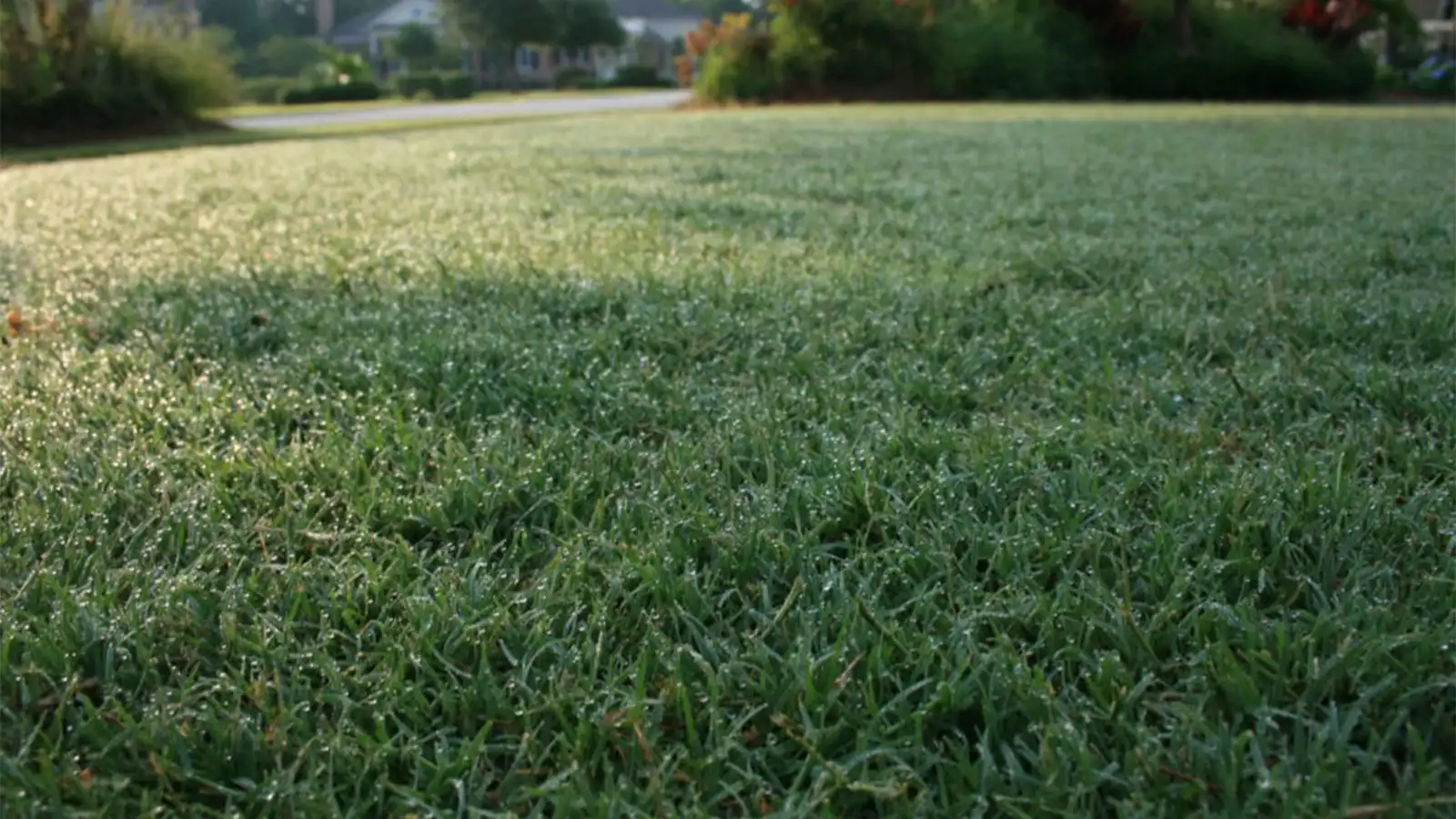
Both grasses follow the same rhythm. Clemson’s Bermudagrass calendar calls for ½ to 1 pound of nitrogen in early May once the lawn fully greens up, again in June or July, and a final round before August 15.
For the summer feedings, Clemson suggests a high-potassium blend such as 15-0-15. Potassium helps the grass resist disease and handle cold as it heads into dormancy. The Zoysiagrass calendar uses the same timing and rates.
Spacing feedings roughly six to eight weeks apart gives each one time to do its job. If you’re wondering why results don’t show overnight, here’s how long fertilizer takes to work by type.
St. Augustine Lawn Fertilizer Schedule
St. Augustine is the least cold-tolerant warm-season grass, so it’s the last one you should rush in spring. Clemson’s St. Augustinegrass calendar recommends three summer feedings on sandy soil: early May, June to July, and before August 15.
On heavier clay soils, two feedings (early May and early July) are usually enough. If the lawn turns yellow between feedings, that can be an iron shortage rather than a nitrogen one, and a quick iron product greens it up without pushing extra growth.
Centipede and Bahia: The Light-Feeder Lawn Fertilizer Schedule
Here’s where many Southern homeowners go wrong. Centipede needs only 1 to 2 pounds of nitrogen per 1,000 square feet per year, and Clemson’s Centipedegrass calendar warns that going over 2 pounds builds thatch and invites disease.
Bahia is also a modest feeder. The UF/IFAS fertilizer guidelines put bahia lawns at 1 to 3 pounds a year in North and Central Florida and 1 to 4 pounds in South Florida.
Fall and Winter: Switch to Potassium, Not Nitrogen
Once fall arrives, stop the nitrogen. Instead, if your soil test shows low potassium, apply about 1 pound of potash per 1,000 square feet four to six weeks before your first expected frost. That boosts winter hardiness without forcing growth the grass can’t use.
Adjusting Your Lawn Fertilizer Schedule for Local Climate and Laws
Your region shifts the dates, and in some states the law sets hard limits on top of that. Here’s how to fine-tune the plan for where you live.
Regional Lawn Fertilizer Schedule Quick Reference
Northeast and Midwest: Follow the cool-season plan. Make the Labor Day feeding your priority and add the late-season winterizer after your last mow.
Transition zone: Most lawns here are tall fescue, so they follow the fall-heavy cool-season plan. If you grow Bermuda or zoysia instead, switch to the summer warm-season plan.
Southeast: Use the warm-season plan, and keep centipede lawns on the light side.
Florida: The season runs longer and South Florida rates run higher, but many counties ban summer nitrogen. Plan your feedings for spring and fall.
Texas and the Southwest: Texas A&M AgriLife recommends the last fall feeding at least six weeks before your historic first frost. For much of Texas, that means no nitrogen after September.
Pacific Northwest: These are cool-season lawns, often perennial ryegrass. Oregon State University Extension advises skipping early spring feedings unless the lawn is weak, since grass grows vigorously on its own then. Western Oregon soils also tend to run low in potassium.
Fertilizer Blackout Dates and State Laws
Some states put fertilizer rules into law, and they apply to homeowners, not just pros. Under Maryland’s Lawn Fertilizer Law, you can’t fertilize between November 16 and March 1. A single application can’t exceed 0.9 pound of nitrogen per 1,000 square feet, and you need a soil test before applying phosphorus.
Florida works the other way around. Many Florida counties ban fertilizer containing nitrogen or phosphorus from June 1 to September 30 to protect waterways during the rainy season.
Rules vary by state, county, and even city. A quick call to your county extension office will tell you which ones apply to you.
How Much Fertilizer to Apply Each Time
The target for most single feedings is about 1 pound of actual nitrogen per 1,000 square feet. Clemson Extension offers a simple shortcut: divide 100 by the first number on the bag. The answer is how many pounds of product to spread per 1,000 square feet.
Here’s a quick example. You have a 5,000 square foot lawn and a bag of 32-0-4.
- 100 divided by 32 equals about 3.1 pounds of product per 1,000 square feet.
- 3.1 times 5 (for 5,000 square feet) equals about 15.6 pounds of product for the whole lawn.
Never put down more than 1 pound of quick-release nitrogen in a single feeding. Above that, the risk of burn and a weak flush of growth climbs fast.
Lawn Fertilizer Schedule Mistakes That Burn or Starve Your Lawn
- Feeding too early in spring. New growth pushed out too soon gets hit by late frost, and you’ve wasted a feeding.
- Feeding cool-season grass in summer heat. The grass can’t use it, and you risk scorched turf.
- Relying on weed-and-feed for timing. Illinois Extension calls these convenience products that compromise the timing of either the weed control or the fertilizer. Here’s how to time fertilization and weed control the right way.
- Pushing nitrogen late on warm-season grass. Texas A&M links too much late nitrogen to winter kill and large patch disease.
- Leaving granules on the driveway. Sweep them back onto the grass. Otherwise they wash into storm drains, and iron-based products can stain concrete.
Lawn Fertilizer Schedule FAQs
How many times a year should you fertilize your lawn?
Anywhere from one to four times, depending on your grass and how thick you want it. A cool-season lawn fed only once should get that feeding around Labor Day. Warm-season lawns usually need two to three feedings between late spring and mid-August.
What month should you start your lawn fertilizer schedule?
For cool-season grass, start in late April to mid-May, once the lawn is actively growing. For warm-season grass, wait until the lawn has fully greened up. That’s often early May in much of the South and April along the warmer coasts.
Is it too late to fertilize in November?
For cool-season lawns, usually not. A late-season feeding about a week after your final mowing is one of the most useful of the year, unless your state bans it (Maryland’s cutoff is November 15). For warm-season lawns, yes, it’s too late. Skip the nitrogen and use potassium only if your soil test calls for it.
Should you fertilize before or after rain?
A light rain or a good watering after you spread granular fertilizer helps move it into the soil. Avoid fertilizing when heavy rain is in the forecast, since that washes nutrients off the lawn. Granular products work best on dry grass blades with moist soil underneath, and we explain why in our guide on applying fertilizer to wet grass.
Does a new lawn follow the same fertilizer schedule?
No. Newly seeded grass needs a higher-phosphorus starter fertilizer at planting to build roots. Switch to your regular schedule after you’ve mowed the new grass two or three times. Our starter fertilizer guide covers which formulas to use.
Get Your Lawn Fertilizer Schedule Right This Season
A lawn that won’t thicken up rarely needs more fertilizer. It needs better timing. Here’s what to remember:
- Cool-season grass gets its most important feeding around Labor Day, plus an optional winterizer after the last mow.
- Warm-season grass gets fed from full green-up through mid-August, with no nitrogen in fall.
- Aim for about 1 pound of nitrogen per 1,000 square feet per feeding, and go lighter on centipede and bahia.
- Check your state and county rules before you spread anything, especially in Maryland and Florida.
Your next step is simple. Pick up a soil test kit from your county extension office this week, confirm your grass type, and choose the one-to-four-feeding plan that fits how much time you want to spend. Get those three things right and every bag you buy will finally pay off.
About Author
Khalid Fazal is a seasoned lawn care specialist and horticultural researcher with over 15 years of hands-on experience transforming challenging landscapes into lush, resilient green spaces. His journey didn’t start in a lab, but in a backyard full of stubborn, cracked clay that “experts” said would never grow a healthy blade of grass. Refusing to accept a yard full of dust, Khalid spent years experimenting with organic soil restoration and precise mulching, eventually turning that wasteland into a neighborhood showpiece on a shoestring budget.
From mastering core aeration techniques to optimizing soil pH for specialized turf varieties, Khalid’s approach combines old-school grit with modern agronomic science. He founded Gen Lawn to provide homeowners with honest, research-backed advice that prioritizes long-term soil health over quick-fix chemical solutions. When he isn’t analyzing soil profiles, he’s developing precision tools to help others achieve professional results without the professional price tag.

Lawn Winterizer: When to Apply by Grass & Region [2026]
Table of Contents Home / By Khalid Fazal | Updated:...
Read More
Spring Lawn Care: What to Do and When in Every US Region
Table of Contents Home / By Khalid Fazal | Updated:...
Read More
Lawn Maintenance Checklist by Season and Grass Type (2026)
Table of Contents Home / By Khalid Fazal | Updated:...
Read More
Liquid Fertilizer vs Granular Fertilizer: Which Wins?
Table of Contents Home / By Khalid Fazal | Updated:...
Read More