
NPK Ratio for Grass: The Right Numbers for Your Lawn Type and Region
You bought the bag with the greenest lawn on the front, spread it on a Saturday, and waited. Two weeks later the grass looks the same, or worse, it has yellow stripes where the spreader overlapped. The problem usually isn’t your effort. It’s the three numbers on the bag.
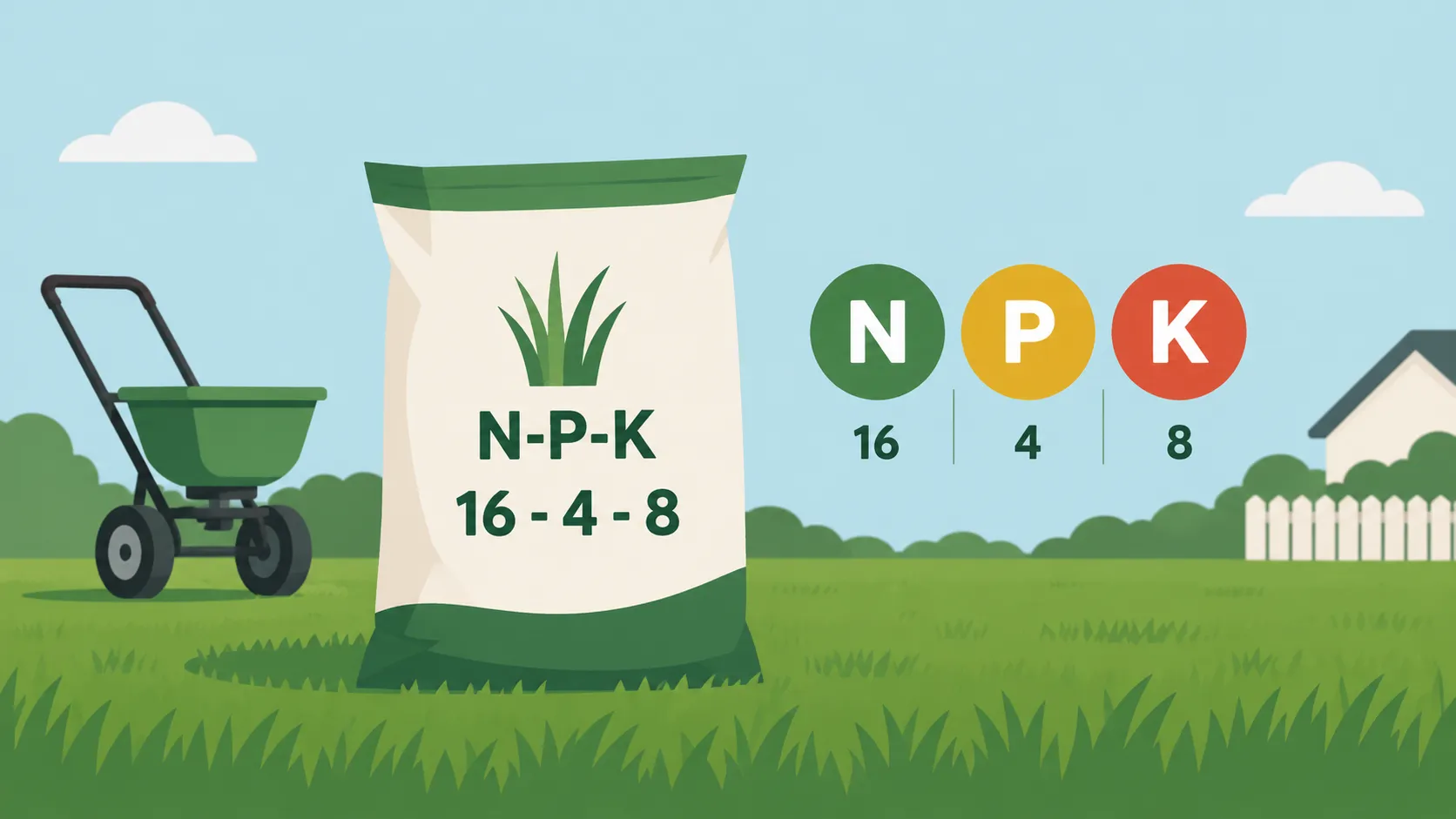
Here’s the short answer: the best NPK ratio for grass on an established lawn is 4-1-2 or 3-1-2, such as a 16-4-8 or 12-4-8 bag, when you don’t have a soil test. That nitrogen-heavy balance matches what mature turf actually uses, and it’s the maintenance ratio Virginia Cooperative Extension recommends for home lawns.
That answer shifts if you’re seeding a new lawn, growing Bermuda in Texas instead of fescue in Ohio, or living in a state that restricts phosphorus. Each of those changes the bag you should buy.
What Is the Best NPK Ratio for Grass?
For most established lawns, the best NPK ratio for grass is 4-1-2, with 3-1-2 a close second. In plain terms, grass wants about four parts nitrogen for every one part phosphorus and two parts potassium.
Why 4-1-2 Is the Standard NPK Ratio for Grass
Grass is a leaf crop. You mow off fresh growth every week, and that growth is built mostly from nitrogen. Mature lawns need far more nitrogen than phosphorus or potassium, which is why Virginia Tech’s turf specialists list 4-1-2 and 4-1-3 as the commonly recommended ratios.
Illinois Extension goes a step further and recommends 3:0:2 or 4:0:2. That zero in the middle isn’t a typo.
Here’s the thing: many established lawns already hold enough phosphorus in the soil. Adding more every year wastes money and can wash into lakes and streams. That’s why so many store bags now carry a zero as the middle number.
How to Read the NPK Ratio for Grass on a Fertilizer Bag
The three numbers on every bag are percentages by weight. A 16-4-8 bag is 16% nitrogen, 4% phosphate, and 8% potash. Phosphate and potash are simply the labeled forms of phosphorus and potassium.
To find the ratio, divide all three numbers by the smallest one that isn’t zero. So 16-4-8 divided by 4 becomes 4-1-2. A 12-4-8 bag becomes 3-1-2.
What about the rest of the bag? A 50-pound bag of 16-4-8 holds 8 pounds of nitrogen. The remaining weight is carrier material that lets you spread the nutrients evenly instead of scorching one spot.
Use this table to decode the bags you’ll see at a US garden center:
Bag | Ratio | Use it for |
|---|---|---|
16-4-8 | 4-1-2 | Routine lawn feeding |
12-4-8 | 3-1-2 | Routine feeding, extra K |
23-3-7 | 8-1-2 | High-nitrogen feeding |
28-0-12 | 7-0-3 | Phosphorus-free states |
24-25-4 | 6-6-1 | New seed or sod |
10-10-10 | 1-1-1 | Garden beds, not lawns |
What N, P, and K Each Do for Your Grass
Nitrogen (N) drives leaf growth and deep green color. A lawn short on nitrogen turns pale yellow-green and grows slowly. Too much causes a flush of soft growth that invites disease and insects, as Illinois Extension warns.
Phosphorus (P) builds roots. It matters most for seedlings and new sod, and far less for a lawn that has been growing for years.
Potassium (K) is the stress nutrient. It helps grass handle heat, cold, drought, foot traffic, and disease. That’s why fall “winterizer” blends lean on the third number.
NPK Ratio for Grass by Grass Type and Season
The NPK ratio for grass stays nitrogen-heavy almost everywhere in the US. What changes from Minnesota to Florida is how much nitrogen your lawn needs each year and when you put it down.
Cool-Season Grass NPK Ratio (Northern US)
Kentucky bluegrass, tall fescue, perennial ryegrass, and fine fescue cover most lawns in the North, Midwest, Northeast, and Pacific Northwest. For these grasses, stick with 4-1-2 or 3-1-2, or a phosphorus-free 4-0-2 style bag if your soil already has enough phosphorus.
How much nitrogen? Purdue Extension puts low-maintenance cool-season lawns at 1 to 3 pounds of actual nitrogen per 1,000 square feet per year, and well-kept lawns at 3.5 to 4 pounds. Fine fescues want less, around 1 to 2 pounds.
Timing matters more than most people think. Cool-season grass does its real growing in fall, so the late summer to early fall feeding is the most important one of the year. Heavy nitrogen in July heat does more harm than good.
Warm-Season Grass NPK Ratio (Southern US)
Bermuda, zoysia, St. Augustine, and centipede dominate the South, Southwest, and Gulf Coast. The same 4-1-2 starting point works here, but appetite varies wildly from one grass to the next. Not sure which one you have? Our guide to warm season grass types helps you identify it.
The University of Florida IFAS guidelines show the spread clearly. Bermuda can take 3 to 7 pounds of nitrogen per 1,000 square feet a year depending on how far south you are. Centipede gets by on as little as 0.4 to 3 pounds.
But wait: more nitrogen doesn’t always mean a better lawn. Virginia Tech notes that centipede and mature zoysia perform best at just 1 to 2 pounds a year. Pushing them harder for darker color invites thatch and disease.
One more rule for warm-season lawns: wait until the grass has fully greened up in spring before the first feeding.
NPK Ratio for New Grass Seed and Sod
New lawns flip the script. Seedlings need roots before they need leaves, so phosphorus takes the lead. Starter blends like 24-25-4 or 18-24-12 have a middle number equal to or higher than the first.
Even most phosphorus-restricted states make an exception for new seed and sod. Once the grass is established, usually after 6 to 8 weeks, switch back to a maintenance ratio. For product picks and application rates, see our full guide on starter fertilizer for new grass seed.
How the NPK Ratio for Grass Shifts From Spring to Fall
Spring and summer feedings stay nitrogen-forward for both grass groups. Warm-season lawns get their heaviest feeding in late spring and summer, while cool-season lawns get a light spring feeding at most.
Fall is where potassium earns its spot. Illinois Extension describes winterizer fertilizers as high in both nitrogen and potassium, because potassium helps grass handle cold and other stress. For exact dates in your region, follow our lawn fertilizer schedule.
Grass | Ratio | Nitrogen per year |
|---|---|---|
Bluegrass, tall fescue, ryegrass | 4-1-2 or 4-0-2 | 1 to 4 lb |
Fine fescue | 4-1-2 or 4-0-2 | 1 to 2 lb |
Bermuda | 4-1-2 or higher N | 3 to 7 lb |
St. Augustine | 4-1-2 or 4-0-2 | 2 to 6 lb |
Zoysia | 4-1-2 | 1 to 4.5 lb |
Centipede | 4-1-2, light rates | 0.4 to 3 lb |
Nitrogen is in pounds per 1,000 square feet per year. Ranges come from Purdue Extension, Virginia Tech, and UF/IFAS. Southern ranges run higher where the growing season is longer.
How Much Fertilizer to Apply for the Right NPK Ratio for Grass
Picking the right NPK ratio for grass is only half the job. Put down too much and you burn the lawn; put down too little and nothing happens. The fix is to measure by pounds of nitrogen, not pounds of product.
The 1-Pound Nitrogen Rule and the Spreader Math
Most extension services build every feeding around one number. Illinois Extension suggests about 1 pound of nitrogen per 1,000 square feet per application in most cases. Here’s the simple formula:
Pounds of product per 1,000 sq ft = pounds of nitrogen you want ÷ (first number on the bag ÷ 100)
Let’s run a real example. You have a 5,000 square foot lawn and a bag of 16-4-8.
- Divide 1 by 0.16 to get 6.25 pounds of product per 1,000 square feet.
- Multiply by 5 (for 5,000 square feet) to get about 31 pounds of product.
- A 50-pound bag covers your lawn once, with about 19 pounds left for next time.
Don’t want to do the math by hand? The free Purdue Turf Fertilizer Calculator does it for you and even compares cost per pound of nitrogen between bags.
One more thing: the right amount only works if your spreader puts it down evenly. Purdue’s guide on calibrating your spreader walks through gate settings and overlap so you avoid those yellow and dark green stripes.
Slow-Release vs. Quick-Release and the Single-Application Limits
The type of nitrogen in the bag changes how much you can safely apply at once. Quick-release nitrogen, like urea, greens the lawn fast but can burn grass and wash away. Slow-release nitrogen feeds evenly over several weeks and is far less likely to burn, as Illinois Extension’s comparison table shows.
How do you tell which one you have? Look for water insoluble nitrogen (WIN) in the guaranteed analysis on the back of the bag. Virginia Tech treats a fertilizer as slow-release when 15% or more of its nitrogen is in slowly available form, and shows how to calculate it from the label.
How much nitrogen can you put down at once? Most guidelines land between 0.7 and 1 pound of quick-release nitrogen per 1,000 square feet per feeding.
Illinois Extension sets the cap at 1 pound per application. Virginia Tech is stricter for cool-season lawns at 0.7 pound per growing month, or 0.9 pound with slow-release products. Its warm-season guidance allows 0.9 pound of quick-release or 1 pound of slow-release nitrogen.
Florida goes its own way. The Urban Turf Fertilizer Rule limits quick-release nitrogen to 0.7 pound at any one time, but allows up to 2 pounds in spring or summer when at least 65% of the nitrogen is controlled-release.
If your state has no rule of its own, the 1-pound rule is a safe ceiling. Whatever you use, sweep any granules off the driveway and sidewalk back onto the grass so they don’t end up in storm drains.
When to Change the Standard NPK Ratio for Grass
Two things override the 4-1-2 default: what your soil test says and what your state allows. Either one can move you to a different bag.
What a Soil Test Tells You That the Bag Can’t
A soil test measures your phosphorus, potassium, and pH, which are exactly the numbers the bag is guessing at. Virginia Tech puts it simply: if your test shows low or medium phosphorus or potassium, use a complete fertilizer; if both are high or very high, a nitrogen-only product is all you need. Retest about every 3 years.
Reading the results is easier than it looks. Say the lab recommends 4 pounds of nitrogen, 1 pound of phosphate, and 2 pounds of potash per 1,000 square feet per year. That’s a 4-1-2 ratio, so a 16-4-8 bag matches it.
Taking the sample takes about 15 minutes. Penn State Extension’s short video on how to take a soil sample shows the tools and depth. Your county extension office can usually send it to your state university’s lab, or you can pick from Purdue’s list of soil testing laboratories.
Here’s why: if your soil pH is off, nutrients get locked up and fertilizer seems to stop working no matter which ratio you pick. Our guide to soil amendments for lawns covers how to fix pH with lime or sulfur.
State Phosphorus Laws That Affect Your NPK Ratio for Grass
In some states, the middle number isn’t just a choice. By 2012, at least 11 states had banned or restricted phosphorus lawn fertilizer: Illinois, Maine, Maryland, Michigan, Minnesota, New Jersey, New York, Vermont, Virginia, Washington, and Wisconsin, according to a Connecticut legislative research report.
The reason is water quality. Phosphorus that runs off lawns feeds algae blooms in lakes and rivers, which drain oxygen from the water and can kill fish. The same report explains this process, called eutrophication, in plain terms.
Most of these laws share the same exceptions. You can still use phosphorus when a soil test shows a deficiency, when you’re seeding or sodding a new lawn, or in some states when repairing turf.
Minnesota, the first state to pass such a law, tells homeowners to look for the zero in the middle. A bag like 22-0-15 is phosphorus-free. Florida takes a different route: its Urban Turf Fertilizer Rule caps phosphate at 0.25 pound per 1,000 square feet per application and 0.50 pound per year unless a soil test shows a need.
Laws change, and some counties and cities add their own rules. Check with your state department of agriculture before buying, especially if you live near a lake or river.
Frequently Asked Questions About NPK Ratio for Grass
Is 10-10-10 fertilizer good for grass?
It works, but it’s rarely the best NPK ratio for grass. A 10-10-10 bag has a 1-1-1 ratio, so every pound of nitrogen comes with a full pound each of phosphate and potash your established lawn probably doesn’t need. In phosphorus-restricted states, using it on an established lawn without a soil test can also break the law.
What NPK ratio makes grass greener fastest?
A high first number with quick-release nitrogen, like a 29-0-4 or 46-0-0 urea, greens grass within days. The trade-off is a higher burn risk and a shorter effect. A slow-release 4-1-2 product greens more gradually but evenly. For realistic timelines by product type, see how long fertilizer takes to work.
What is the best NPK ratio for grass in spring?
For cool-season lawns, a light feeding of 4-1-2 or 4-0-2 with slow-release nitrogen is enough, since the big feeding comes in fall. For warm-season lawns, wait until the grass has fully greened up, then use 4-1-2 at your normal rate.
What is the best NPK ratio for Bermuda grass?
Bermuda does well on 4-1-2 or a higher-nitrogen blend like 23-3-7. It’s one of the hungriest lawn grasses, taking 3 to 7 pounds of nitrogen per 1,000 square feet a year depending on your region, according to UF/IFAS. Spread that across feedings about 4 weeks apart during summer.
Can I use garden fertilizer on my lawn?
In a pinch, yes, but it’s not ideal. Garden fertilizers are usually balanced or high in phosphorus to push flowers and fruit, while grass needs a nitrogen-heavy NPK ratio. Using one regularly wastes money and builds up phosphorus your lawn can’t use.
Final Thoughts
The right NPK ratio for grass isn’t a mystery once you know what your lawn is asking for. Here’s what to remember:
- Start with 4-1-2 or 3-1-2 (like 16-4-8) for an established lawn without a soil test.
- Match nitrogen to your grass type. Bermuda and St. Augustine eat far more than centipede or fine fescue.
- Switch to a high-phosphorus starter only for new seed or sod, then go back to maintenance.
- Check your state’s phosphorus law and use a zero-middle bag if you live in a restricted state.
Your next step is simple: send off a soil test before your next feeding. Then pick a bag that matches your grass, your region, and your results, and follow our lawn fertilizer schedule to time it right.
About Author
Khalid Fazal is a seasoned lawn care specialist and horticultural researcher with over 15 years of hands-on experience transforming challenging landscapes into lush, resilient green spaces. His journey didn’t start in a lab, but in a backyard full of stubborn, cracked clay that “experts” said would never grow a healthy blade of grass. Refusing to accept a yard full of dust, Khalid spent years experimenting with organic soil restoration and precise mulching, eventually turning that wasteland into a neighborhood showpiece on a shoestring budget.
From mastering core aeration techniques to optimizing soil pH for specialized turf varieties, Khalid’s approach combines old-school grit with modern agronomic science. He founded Gen Lawn to provide homeowners with honest, research-backed advice that prioritizes long-term soil health over quick-fix chemical solutions. When he isn’t analyzing soil profiles, he’s developing precision tools to help others achieve professional results without the professional price tag.

Lawn Winterizer: When to Apply by Grass & Region [2026]
Table of Contents Home / By Khalid Fazal | Updated:...
Read More
Spring Lawn Care: What to Do and When in Every US Region
Table of Contents Home / By Khalid Fazal | Updated:...
Read More
Lawn Maintenance Checklist by Season and Grass Type (2026)
Table of Contents Home / By Khalid Fazal | Updated:...
Read More
Liquid Fertilizer vs Granular Fertilizer: Which Wins?
Table of Contents Home / By Khalid Fazal | Updated:...
Read More