
Grub Control Products for Lawns: What to Buy, When to Apply, and What Doesn’t Work
Brown patches that peel back like loose carpet. Skunks and raccoons tearing up the turf overnight. And a $40 bag of grub killer that didn’t change a thing.
Here’s the thing: most grub control products for lawns work fine. They fail because the active ingredient doesn’t match the time of year. Preventive products must be in the soil before beetle eggs hatch in early summer, while curative products are for grubs already chewing roots and work best while those grubs are still small.
Get the ingredient and the timing right, and one application usually solves the problem. Get them wrong, and you’ve paid to water chemicals into soil where nothing is feeding. If grubs are only one of several pests in your yard, our lawn care and pest control guide covers the full picture.
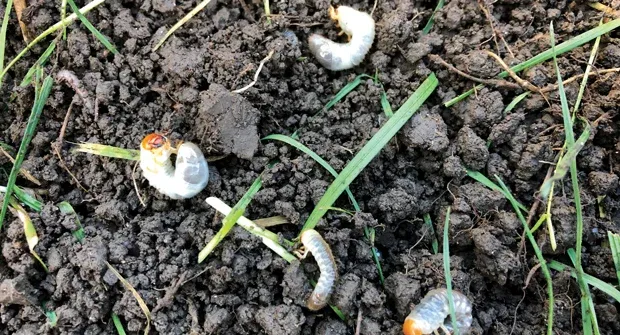
Do You Really Need Grub Control Products for Your Lawn?
Only if you find enough grubs to cause damage. A few grubs live in almost every healthy lawn, and Michigan State University entomologists are clear that finding one or two is no reason to treat.
Grub Damage or Drought Stress?
Both start the same way: wilting, gray-green grass that turns brown in irregular patches. The difference shows up when you pull on it.
Grub-damaged turf has no roots left, so it lifts off the soil like a loose rug. Drought-stressed grass stays anchored. If you are still unsure, our guide to brown patches on lawns in summer covers the other common causes.
Animal activity is the other giveaway. Skunks, raccoons, crows, and moles dig for grubs, and in the South, armadillos join in. According to Penn State Extension, grub damage usually shows up in April and May, then again in September and October. If critters are already tearing up your yard, here is how to stop raccoons from digging up grass while you deal with the grubs underneath.
Do the Square-Foot Test Before Buying Grub Control Products
Here’s how to check in a few minutes with nothing more than a flat spade:
- Cut three sides of a 1-foot square, 2 to 4 inches deep, at the edge of a damaged patch.
- Fold the turf back like a page and break apart the soil and thatch (the spongy layer of dead stems between the grass blades and the soil).
- Count the cream-colored, C-shaped grubs with brown heads.
- Repeat in 3 to 5 spots, including one area that still looks healthy.
- Press the sod back down and water it so it reroots.
Penn State recommends sampling from August through early September for the most accurate picture. Want to know exactly which beetle you are dealing with? Ohio State’s white grub identification guide shows the raster pattern, the arrangement of tiny hairs on the grub’s rear end that tells species apart under a hand lens.
How Many Grubs Per Square Foot Is Too Many?
It depends on the species, because bigger grubs eat more roots. These treatment thresholds come from University of Maine Cooperative Extension:
Grub species | Treat at (per sq ft) |
|---|---|
May and June beetle | 3 to 4 |
European chafer | 5 to 8 |
Oriental beetle | 8 |
Japanese beetle | 8 to 10 |
Asiatic garden beetle | 18 to 20 |
Healthy, well-watered turf can handle a few more. Not sure of the species? Penn State uses 5 to 10 grubs per square foot as a general trigger.
One more thing: you do not need grub control products every year by default. Michigan State calls the idea that every lawn near Japanese beetles must be treated annually a mistake. If you have treated for a few seasons and your square-foot tests come up clean, it is time to stop.
Types of Grub Control Products for Lawns: Read the Active Ingredient, Not the Brand
Every grub product on the shelf does one of two jobs. It either prevents the next generation of grubs, or it kills the grubs feeding right now. The brand name won’t tell you which, but the active ingredient on the back of the bag will.
Here’s a shortcut for the store aisle: bags that say “Season Long” are preventive, and bags that say “24 Hour” are curative.
Preventive Grub Control Products: Chlorantraniliprole and Imidacloprid
Preventive products sit in the root zone and kill young grubs as they hatch and start feeding. They are the most reliable option, but only if they are down before the damage starts.
Scotts GrubEx1 uses 0.08% chlorantraniliprole and is limited to one application per year. A 28.7 lb bag covers 10,000 square feet. According to the National Pesticide Information Center, chlorantraniliprole is very low in toxicity to people and mammals. UMass Extension adds that it needs no signal word on the label, shows no activity against bees, and controls every major grub species in the Northeast, plus armyworms and cutworms.
The catch? It works slowly. The grass roots have to absorb it before grubs feed, so it needs weeks of lead time and does nothing for large grubs already chewing.
BioAdvanced Season Long Grub Control uses 0.25% imidacloprid, a neonicotinoid. That is a systemic insecticide, meaning the plant absorbs it and grubs die when they eat the roots. UMass found imidacloprid applied too early can wear off before late-summer grubs arrive, and it does not control Asiatic garden beetle grubs.
Local note: Maine homeowners cannot use this one. The Maine Board of Pesticides Control prohibits imidacloprid, clothianidin, thiamethoxam, and dinotefuran on residential lawns.
Curative Grub Control Products for Active Infestations: Trichlorfon and Carbaryl
Curative products kill on contact and break down fast. Use them only after a square-foot test confirms grubs above the threshold.
BioAdvanced 24 Hour Grub Killer Plus contains 9.3% trichlorfon, an organophosphate insecticide (the same active ingredient sold to professionals as Dylox). UMass reports that it kills within one to three days and breaks down within seven to ten. The label requires watering it in within 24 hours.
But here’s the problem: once grubs reach full size, often by mid-September, UMass says curative treatments seldom cut populations by more than half. Timing matters more than the product. In Maine, trichlorfon must be applied by a licensed professional.
Carbaryl (sold as Sevin) is the other curative option, but UMass rates it inconsistent and very toxic to bees.
Organic Lawn Grub Control: Nematodes, Btg, and the Milky Spore Problem
Biological options work, but they demand more care and give less predictable results.
Beneficial nematodes are microscopic roundworms that hunt grubs in the soil. Buy the species Heterorhabditis bacteriophora (often labeled Hb), which UC IPM notes actively searches below the surface. UC IPM recommends applying in late summer or early fall, only when soil is 60°F or warmer, watering before and after, applying in the evening, and repeating two weeks later.
Btg (Bacillus thuringiensis galleriae, sold as grubGONE) is a naturally occurring bacterium. UW-Madison Extension lists it as a biological option but warns that results vary widely compared to chemical products.
Now, milky spore. It is still heavily marketed, but UW-Madison states it has not proven effective for white grub control in recent university research. Penn State adds that it only targets Japanese beetle grubs and can take three to five years to establish. Skip it.
Lawn Insect Killers That Fall Short on Grubs
General lawn insect killers often list grubs on the label, and that’s where a lot of money gets wasted.
Spectracide Triazicide Insect Killer for Lawns uses 0.05% gamma-cyhalothrin, a pyrethroid. Its label does list Japanese beetle and green June beetle grubs. However, Michigan State research, reported by Turf Magazine from a University of New Hampshire Extension specialist, found that products containing only pyrethroids such as gamma-cyhalothrin, lambda-cyhalothrin, or bifenthrin do not work for grub control.
These products are fine for ants, fleas, and surface insects. Just don’t count on them for grubs.
Which Grub Control Product Should You Buy?
Product | Type | Buy it if |
|---|---|---|
Scotts GrubEx1 | Preventive | You had grub damage last year |
BioAdvanced Season Long | Preventive | You plan a June or July application |
BioAdvanced 24 Hour | Curative | Your test finds grubs in Aug or Sept |
Hb nematodes | Organic | You want a non-chemical option |
Spectracide Triazicide | Skip | Not reliable for grubs |
When to Apply Grub Control Products for Lawns by US Region
The right window depends on when beetles lay eggs where you live. Preventive products must be in the root zone when eggs hatch, and curative products must hit grubs while they are still small.
Here is the simple version for most US lawns:
Region | Preventive window | Curative window |
|---|---|---|
Northeast | Mid-April to early June | August to mid-September |
Midwest | May to early July | August to September |
Texas and South | June to early July | Late summer, once grubs are confirmed |
The preventive dates above are for chlorantraniliprole. Using an imidacloprid product instead? In the North, wait until mid-June to July.
Northern and Midwest Lawns (Cool-Season Grass)
Most northern grub problems come from Japanese beetles, European chafers, and masked chafers. These beetles fly in early summer and lay eggs from late June through July.
For chlorantraniliprole, UMass Extension recommends mid-April to early June in New England. In Maine, UMaine Extension suggests about late April, roughly three weeks before May and June beetle grubs move up to feed. For imidacloprid, UMass advises waiting until mid-June because early applications can wear off too soon.
Timing also shifts by species. UW-Madison Extension puts the preventive window for May and June beetles at May to early June, but June to July for Japanese beetles. That’s one more reason the square-foot test and species ID pay off.
Southern and Texas Lawns (Warm-Season Grass)
In the South, the main culprits are May and June beetles and the southern masked chafer. They feed on bermudagrass, zoysia, St. Augustine, and buffalograss.
Texas A&M AgriLife Extension says June is generally the ideal treatment time in south Texas, while early July fits north Texas. Their practical cue: apply after the June beetle mating flights end. Those are the night swarms around porch lights and windows.
Applying too early is the most common mistake here. Texas A&M notes that preventive products put down too soon can break down before the grubs even hatch.
Outside Texas, use the same logic and check with your county Cooperative Extension office for local beetle flight dates.
Why Spring Grub Control Treatments Usually Disappoint
Spring is when most people notice the damage, so it’s when most people buy grub control. It is also the worst time to use it.
Penn State Extension explains that spring grubs are larger and harder to kill. A curative treatment in April or May also gives zero protection against the new eggs laid later that summer. Texas A&M goes further, noting that spring feeding in Southern lawns is not significant and control is not recommended.
So what should you do in spring? Rake out dead turf, reseed bare spots once grubs stop feeding in late May, and mark your calendar for the preventive window.
How to Apply Grub Control Products for the Best Results
The right product at the right time still fails if it never reaches the root zone. Results come down to three things: even coverage, watering it in, and protecting everyone who uses the yard.
Measure, Spread, and Water It In
Start by measuring your lawn so you buy the right bag size. Our free lawn and garden calculator handles odd shapes, and for reference, a 28.7 lb bag of GrubEx1 covers 10,000 square feet.
Next, set your spreader to the setting printed on the bag. If your spreader isn’t the brand listed, take ten minutes to calibrate it, which simply means checking how much product it actually puts down. University of Missouri Extension has a clear step-by-step guide for both drop and rotary spreaders.
Then spread on dry grass and sweep any granules off the driveway and sidewalk back onto the lawn.
Now the step most people skip: water it in. UW-Madison Extension says every grub product needs about half an inch of water after application to move it into the root zone, and skipping this step leads to poor control. If your soil is bone dry, Texas A&M suggests a quarter to half inch of water the day before, too. Set a few empty tuna cans on the lawn to measure how much your sprinkler delivers.
Keeping Kids, Pets, and Pollinators Safe
Keep kids and pets off the lawn until the product has been watered in and the grass is dry, which is what both the GrubEx1 and 24 Hour Grub Killer Plus labels direct. Sweep up spills right away, because the National Pesticide Information Center notes that young children and pets can mistake granules for food crumbs.
For bees, the biggest risk comes from flowering weeds like clover and dandelions. A UW-Madison Extension pollinator guide recommends mowing right before you apply, which removes more than 90% of the flowers. It also notes that granular products move into the soil once watered, leaving no residue in the flowers, and that chlorantraniliprole has shown no harmful effects on pollinators that ingest it.
One more caution: chlorantraniliprole is highly toxic to aquatic insects and crayfish. Keep it well away from ponds, streams, and storm drains.
Repairing Your Lawn After Grub Control
Grass killed by grubs will not come back on its own, because the roots are gone. Rake out the dead turf and reseed.
For cool-season lawns, fall is the best time to reseed, and our guide to overseeding your lawn in fall walks through the timing step by step. If the damage shows up in spring, UMaine Extension notes you can safely reseed by the end of May, once most grubs stop feeding and pupate.
Frequently Asked Questions About Grub Control Products for Lawns
What is the most effective grub control product for lawns?
It depends on timing. For prevention, chlorantraniliprole (Scotts GrubEx1) is the strongest all-around choice because it controls every major grub species and carries the lowest risk to bees. For grubs already feeding in late summer, trichlorfon (BioAdvanced 24 Hour Grub Killer Plus) is the fastest curative option.
Is it too late to apply grub control to my lawn in fall?
Usually, yes, once you reach mid-October. By mid-September most grubs are full size, and curative treatments rarely kill more than half of them. As the soil cools, Penn State Extension notes that grubs move 2 to 8 inches deeper to overwinter, out of reach. Your better move is to repair the turf and plan a preventive application next season.
Can you put down grub control and fertilizer on the same day?
In most cases, yes. Most granular grub control products can go down alongside fertilizer, but check both labels for restrictions and water everything in afterward. Our lawn fertilizer schedule shows when to feed grass in your region, so you can line up both jobs.
Do I need to use grub control products every year?
No. Treat only if your square-foot test finds grubs above the threshold or your lawn has a history of damage. Michigan State University advises that if you’ve treated for several years and see no grubs in your lawn or your neighbor’s, it may be time to stop.
Are lawn grub control products safe for dogs and kids?
They are when you follow the label. Chlorantraniliprole is very low in toxicity to people and mammals, while trichlorfon is an organophosphate and calls for more caution. With either one, keep kids and pets off the lawn until it’s watered in and dry, sweep up stray granules, and store bags out of reach.
Final Word on Grub Control Products for Lawns
Grub control isn’t complicated once you stop shopping by brand and start shopping by ingredient and calendar.
- Confirm first. Dig a square-foot test and compare your count to the threshold for your grub species.
- Match the job. Use “Season Long” preventive products before eggs hatch and “24 Hour” curative products only on small, actively feeding grubs.
- Time it for your region. Mid-April to early July works across most of the North, while June to early July fits Texas and the South.
- Water it in every time. About half an inch of water moves the product to the roots where grubs feed.
Your next step: grab a spade this weekend, check three spots in your yard, and set a reminder for your preventive window next spring.
About Author
Khalid Fazal is a seasoned lawn care specialist and horticultural researcher with over 15 years of hands-on experience transforming challenging landscapes into lush, resilient green spaces. His journey didn’t start in a lab, but in a backyard full of stubborn, cracked clay that “experts” said would never grow a healthy blade of grass. Refusing to accept a yard full of dust, Khalid spent years experimenting with organic soil restoration and precise mulching, eventually turning that wasteland into a neighborhood showpiece on a shoestring budget.
From mastering core aeration techniques to optimizing soil pH for specialized turf varieties, Khalid’s approach combines old-school grit with modern agronomic science. He founded Gen Lawn to provide homeowners with honest, research-backed advice that prioritizes long-term soil health over quick-fix chemical solutions. When he isn’t analyzing soil profiles, he’s developing precision tools to help others achieve professional results without the professional price tag.

Crabgrass Pre Emergent: When to Apply It by US Region [2026]
The bag says to apply crabgrass pre emergent in “early...
Read More
Grub Control Products for Lawns: What to Buy and When
Table of Contents Home / By Khalid Fazal | Updated:...
Read More
Lawn Winterizer: When to Apply by Grass & Region [2026]
Table of Contents Home / By Khalid Fazal | Updated:...
Read More
Spring Lawn Care: What to Do and When in Every US Region
Table of Contents Home / By Khalid Fazal | Updated:...
Read More