Best Fungicide for Lawns: 6 Picks Matched to Your Disease
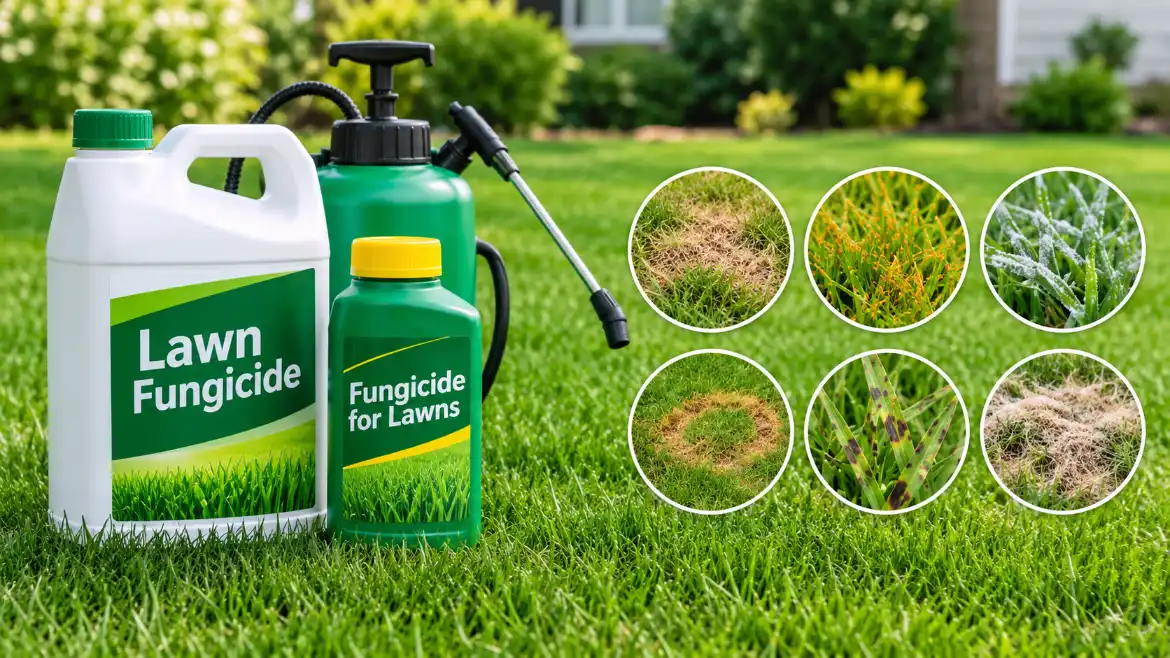
You spread fungicide, waited two weeks, and the brown circles kept growing. That isn’t bad luck. Every lawn fungicide works on a specific set of diseases, and the best-selling one at the garden center does almost nothing against one of the most common lawn diseases in the country.
Here’s the proof. Virginia Tech turfgrass pathologist David McCall notes that azoxystrobin is excellent on brown patch but has essentially no activity against dollar spot. Buy the wrong active ingredient and you are paying to watch the disease spread.
So the best fungicide for lawns is the one matched to your disease, your grass type, and your season. These are the six worth buying, and exactly what each one controls.
Pick | Best for |
|---|---|
Scotts DiseaseEx | Brown patch |
Propiconazole 14.3 | Dollar spot |
Pillar G Intrinsic | Mixed diseases |
Armada 50 WDG | Large lawns |
Spectracide Immunox | Fungus plus bugs |
GreenCure | Lower toxicity |
The Best Fungicide for Lawns: 6 Picks by Disease
Each pick below wins for a specific job. Read what it controls, and just as important, what it doesn’t.
Best Fungicide for Lawns With Brown Patch: Scotts DiseaseEx
Scotts DiseaseEx is the easiest strong option you can buy at a big-box store. It contains 0.31% azoxystrobin, a systemic strobilurin that moves into the grass blade instead of sitting on top of it.
Scotts says it starts working within 24 hours and keeps controlling disease for up to 4 weeks. One 10 lb bag covers 5,000 sq ft, and you can reapply every 14 to 28 days.
It’s labeled for 26 diseases, including brown patch, red thread, gray leaf spot, summer patch, pythium blight, and both snow molds. That makes it the go-to for summer brown patches on tall fescue and for large patch on warm-season grass.
The catch: dollar spot is not on its list. If you see small, silver-dollar-sized straw spots, skip this one and go to propiconazole.
Best Fungicide for Dollar Spot: Propiconazole 14.3
Propiconazole 14.3 is a liquid concentrate in FRAC Group 3, the DMI family. It’s the fix for dollar spot fungus, the disease azoxystrobin can’t touch.
The label rate runs from 0.5 to 4 fl oz per 1,000 sq ft depending on the disease. It also controls brown patch, rust, gray leaf spot, summer patch, anthracnose, and pink and gray snow mold. A quart goes a long way, so the cost per application is low.
Two things to know. Don’t go over 16 fl oz per 1,000 sq ft in a year, because heavy rates can briefly stunt grass. And dollar spot has widely documented resistance to DMIs, so rotate it with a different group instead of spraying it all summer.
Best Granular Fungicide for Lawns With Mixed Diseases: Pillar G Intrinsic
Not sure which disease you have, or fighting two at once? Pillar G Intrinsic packs two active ingredients into one granule: pyraclostrobin (Group 11) and triticonazole (Group 3).
That combo covers both sides of the gap. It’s labeled for dollar spot, brown patch, large patch, take-all patch, leaf spots, and snow molds. Apply 3 lb per 1,000 sq ft every 14 to 28 days, with a cap of 5 applications per year. A 30 lb bag treats 10,000 sq ft.
It’s the product Virginia Tech’s McCall points homeowners to when standard granular products keep failing, because it’s formulated for better spread. It costs more than retail brands and you’ll usually buy it online, but one bag replaces two products.
Best Liquid Combo for Large Lawns: Armada 50 WDG
Armada 50 WDG is a professional-grade powder you mix with water and spray. Like Pillar G, it pairs a Group 11 (trifloxystrobin) with a Group 3 (triadimefon).
The label rate is 0.6 to 1.5 oz per 1,000 sq ft, and one 2 lb jug treats up to 50,000 sq ft. For an acre-plus lawn, that’s the lowest cost per square foot on this list. It controls dollar spot, brown patch, gray leaf spot, red thread, summer patch, rust, and pink snow mold.
The catch: it works best in a preventive program, not as a rescue spray. It isn’t sold in Alaska or Arkansas, and New York restricts it to licensed applicators.
Best Budget Lawn Fungicide for Fungus Plus Insects: Spectracide Immunox
Spectracide Immunox Fungus Plus Insect Control for Lawns is a hose-end bottle you hook up and spray. One 32 oz bottle covers 2,500 sq ft and protects for up to 2 weeks. It’s rainproof within hours.
It combines propiconazole for brown patch, rust, and dollar spot with lambda-cyhalothrin, an insecticide that kills ants, sod webworms, fleas, and ticks on contact. That’s handy when you can’t tell whether brown grass is fungus or bugs.
The catch: the 2-week window means more frequent spraying. And lambda-cyhalothrin is highly toxic to bees, so don’t spray it over blooming clover or flowering weeds.
Best Lower-Toxicity Lawn Fungicide: GreenCure
GreenCure is 85% potassium bicarbonate, a cousin of baking soda. UC IPM rates potassium bicarbonate as low in acute toxicity to people and other mammals.
Its turf label covers dollar spot, powdery mildew, rust, anthracnose, and several leaf spots. Mix 1 to 2 tablespoons per gallon of water, which covers about 450 sq ft, and repeat every 1 to 2 weeks while the weather favors disease.
The catch: it’s a contact fungicide, so it only protects what it touches and needs frequent reapplying. Brown patch isn’t on its label. It makes sense for small lawns, not big brown patch outbreaks.
Best Fungicide for Lawns by US Region and Grass Type
Where you live decides which diseases show up, and when. A Minnesota bluegrass lawn and a Houston St. Augustine lawn need completely different fungicides on completely different calendars.
Cool-Season Lawns (North, Midwest, Northeast)
If you grow cool-season grass like Kentucky bluegrass, perennial ryegrass, or fine fescue, dollar spot is your main summer threat.
According to Penn State Extension, it usually peaks in late summer during humid weather between about 60°F and 85°F, and it can flare again in early fall when nights cool off. Look for white, cobweb-like threads on the grass at dawn while dew is still on it.
Your best fungicide here is propiconazole or a two-way combo like Pillar G. Azoxystrobin alone won’t stop it.
Here’s the thing: lawns low on nitrogen get hit harder. A late-spring feeding often reduces dollar spot enough that you never need to spray. In late winter, snow mold patches are the other common problem, but most recover on their own.
Transition Zone (Virginia, North Carolina, Tennessee, Kentucky, Missouri)
The transition zone runs on tall fescue, and tall fescue’s enemy is brown patch.
University of Missouri Extension uses a simple rule: watch for nights near 68°F and days near or above 86°F. Virginia Tech puts peak activity in July and August. The patches are tan circles 6 inches or wider, sometimes with white, cottony threads along the edge early in the morning.
The best fungicide for lawns in this zone is azoxystrobin (Scotts DiseaseEx), applied before nights stay in the upper 60s. Pair it with good habits: water early in the morning, skip summer nitrogen, and keep tall fescue cut at 3.5 to 4 inches through the heat.
Warm-Season Lawns (South, Texas, Florida, Gulf Coast)
If you grow warm-season grass, your three big diseases each run on their own clock.
Large patch hits St. Augustine and zoysia hardest. Texas A&M AgriLife recommends spraying in fall when soil temperature drops below 70°F, usually October to November, before symptoms appear. Fungicides do little once patches show, and spring sprays aren’t worth the money.
Gray leaf spot attacks St. Augustine in warm, rainy weather from May through September. UF/IFAS rates strobilurins (Group 11) as some of the most effective options, and warns that too much nitrogen makes it worse.
Spring dead spot shows up as bleached circles in Bermuda each spring, but the infection happens in fall. UGA Extension recommends one fall application when soil temperatures sit between 60°F and 80°F, plus a second 4 to 6 weeks later if pressure is high. Expect two to four years of consistent treatment for full control.
How to Choose the Best Fungicide for Your Lawn
Once you know the disease, four label details decide whether a product will actually work for you.
Preventive vs. Curative Rates
A preventive application goes down before the disease shows up. A curative application goes down after you see damage.
University of Illinois Extension compares fungicides to sunscreen: they prevent a burn, but they can’t heal one. A curative spray stops the spread, but the brown grass you already have won’t turn green again. It has to grow out.
That’s why most labels list two rates. Curative rates are higher and applied at shorter intervals, so waiting until you see damage costs you more product and more money.
Systemic vs. Contact Fungicides
Systemic fungicides like azoxystrobin and propiconazole soak into the grass blade. Once absorbed, rain and mowing don’t remove them, so they last 2 to 4 weeks.
Contact fungicides like potassium bicarbonate sit on the leaf surface. They only protect what they cover and wear off fast, which is why GreenCure needs a repeat every 1 to 2 weeks.
But wait: systemics carry a higher risk of the fungus becoming resistant. That’s where rotation comes in.
Granular vs. Liquid Lawn Fungicide
Granules are easier. You load a spreader and walk. Liquids take a sprayer and some mixing.
The tradeoff is coverage. Virginia Tech’s McCall explains that granules are harder to spread evenly than sprays, and thin spots in coverage lead to disease breaking through. If you’re using granules, calibrate your spreader and overlap your passes slightly.
As a rule, pick granular for convenience and mid-size lawns. Pick liquid when you need the strongest coverage or have a large property.
FRAC Groups and Why Rotation Matters
Every fungicide label carries a group number from the Fungicide Resistance Action Committee (FRAC). The number tells you how the chemical attacks the fungus. Products with the same number work the same way, so a fungus that survives one will survive the others.
The two groups you’ll see most on lawn products are Group 11 (strobilurins such as azoxystrobin and pyraclostrobin) and Group 3 (DMIs such as propiconazole and triticonazole).
Here’s why this matters. UC IPM guidelines (written for California) advise no more than one Group 11 application before switching to a different group, and no more than two back-to-back applications of most other groups. A simple homeowner rotation looks like this: Scotts DiseaseEx (Group 11), then Propiconazole 14.3 (Group 3), then back again. Combo products like Pillar G and Armada already contain both groups.
How to Apply Lawn Fungicide So It Actually Works
The right product at the wrong time or rate still fails. These three steps make the difference.
When to Apply Fungicide to Your Lawn
Spray when the weather turns favorable for your disease, not when the lawn already looks bad. Use these triggers:
- Brown patch: nights holding in the upper 60s°F with humid, wet weather
- Dollar spot: humid stretches between 60°F and 85°F with heavy morning dew
- Large patch and spring dead spot: fall, as soil temperature drops toward 70°F
- Gray leaf spot: warm, rainy summer weather on St. Augustine
If a disease hit your lawn last year, it often returns in the same spots. Treat those areas first and treat them early.
Rates, Intervals, and Watering In
Start by measuring your lawn. Rates are listed per 1,000 sq ft, and guessing leads to under-dosing (which fails) or over-dosing (which can stress the grass). Our free Lawn & Garden Calculator gives you the square footage in a minute.
Then follow the label for your specific disease. Most products repeat every 14 to 28 days. Respect the yearly caps: 16 fl oz per 1,000 sq ft for Propiconazole 14.3, 37 lb per 1,000 sq ft for Scotts DiseaseEx, and 5 applications for Pillar G.
How you water afterward depends on the form and the disease:
- Liquid sprays for leaf diseases like brown patch, dollar spot, and gray leaf spot should dry on the grass before irrigation. Armada’s label also says to mow first or wait until the spray dries.
- Granules usually need light watering so the active ingredient moves off the granule and into the grass.
- Root diseases like spring dead spot work better when watered in right away, according to UGA.
Mowing, Pets, and Kids After Treatment
The label is a legal document, and its re-entry instructions come first. Beyond that, the National Pesticide Information Center recommends keeping pets off treated grass until sprays are completely dry. For granular products, plan on 24 hours or longer while the granules dissolve and the lawn dries.
Pick up toys, bowls, and pet bedding before you start. Hold off mowing until a spray has dried so you don’t strip product off the blades.
Frequently Asked Questions
What is the best fungicide for brown patch in lawns?
Azoxystrobin is the strongest choice for brown patch, and Scotts DiseaseEx is the easiest way to buy it. Apply it preventively once nights stay in the upper 60s. Propiconazole also controls brown patch, but Virginia Tech notes its protection against brown patch is usually shorter.
Is granular or liquid fungicide better for lawns?
Liquid gives better, more even coverage, which means fewer breakthrough spots. Granular is easier to apply with a spreader you already own. For most homeowners with an average lawn, a quality granular like Scotts DiseaseEx or Pillar G works well if you spread it evenly.
When should I apply fungicide to my lawn?
Apply before the disease shows up, based on weather. That means early summer for brown patch and dollar spot on cool-season grass, and early fall for large patch and spring dead spot on warm-season grass. Curative sprays after damage appears need higher rates and won’t revive grass that’s already dead.
Can I mow or water after applying lawn fungicide?
Wait until a liquid spray dries on the grass before you mow or water, especially for leaf diseases. Most granular products need light watering to activate. Always check the label, since some products for root diseases should be watered in right away.
Is lawn fungicide safe for pets?
Pet safety comes down to timing and following the label. Keep pets off the lawn until sprays are fully dry, and for 24 hours or longer after granular products. Read the label’s re-entry instructions and remove toys and food bowls before you treat.
Pick the Fungicide That Fits Your Disease
The best fungicide for lawns isn’t one bottle. It’s the right active ingredient, put down at the right time, then rotated.
- Match the active ingredient to the disease: azoxystrobin for brown patch, propiconazole for dollar spot, a combo when you’re unsure.
- Apply preventively, ahead of your region’s disease season, not after the damage shows.
- Rotate Group 11 and Group 3 products to keep the fungus from building resistance.
- Measure your lawn and follow the label rate, interval, and yearly limit.
Your next step: identify the exact disease before you buy anything. Compare your patches against our guides to summer brown patches and dollar spot, measure your lawn with the calculator above, and buy the one product from this list that matches.
About Author
Khalid Fazal is a seasoned lawn care specialist and horticultural researcher with over 15 years of hands-on experience transforming challenging landscapes into lush, resilient green spaces. His journey didn’t start in a lab, but in a backyard full of stubborn, cracked clay that “experts” said would never grow a healthy blade of grass. Refusing to accept a yard full of dust, Khalid spent years experimenting with organic soil restoration and precise mulching, eventually turning that wasteland into a neighborhood showpiece on a shoestring budget.
From mastering core aeration techniques to optimizing soil pH for specialized turf varieties, Khalid’s approach combines old-school grit with modern agronomic science. He founded Gen Lawn to provide homeowners with honest, research-backed advice that prioritizes long-term soil health over quick-fix chemical solutions. When he isn’t analyzing soil profiles, he’s developing precision tools to help others achieve professional results without the professional price tag.

How Do I Get Rid of Ants in My Lawn? And get rid of the Colony
Table of Contents Home / By Khalid Fazal | Updated:...
Read More
Best Fungicide for Lawns: 6 Picks Matched to Your Disease
Table of Contents Home / By Khalid Fazal | Updated:...
Read More
Snow Mold Patches After the Melt? Most Recover in 3 Weeks
Table of Contents Home / By Khalid Fazal | Updated:...
Read More
Dollar Spot Fungus: Fix It Without Fungicide (By Region)
Table of Contents Home / By Khalid Fazal | Updated:...
Read More