
Cost of Synthetic Grass Per Square Foot: What You’re Really Paying For (2026)
Synthetic grass costs about $2 to $8 per square foot for the turf itself and roughly $6 to $20 per square foot once it’s professionally installed. According to Lawn Love, most homeowners pay an average of $12.75 per square foot installed, with higher prices for curved yards, large properties, or nylon turf.
Here’s the thing: those averages hide a lot. Two rolls that look identical online can be several dollars apart per foot. And the way you lay them out can add hundreds of dollars before a single blade touches the ground.
This guide breaks down the cost of synthetic grass per square foot spec by spec: fiber type, face weight, pile height, and backing. Then it walks you through the exact math to price your own yard. If you want the full labor and site prep picture, our artificial turf installation cost guide covers that line by line.
Quick Price Snapshot
| Tier | Turf Material Only | Typical Installed Price |
|---|---|---|
| Budget | $2 to $3.50 per sq ft | $6.50 to $8 per sq ft |
| Mid-range | $3.50 to $5.50 per sq ft | $8 to $12 per sq ft |
| Premium | $5.50 to $8+ per sq ft | $12 to $20 per sq ft |
Ranges compiled from 2026 pricing published by Angi, Lawn Love, US Turf Direct, and Integriturf.
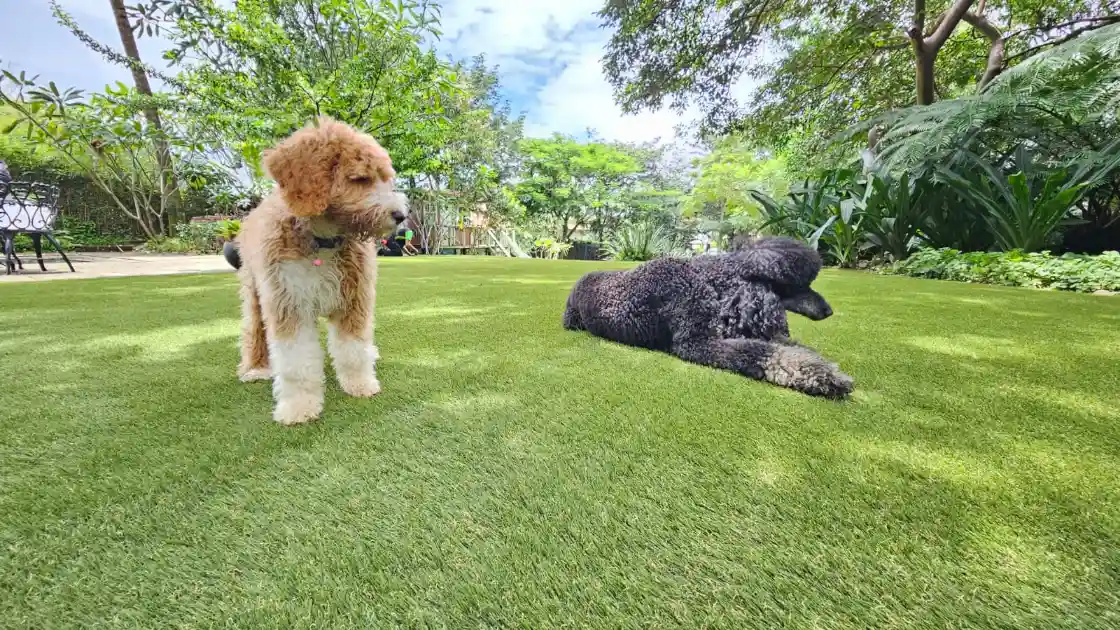
Cost of Synthetic Grass Per Square Foot at a Glance
Before you compare products, you need to know which number you’re looking at. Store prices and installer quotes measure completely different things.
Material vs. Installed Cost of Synthetic Grass Per Square Foot
The material price is just the turf. Angi’s 2026 data puts turf materials at $2 to $8 per square foot, with labor adding another $4 to $9 per square foot depending on yard size and how much excavation is needed.
That’s why installed quotes look so much higher. Labor typically makes up about 50% to 60% of a synthetic turf project’s total cost.
US Turf Direct breaks it down further: the turf product runs about $2.60 to $3.50 per square foot, base materials add $1 to $2, lawn removal and grading add $0.50 to $1.50, and installation labor adds $2.50 to $4.50. US Turf Direct
Bottom line: when a store lists turf at $3 a foot, expect to pay two to four times that for a finished lawn.
Budget, Mid-Range, and Premium Synthetic Grass Prices
Price tiers line up closely with a few measurable specs. Here’s how they compare:
| Tier | Material Price | Face Weight | Pile Height | Best For |
|---|---|---|---|---|
| Budget | $2 to $3.50 | Under 50 oz | 1 to 1.5 inches | Decorative areas, side yards, low traffic |
| Mid-range | $3.50 to $5.50 | 50 to 80 oz | 1.5 to 2.5 inches | Family backyards, kids, moderate pet use |
| Premium | $5.50 to $8+ | 80+ oz | 2.5+ inches or nylon blends | Show lawns, heavy traffic, hot climates |
Don’t worry if face weight and pile height are new terms. We explain both below.
Why the Cost of Synthetic Grass Per Square Foot Changes by City
Where you live changes your price, mostly through labor. US Turf Direct notes that labor rates vary by market, especially in high-demand cities. It also points out that a Phoenix homeowner pays about the same per square foot as one in Tampa, but Florida yards often need more drainage prep because of heavier rain. US Turf Direct
Your yard’s layout matters too:
- Curves and tight spaces: Angi reports that cutting around curves or fitting turf between pavers adds $1 to $3 per square foot. Angi
- Unusual surfaces: Rooftops, stairways, pool areas, and concrete surfaces all cost more than a standard backyard install. Angi
- Project size: Smaller jobs cost more per foot. Projects under 400 square feet can run $17 to $25 per square foot, while jobs over 2,000 square feet often drop to around $9. Gen Lawn
Here’s why: every job needs a crew, a truck, and a setup day, whether your yard is tiny or huge.
What Drives the Cost of Synthetic Grass Per Square Foot
This is where most price guides stop. But if you want to know why one product costs twice as much as another, these four factors explain nearly all of it.
Fiber Type: Polypropylene vs. Polyethylene vs. Nylon
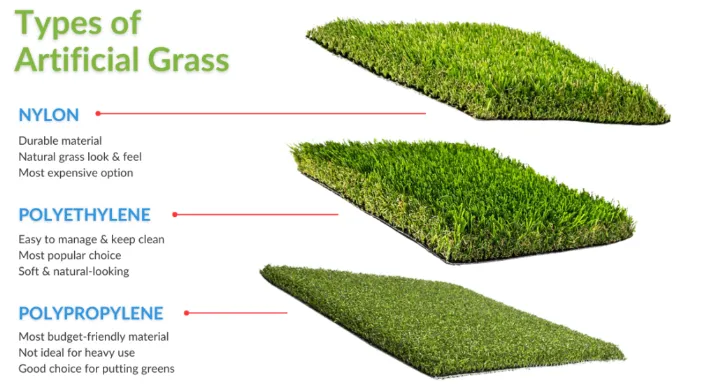
Every synthetic grass blade is made from one of three plastics. Each one has a different price and a different job.
| Fiber | Cost Per Sq Ft (2026) | Strengths | Weaknesses |
|---|---|---|---|
| Polypropylene | $2 to $5 | Cheapest option | Wears faster under traffic |
| Polyethylene | $2 to $7 | Soft, natural look | Less durable than nylon |
| Nylon | $5 to $8 | Toughest, holds shape in heat | Stiffer feel, highest price |
Source: Angi’s 2026 artificial grass cost data
Lawn Love recommends nylon for lawns that get extreme heat and long sun exposure because it keeps its shape better under heavy use, though its blades feel less natural than other materials. LawnLove
For most family yards, polyethylene hits the sweet spot between feel and price.
Face Weight and Pile Height: The Specs Behind the Price
These two numbers appear on every product spec sheet, and they drive price more than anything else.
Face weight is how much yarn is in the turf, not counting the backing. Synthetic Grass Warehouse explains that turf with a face weight above roughly 80 ounces per square yard is thicker and softer, and that higher face weight generally means a sturdier, more durable product. Their plain-English guide to pile height and face weight is worth reading before you shop. Syntheticgrasswarehouse
For residential lawns, Lawn Love suggests looking for 50 to 80 ounces, and notes that prices generally rise with face weight. LawnLove
Pile height is how tall the blades are. Taller blades use more yarn, so they cost more. Integriturf’s 2026 pricing shows short pile (1 to 1.5 inches) at about $2 to $4 per square foot, medium pile (1.5 to 2.5 inches) at $3 to $5.50, and long pile (2.5 inches and up) at $4 to $8. You can see the full breakdown in their artificial grass price range guide. Integriturf
But wait: taller isn’t always better. Shorter blades resist matting better, which makes them a smarter pick for high-traffic areas, while longer blades look and feel more like real grass. Syntheticgrasswarehouse
Backing, Drainage, and Warranty
The backing is the base layer the blades are stitched into. It’s invisible once installed, but it affects both price and performance.
Synthetic Grass Warehouse describes how backing designs vary widely. A standard dual-layer backing drains at least 30 inches of rain per hour per square yard, while their premium quad-layer backing drains up to 400 inches per hour. Their backing technology overview shows the differences side by side. syntheticgrasswarehouse
Why pay more? Faster drainage matters for pet areas and rainy climates, where standing water leads to odor and wear.
Warranty length is another price signal. Angi reports that artificial grass lasts 10 to 20 years with minimal maintenance. Products backed by longer fade and wear warranties usually cost more upfront, but they protect that lifespan. Angi
Brand and Specialty Turf Costs
Brand name alone can move your price several dollars per foot. Here’s how Angi’s 2026 data compares popular brands: Angi
| Brand | Cost Per Sq Ft |
|---|---|
| EasyTurf | $1.80 |
| Petgrow | $2 to $3 |
| SunVilla | $3 to $4 |
| ForeverLawn | $4.50 to $9.50 |
| SYNLawn | $5.50 to $7.50 |
| ProGreen | $4.50 to $11.50 |
Specialty turf costs more too. US Turf Direct prices pet and putting green turf at $10 to $12 per square foot installed, because these products need extra infill, odor control, or a precisely shaped base. Sports turf materials typically run $5 to $8 per square foot. US Turf DirectIntegriturf
How to Calculate the Cost of Synthetic Grass Per Square Foot for Your Yard
Here’s where you can save real money. Most homeowners multiply square footage by price and stop. That misses roll widths, waste, and extras.
Step 1: Measure Your Square Footage
Multiply length by width for rectangular spaces. For odd shapes, Patio Productions recommends breaking the area into smaller rectangles, measuring each one, and adding them together. For curves around trees or flower beds, measure an imaginary rectangle that covers the curve. patioproductions
Measure twice. Sketch as you go.
Step 2: Plan Around 15-Foot Rolls and Waste
Synthetic grass comes in rolls, not custom shapes. Lawn Love notes that turf is usually sold in widths of 5, 7, 10, or 15 feet, and you buy the length you need. Most residential lawns use 15-foot rolls. LawnLove
This is the step that trips people up. Patio Productions suggests dividing your project width by 15 feet and rounding up to get the number of strips, then adding about 10% for trimming, fitting around obstacles, and small repairs. Their turf sizing guide includes helpful layout examples. patioproductions
Curved yards need more. A curved property can add 15% to 20% to your budget because the extra cuts require more turf and more labor time. LawnLove
Step 3: Add Infill, Weed Barrier, and Seam Tape
Turf alone isn’t a finished lawn. These per-square-foot extras add up:
- Infill: This is sand or granules brushed between the blades to hold them upright and weigh the turf down. Angi estimates about 1 pound per square foot, with silica sand around $0.30 per pound, acrylic-coated sand around $1, zeolite around $1.15, and crumb rubber around $1.75. Some installers recommend 2 to 3 pounds per square foot for residential lawns, and zeolite is a popular choice for pet yards because it helps neutralize urine odor. NexGen Lawns has a clear guide to infill types if you’re unsure which fits your yard. Anginexgenlawns
- Weed barrier: This fabric layer costs $0.40 to $0.80 per square foot. Angi
- Seam tape: Joining two turf strips requires seam tape, which runs $0.50 to $1.40 per linear foot. LawnLove
- Base layer: This is the compacted gravel foundation under the turf. Angi’s sub-base guide recommends a layer two to four inches deep and explains why decomposed granite drains better than cheaper crushed base. Read their artificial grass sub-base guide to understand your options. angi
Worked Example: Pricing a 20 x 30 Foot Backyard
Let’s price a simple 600-square-foot rectangular backyard using mid-range polyethylene turf at $4.00 per square foot.
Smart layout: Run the 15-foot rolls along the 20-foot side. The 30-foot width divides perfectly into two strips, so you only need one seam.
| Item | Calculation | Cost |
|---|---|---|
| Turf (600 sq ft + 10% waste) | 660 sq ft × $4.00 | $2,640 |
| Silica sand infill | 600 lbs × $0.30 | $180 |
| Weed barrier | 600 sq ft × $0.60 | $360 |
| Seam tape | 20 ft × $1.00 | $20 |
| Total materials | $3,200 | |
| Real material cost per sq ft | $3,200 ÷ 600 | $5.33 |
Notice something? The turf was listed at $4.00 a foot, but the true material cost came to $5.33.
Now here’s the costly mistake. If you ran the rolls the other way, along the 30-foot side, you’d need two strips covering 30 feet of width. That’s 900 square feet of turf for a 600-square-foot yard, about $960 more in wasted material at the same price.
Same yard. Same turf. Nearly a thousand dollars difference just from layout.
Swap silica for zeolite infill on a pet yard, and add about $510 more. The base layer and labor come on top of this. See our installation cost breakdown for those numbers.
Is the Cost of Synthetic Grass Per Square Foot Worth It?
Synthetic grass costs far more upfront than natural grass. The real question is whether it pays you back.
Synthetic Grass vs. Sod: Cost Per Square Foot Compared
| Factor | Synthetic Grass | Sod |
|---|---|---|
| Installed cost per sq ft | About $6 to $20 | About $1 to $2.50 |
| Lifespan | 10 to 20 years | Ongoing, with repairs |
| Watering | Occasional rinse | Regular irrigation |
| Mowing and fertilizing | None | Weekly to seasonal |
Professional sod installation averages $1 to $2.50 per square foot, according to our sod installation cost guide. For the full breakdown by grass type and region, see our sod installation cost guide. Gen Lawn
Lawn Love estimates about $6,365 to install artificial turf on a 500-square-foot yard versus about $653 for real sod. But if you pay for a monthly lawn care plan at $1,500 to $6,000 a year, it estimates you’d recover the difference in savings within four to five years. LawnLove
Where Synthetic Grass Pays Off Fastest
The biggest savings show up in dry, hot regions. The EPA estimates that US homes use nearly 8 billion gallons of water a day outdoors, mainly for landscape irrigation, and that up to half of it is wasted through overwatering. You can read more on the EPA WaterSense site. epa
US Turf Direct estimates the total cost of turf often evens out with or beats natural grass within five to eight years. If you mow and fertilize yourself, or plan to move soon, sod usually wins on cost. US Turf Direct
One more thing: don’t count on a water rebate. Artificial turf doesn’t qualify for most water utility programs, which typically require living, drought-tolerant plants. If rebate money is a priority, our drought tolerant landscape guide shows options that do qualify. Gen Lawn
Frequently Asked Questions
How much does a roll of synthetic grass cost?
Rolls are priced by square foot, so the cost depends on size. A 15 x 50 foot roll covers 750 square feet. At $2 to $8 per square foot, that roll would cost roughly $1,500 to $6,000 before infill, base, and installation.
What face weight should I buy, and does it raise the cost of synthetic grass per square foot?
Yes, higher face weight costs more. For most home lawns, 50 to 80 ounces is the sweet spot. Go above 80 ounces if you want a thicker, softer feel and don’t mind paying extra.
Is cheap synthetic grass worth it?
For decorative areas with little foot traffic, yes. Angi cautions that budget turf can lead to higher long-term maintenance costs, so it’s best reserved for low-traffic spots. For kids, pets, or daily use, mid-range turf lasts longer and looks better. Angi
How much synthetic grass do I need for 500 square feet?
Plan for at least 550 square feet after adding 10% for waste, and more if your yard has curves or doesn’t divide evenly into 15-foot strips. US Turf Direct estimates a typical 500-square-foot backyard at $3,250 to $5,750 fully installed. US Turf Direct
Is synthetic grass cheaper than sod per square foot?
Not upfront. Sod runs about $1 to $2.50 per square foot installed, while synthetic grass runs about $6 to $20. Synthetic grass can become cheaper over time if you’d otherwise pay for water, mowing, and lawn care.
Conclusion
The cost of synthetic grass per square foot comes down to what’s inside the roll and how you lay it out. Here’s what to remember:
- Material vs. installed: Turf runs $2 to $8 per square foot, but finished lawns typically cost $6 to $20 installed.
- Specs drive price: Fiber type, face weight, pile height, and backing explain most price differences between products.
- Layout matters: Planning around 15-foot rolls can save you hundreds, even close to a thousand dollars, on the same yard.
- Extras add up: Infill, weed barrier, and seam tape can push your real material cost well above the listed price.
- Value depends on you: Turf pays off fastest in dry climates and for homeowners who pay for lawn care.
Your next step: Measure your yard, sketch it on paper with 15-foot strips, and request two or three turf samples. Compare face weight and warranty first, then compare price. Once you’ve picked a product, use our artificial turf installation cost guide to budget for labor and site prep.
About Author
Khalid Fazal is a seasoned lawn care specialist and horticultural researcher with over 15 years of hands-on experience transforming challenging landscapes into lush, resilient green spaces. His journey didn’t start in a lab, but in a backyard full of stubborn, cracked clay that “experts” said would never grow a healthy blade of grass. Refusing to accept a yard full of dust, Khalid spent years experimenting with organic soil restoration and precise mulching, eventually turning that wasteland into a neighborhood showpiece on a shoestring budget.
From mastering core aeration techniques to optimizing soil pH for specialized turf varieties, Khalid’s approach combines old-school grit with modern agronomic science. He founded Gen Lawn to provide homeowners with honest, research-backed advice that prioritizes long-term soil health over quick-fix chemical solutions. When he isn’t analyzing soil profiles, he’s developing precision tools to help others achieve professional results without the professional price tag.
Cost of Synthetic Grass Per Square Foot (2026 Pricing Guide)
Table of Contents Home / By Khalid Fazal | Updated:...
Read More
Artificial Turf Installation Cost: $10-$20/sq ft [2026 Data]
Table of Contents Home / By Khalid Fazal | Updated:...
Read More
Soil Amendments for Lawn: Which One You Need (By Region)
Table of Contents Home / By Khalid Fazal | Updated:...
Read More
Topsoil vs Garden Soil: Which One to Buy [2026 Price Guide]
Table of Contents Home / By Khalid Fazal | Updated:...
Read More