
How to Get Rid of Japanese Beetles: What Works Now and What Stops Them Next Year
Japanese beetles can strip a rose bush, a grapevine or a young linden down to lacy skeleton leaves in a matter of days. Worse, the damage feeds itself. Every chewed leaf gives off a scent that pulls in more beetles, so the handful you saw on Monday is a crowd by the weekend. Grab the wrong trap or spray and you can end up with more beetles than you started with.
Here’s what actually works. Knock the beetles into a bucket of soapy water every morning or evening, cover or spray only the plants you care most about, and keep beetle traps out of your yard. Then deal with the grubs in your lawn so fewer beetles come up next summer.
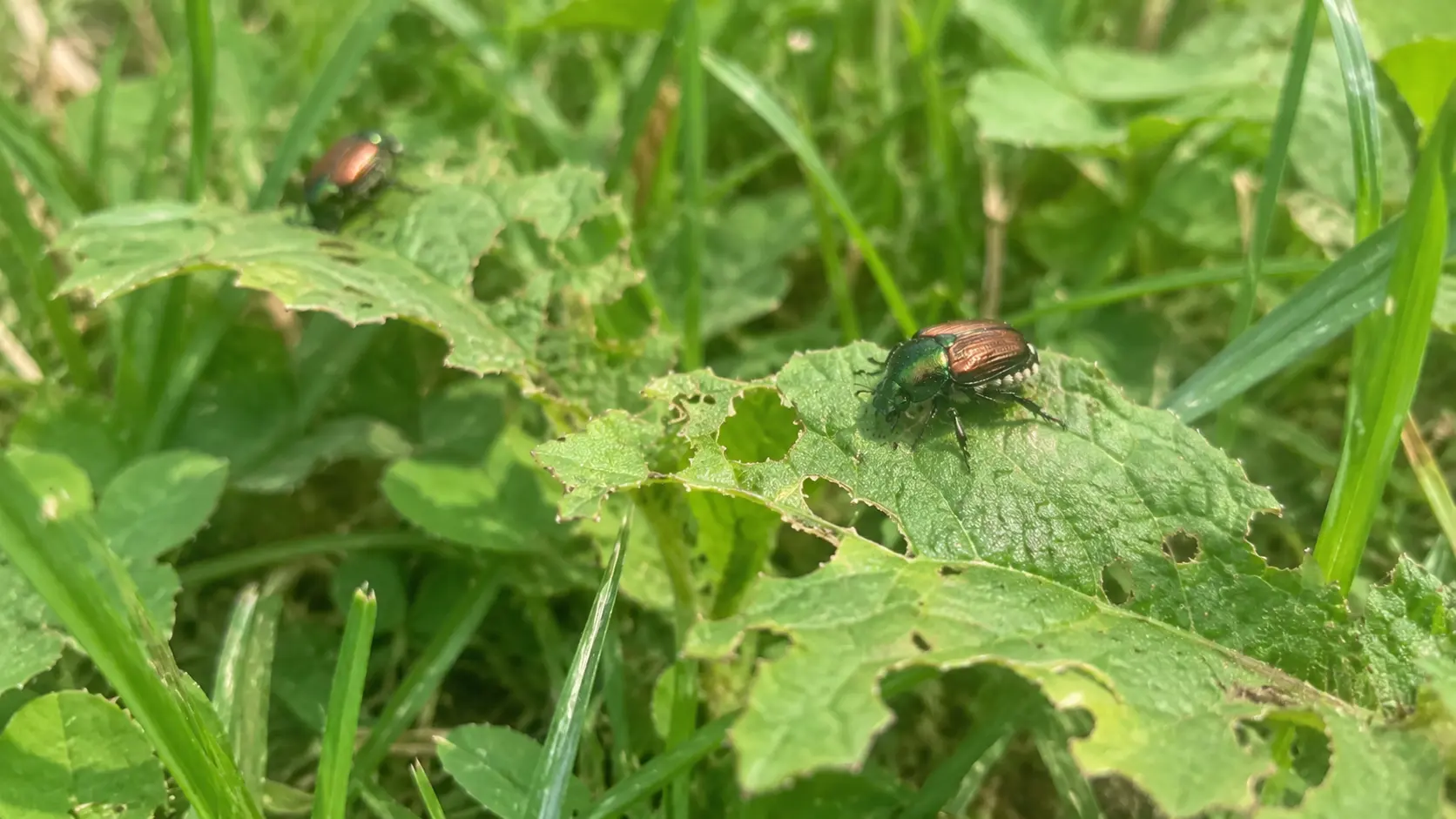
When Japanese Beetles Show Up in Your Area
Japanese beetles show up weeks earlier in the South than in the North, so “summer” means different dates depending on where you live. Starting control the week they appear is what keeps a small problem small.
How to Spot Japanese Beetles and Their Damage
Adults are about 1/3 to 1/2 inch long, with a metallic green head and copper-brown wing covers. The giveaway is five white hair tufts along each side of the body plus two at the tail end, according to University of Minnesota Extension. Look-alike beetles don’t have them.
The damage is just as easy to recognize. Beetles chew out the leaf tissue between the veins and leave a lacy, see-through skeleton behind. They usually start at the top of a plant and work down. Roses, grapes, lindens, raspberries, birch and fruit trees take the worst of it.
Here’s the good news: on healthy, established trees and shrubs, the damage is mostly cosmetic. Young or struggling plants are the ones heavy feeding can stunt or kill, so protect those first.
Japanese Beetle Season by US Region
In warm Southern states like Georgia and North Carolina, adults emerge as early as mid-May. In New England and New York, they show up from late June to early July, according to UF/IFAS Extension. In Kentucky, the heaviest feeding runs for 4 to 6 weeks starting in late June (University of Kentucky). In Minnesota and the upper Midwest, expect them in late June or early July, with most feeding done by mid to late August.
For a date closer to home, use the free Japanese Beetle Pheno Forecast from the USA National Phenology Network. It maps when adults should emerge across the country based on growing degree days, which is the heat that builds up over the season. You can also sign up for an email alert that arrives about two weeks before beetles are expected in your area.
Why Beetles Pile Onto the Same Plants
Beetle-damaged leaves give off a scent that draws in more beetles. That’s why one rose bush gets mobbed while an identical one a few feet away barely gets touched.
The takeaway is simple. Every beetle you remove in the first week means fewer chewed leaves sending out that signal, and fewer beetles arriving in week three.
How to Get Rid of Japanese Beetles on Plants Right Now
For most home yards, daily hand-picking plus covering a few key plants beats any spray. Reach for a spray only when there are more beetles than your bucket can keep up with.
Hand-Pick Japanese Beetles Into Soapy Water
Fill a bucket or wide jar with water and a squirt of dish soap. Hold it under the leaves and tap the branch. Japanese beetles drop when they’re disturbed, so most fall straight in, and the soap keeps them from floating back out.
Timing matters. Go out in the early morning or evening, when beetles are cool and sluggish, and check your plants every day, as University of Minnesota Extension recommends. Each beetle you leave behind keeps chewing and keeps calling in more.
One exception: leave alone any beetle with a small, pearly white dot just behind its head. That’s an egg from the Winsome fly, a parasite that makes the beetle stop feeding within 3 to 4 days and kills it soon after. The fly is established in parts of the Northeast and upper Midwest, and every parasitized beetle you spare helps build next year’s free control.
Cover the Plants You Care About Most
Fine netting or cheesecloth over roses, raspberries, grapes and young trees keeps beetles off during peak weeks. Drape it loosely over the plant and tie or weigh down the bottom edge so beetles can’t get underneath.
There’s one catch with fruiting plants. Don’t cover anything in bloom that needs bees to set fruit. Hand-pick until the flowers are done and the fruit starts forming, then put the netting on.
Japanese Beetle Sprays Ranked by How Long They Last
No spray lasts all season, so the real question is how many days of protection you get and what else it harms. Here’s how the common options compare, based on University of Minnesota and University of Kentucky research.
Spray | Protection | Risk to bees | Worth knowing |
|---|---|---|---|
About 3 to 4 days | Low | Deters feeding but weakens fast when beetle numbers are high | |
Btg (sold as beetleGONE) | 1 to 2 weeks | Low | Kills monarch caterpillars, so keep it away from milkweed |
Carbaryl (Sevin) | 1 to 2 weeks | High | Shortest-lasting of the synthetic options |
Pyrethroids (bifenthrin, cyfluthrin, permethrin) | 2 to 3 weeks | High | Keep off plants bees are visiting |
Chlorantraniliprole (Acelepryn) | 2 to 4 weeks | Low | Longest protection with low bee risk |
Whatever you choose, coat both the leaves and flowers thoroughly and expect to repeat it while beetles are still flying. Don’t spray on windy days or while bees are working the plant. Check that the label lists the plant you’re treating, and on fruits and vegetables, follow the waiting period between spraying and harvest.
Japanese Beetle Remedies That Waste Your Time
A lot of the advice online for Japanese beetles either does nothing or makes the problem worse. Skip these three.
Japanese Beetle Traps
Traps catch a lot of beetles, which is exactly why they fool people. The bag lure combines a female sex scent with a strong floral odor, and it pulls in beetles from far beyond your yard. University of Kentucky research found that traps attract many more beetles than they actually catch, so plants near the trap end up with more damage than if you’d hung nothing at all.
Iowa State University Extension puts it bluntly: traps don’t control moderate to heavy infestations. The only exception is a property that’s isolated or very lightly infested, with the trap set far from anything you want to protect.
Homemade Soap, Garlic and Pepper Sprays
A bucket of soapy water works because the beetles drown in it. Spraying that same mix on leaves doesn’t. Kentucky extension entomologists rate insecticidal soap, garlic, hot pepper and orange peel extracts as generally ineffective against Japanese beetles, and University of Minnesota Extension warns that pantry mixes can also burn plants and hurt helpful insects.
“Repellent” Companion Plants
You’ll see garlic, catnip, marigolds and four o’clocks promoted as plants that keep beetles away. Kentucky rates companion planting as generally ineffective, and UMN found no evidence behind the four o’clock claim. Marigolds are actually on UMN’s list of plants the beetles prefer.
A plant that beetles ignore won’t shield the rose growing next to it. Choosing less-favored plants does help over time, but only when they replace the beetles’ favorites.
How to Get Rid of Japanese Beetles for Good
You can’t stop beetles from flying in, but you can cut how many hatch in your own lawn and make your yard less worth the trip.
Treat Japanese Beetle Grubs at the Right Time
Every beetle on your roses started as a C-shaped white grub chewing grass roots underground. Females lay their eggs in lawns during summer, and the grubs feed until fall before burrowing deeper for winter.
Be clear on what grub control fixes, though. Adult beetles can fly 1 to 2 miles to feed, according to Purdue Extension, so treating your lawn won’t keep your neighbors’ beetles off your plants. Treat grubs to protect your grass and to trim local numbers over time.
Grub damage shows up as grass that yellows or browns in late summer and peels back like loose carpet. It’s easy to confuse with brown patches on a lawn in summer caused by heat or disease, so check before you treat. Lift a square foot of sod at the edge of the damage and count the grubs. Purdue says fewer than 5 per square foot rarely need treatment. Skunks and raccoons tearing up turf are another sign, and if they’re doing more damage than the grubs, here’s how to stop raccoons from digging up grass.
Timing makes or breaks grub control:
- Preventive: apply in the month before adult beetles emerge in your area, if your lawn has a history of grub damage.
- Curative: apply from late July to mid-September, while grubs are still small (about 1/2 inch or less).
- Skip spring: grubs are full-grown by then, hard to kill and feed only briefly.
Product choice matters for pollinators. University of Minnesota Extension rates chlorantraniliprole (sold as Scotts GrubEx) as effective and low risk to bees. Imidacloprid and clothianidin also work, but they can harm bees visiting flowering weeds, so mow down clover and dandelions before applying. For a full rundown by grub stage, see our guide to grub control products for lawns.
One more lever: females prefer moist turf for laying eggs, and dry soil reduces egg survival. If your grass can handle it, easing off watering during peak beetle flight can mean fewer grubs next year.
Nematodes vs Milky Spore: What the Research Shows
Beneficial nematodes are microscopic roundworms that hunt grubs through the soil. The strain to look for is Heterorhabditis bacteriophora, one of the most effective against Japanese beetle grubs. Results can be inconsistent, and they only work in moist soil. Apply them after grubs have hatched, in the evening or on a cloudy day, and water before and after.
Milky spore is sold as a set-it-and-forget-it fix, but the research doesn’t back it. MU Extension says it can take several years to show any change and the drop in grubs tends to be modest. University of Minnesota Extension adds that commercial milky spore hasn’t shown any benefit in modern university trials. It also only infects Japanese beetle grubs, so it does nothing for other grub species in your lawn.
If you want a biological option, nematodes are the better bet.
Plants Japanese Beetles Rarely Touch
The longest-lasting fix is planting less of what beetles love. Their favorites include roses, grapes, lindens, sassafras, Norway and Japanese maples, purple-leaf plum and many flowering crabapples, per the University of Kentucky.
Plants they rarely damage include boxwood, clematis, daylily, forsythia, common lilac, magnolia, red and silver maple, oak, redbud, rhododendron, holly, flowering dogwood and most evergreens, such as arborvitae, spruce, pine and yew. Swap in a few of these when a favorite host needs replacing, and next summer’s beetles have less to land on.
Frequently Asked Questions About Japanese Beetles
What kills Japanese beetles instantly?
A bucket of soapy water is the fastest, cheapest option. Knock beetles in and they drown. Pyrethrin sprays also kill on contact, but only when sprayed directly on the beetle, and they break down quickly, so you’ll need to repeat them.
What smell do Japanese beetles hate?
No smell has been shown to reliably keep Japanese beetles off your plants. The scent that actually matters is the one they love: the odor of leaves they’ve already chewed. Removing beetles early, before that damage builds, does more than any repellent.
Does treating grubs get rid of Japanese beetles?
Not on your plants. Adult beetles fly in from lawns up to a couple of miles away, so grub control mainly protects your grass. It can lower local numbers over a few seasons, but it won’t stop this summer’s beetles.
When do Japanese beetles go away?
Each adult lives about 30 to 45 days, and the whole flight lasts 6 to 8 weeks. In the Midwest, feeding usually winds down by late August. In the South, beetles show up as early as mid-May, so the season starts weeks earlier.
Is it okay to squish Japanese beetles?
Yes. University of Kentucky entomologist Dan Potter confirmed through Ask Extension that crushed beetles don’t attract more beetles. The crowds come from the scent of damaged leaves, not from the beetles themselves.
Getting Rid of Japanese Beetles: The Bottom Line
- Start the week beetles show up, and knock them into soapy water every morning or evening.
- Net or spray only the plants that matter most, and keep bee-toxic sprays off anything in bloom.
- Skip traps and homemade sprays. They either do nothing or bring in more beetles.
- Treat grubs at the right time to protect your lawn, and swap out beetle favorites as plants need replacing.
Planning a grub treatment? Trace your lawn on a satellite map with the free GenLawn Lawn & Garden Calculator to get its exact square footage, so you buy the right amount of product the first time.
About Author
Khalid Fazal is a seasoned lawn care specialist and horticultural researcher with over 15 years of hands-on experience transforming challenging landscapes into lush, resilient green spaces. His journey didn’t start in a lab, but in a backyard full of stubborn, cracked clay that “experts” said would never grow a healthy blade of grass. Refusing to accept a yard full of dust, Khalid spent years experimenting with organic soil restoration and precise mulching, eventually turning that wasteland into a neighborhood showpiece on a shoestring budget.
From mastering core aeration techniques to optimizing soil pH for specialized turf varieties, Khalid’s approach combines old-school grit with modern agronomic science. He founded Gen Lawn to provide homeowners with honest, research-backed advice that prioritizes long-term soil health over quick-fix chemical solutions. When he isn’t analyzing soil profiles, he’s developing precision tools to help others achieve professional results without the professional price tag.

How to Get Rid of Japanese Beetles (What Actually Works)
Table of Contents Home / By Khalid Fazal | Updated:...
Read More
Chinch Bug Treatment: What Works and When to Apply by Region
Table of Contents Home / By Khalid Fazal | Updated:...
Read More
How Do I Get Rid of Ants in My Lawn? And get rid of the Colony
Table of Contents Home / By Khalid Fazal | Updated:...
Read More
Best Fungicide for Lawns: 6 Picks Matched to Your Disease
Table of Contents Home / By Khalid Fazal | Updated:...
Read More