
Natural Grass vs Artificial Turf: Side-by-Side Comparison
Turf costs far more upfront and far less every year after. Grass is the reverse. Here’s how the two stack up on the factors homeowners ask about most.
Factor | Natural Grass | Artificial Turf |
|---|---|---|
Upfront cost (500 sq ft) | About $500 to $1,300 for pro-installed sod | About $6,365 installed |
Yearly upkeep | $1,500 to $6,000 with a monthly pro plan, or mostly your time if you DIY | Low: weekly brushing and rinsing, occasional infill top-ups |
Water | About 1 inch per week, rain included | Occasional rinsing and cooling |
Summer surface heat | Commonly 75°F to 95°F | Typically 35°F to 55°F hotter than grass |
Lifespan | Indefinite with good care | About 10 to 25 years |
Ready to use | Wait 10 to 14 days to walk on it, about 6 weeks for regular use | The day the crew finishes |
Pets | Soft and cool, but urine spots and digging | No mud or holes, but needs rinsing to control odor |
Environment | Cools the air, filters rain, supports soil life | Plastic that eventually goes to a landfill |
Natural Grass vs Artificial Turf Upfront Cost
Sod wins day one by a mile. Angi’s 2026 sod pricing data, based on 9,489 real projects, puts the national average sod job at $2,076. Most homeowners pay $1 to $6 per square foot.
Turf usually lands between $10 and $20 per square foot installed. Why so much more? The turf roll is only part of the bill.
Crews remove the old lawn, then build a compacted gravel base (the drainage layer that keeps turf flat and lets water through). Labor alone makes up roughly 50% to 60% of a turf project, according to Lawn Love. Our artificial turf installation cost guide breaks down every line item, and our sod installation cost guide does the same for grass.
One catch on the grass side: dry yards need irrigation. Angi puts a new sprinkler system at $1,650 to $3,600, which narrows the gap in desert climates.
When Does Artificial Turf Pay Off vs Natural Grass?
Here’s the thing: turf only pays for itself if it replaces money you’d actually spend.
If you’d otherwise pay for a monthly lawn plan, Lawn Love estimates you’ll recover the turf premium in about 4 to 5 years. Our installation cost guide puts the typical break-even at 5 to 8 years once water, mowing, and fertilizer savings are counted.
Here’s what 10 years looks like on a 1,000-square-foot yard:
Scenario (1,000 sq ft) | Upfront Cost | Yearly Cost | 10-Year Total |
|---|---|---|---|
Artificial turf, pro-installed | About $12,725 | Low (brushing, rinsing, infill) | About $12,725, plus minor upkeep |
Sod plus a monthly pro lawn plan | $1,000 to $2,500 | $1,500 to $6,000 | $16,000 to $62,500 |
Sod, sprinkler system, and a monthly pro plan (typical desert setup) | $2,650 to $6,100 | $1,500 to $6,000, plus higher water bills | $17,650 to $66,100 or more |
Turf cost uses Lawn Love’s 1,000 sq ft average. Sod and sprinkler costs come from Angi. The lawn plan range comes from Lawn Love.
Now the flip side. If you mow and fertilize yourself in a rainy climate, your yearly cost is mostly fuel, fertilizer, and weekend time. In that case, turf rarely earns back its price before it needs replacing.
And it will need replacing. Lawn Love gives turf a 10 to 25 year lifespan, and cheaper products in hot, high-traffic yards land at the short end.
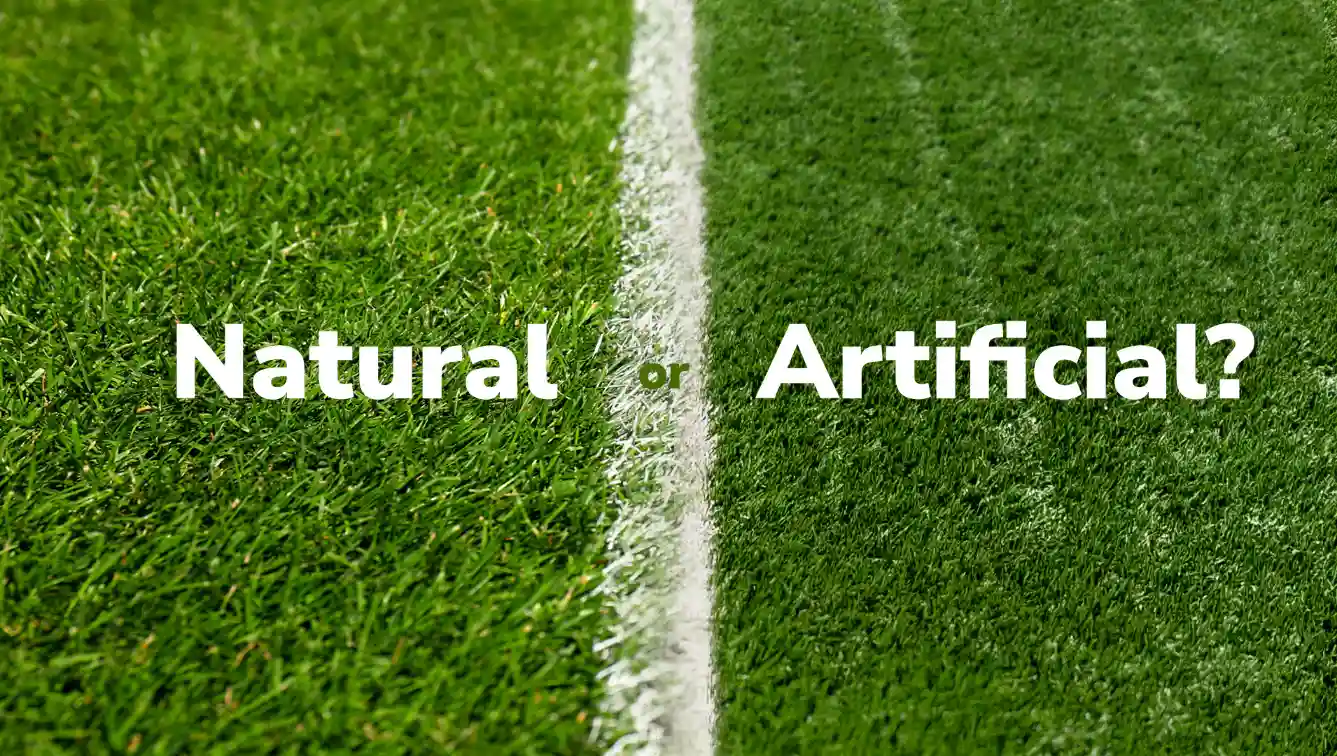
Maintenance: What Turf and Grass Really Ask of You
Neither option is maintenance-free. The work just looks different.
Natural grass needs:
- Mowing every week or two during the growing season
- About 1 inch of water per week, rain included, per Cornell University’s lawn watering guide
- Fertilizing, weed control, and periodic aeration (punching small holes in the soil so air and water reach the roots)
Artificial turf needs:
- Weekly brushing against the grain, plus a light rinse
- Quick pet waste cleanup and rinsing, especially in summer
- Occasional infill top-ups. Infill is the sand or rubber granules brushed between the blades to weigh the turf down and keep it upright.
- No pressure washers or leaf vacuums, since both strip out infill
Lawn Love’s artificial grass cleaning guide walks through a full weekly and monthly turf routine if you want the step-by-step version.
Natural Grass vs Artificial Turf for Kids, Pets, and Summer Heat
Heat is turf’s biggest weakness. It matters most for the two groups who spend the most time on the ground: kids and dogs.
How Hot Does Artificial Turf Get Compared to Natural Grass?
Hotter than most people expect. According to Penn State’s Center for Sports Surface Research, natural grass commonly stays between 75°F and 95°F on hot days. Synthetic turf generally runs 35°F to 55°F hotter.
The extremes are worse. Researchers in Provo, Utah, measured a turf surface of 200°F on a 98°F day. Turf in central Pennsylvania has reached 175°F.
Why such a big gap? Grass leaves transpire, meaning they release water vapor that cools the surface as it evaporates, much like sweat cools your skin. Plastic blades can’t do that. Penn State found the fibers themselves are a major heat source, not just dark rubber infill.
But wait: can’t you just hose it down? Only for a few minutes. In one study, watering dropped turf from 174°F to 85°F. It climbed back to 120°F within five minutes and 164°F within twenty.
For perspective, BYU’s guideline for its own athletic fields was no use above 120°F.
If you choose turf, a few things help:
- Add shade trees or shade sails over play areas
- Schedule play for mornings and evenings on summer days
- Skip black rubber infill, which ran hottest in Penn State’s heat lamp tests
- Ask for independent test data before paying extra for “cooling” turf products
Natural Grass vs Artificial Turf for Dogs
Dogs are where turf makes its strongest case. They’re also where it gets messiest.
Natural grass for dogs:
- Cool and soft on paws, even in summer
- Urine soaks into living soil instead of sitting on plastic
- Downside: brown spots and dig holes
Those brown spots come from concentrated nitrogen and salts, not acidity, according to Colorado State University Extension. CSU notes that no supplement or lawn spray has been proven to prevent them. Water is the only thing that dilutes the damage, and training your dog to use a mulch or gravel spot is the only sure fix.
Artificial turf for dogs:
- No mud, holes, or dead patches
- Solid waste is easy to scoop
- Downside: hot on paws in full sun, and urine odor builds up without regular rinsing
If you go with turf, choose a pet-grade product with antimicrobial infill and a backing that drains quickly. Many dog owners land on a middle path: a small turf or gravel dog run, with natural grass everywhere else.
Is Turf or Grass Safer for Active Kids?
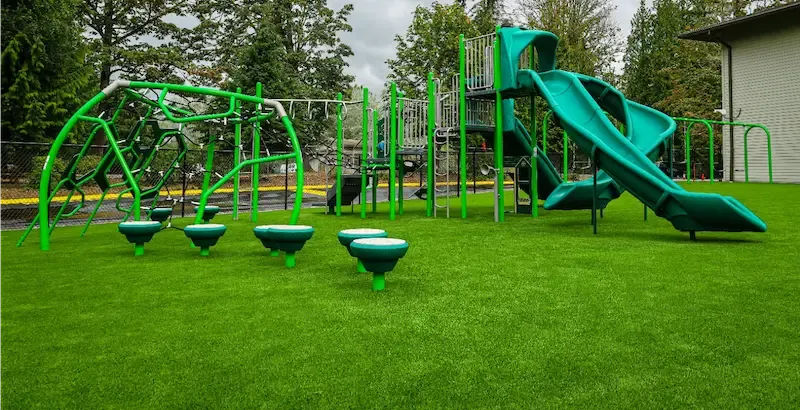
If you have young athletes at home, this one is worth a look.
A 2019 study in the American Journal of Sports Medicine found higher lower-extremity injury rates on synthetic turf in NFL games, especially for noncontact injuries. The leading theory is that turf doesn’t release cleats as easily as grass, so more force travels into the foot, ankle, and knee.
The debate isn’t settled, though. In 2023 league data, noncontact lower-extremity injury rates were nearly identical: 0.043 per 100 plays on synthetic turf versus 0.042 on grass, Athletic Business reported.
For a backyard, the bigger safety issues are simpler. Watch surface heat on sunny afternoons, and keep grass thick enough to cushion falls. If kids play hard on turf, ask installers about a cushioning pad underneath.
Environmental Impact of Natural Grass vs Artificial Turf
Neither option is automatically the green choice. Turf wins on water. Grass wins on almost everything else.
Water Use: Artificial Turf vs Natural Grass
This is turf’s strongest argument. Outdoor watering makes up about 30% of household water use nationally, and far more in the arid West, according to the EPA’s WaterSense program.
Nationwide, that adds up to nearly 8 billion gallons a day. Experts estimate up to half of it is wasted through overwatering.
That second number matters. A lot of grass’s water problem is really a sprinkler problem. The EPA says replacing a clock timer with a WaterSense labeled smart controller (one that adjusts watering to local weather or soil moisture) can save an average home up to 15,000 gallons a year.
The bottom line? In rainy regions, a lawn barely touches the tap. In the desert, turf’s water savings are real and large.
Cooling, Soil, and Wildlife
Here’s where grass pulls ahead.
- Cooling: Living grass cools itself and the air around it through transpiration. Turf does the opposite. A University of California horticulture expert measured synthetic turf around 175°F on 100°F days in Palm Springs.
- Heat islands: Hot surfaces feed the urban heat island effect, where developed areas stay hotter than the land around them. The EPA estimates U.S. cities run about 1°F to 7°F warmer than outlying areas during the day.
- Soil and runoff: Living plants slow stormwater, reduce erosion, and support pollinators. Turf seals the ground under plastic and gravel.
- Emissions: Turf does win one here. There’s no gas mower or fertilizer runoff to worry about.
PFAS, Microplastics, and Disposal
PFAS are a family of manufactured chemicals nicknamed “forever chemicals” because they break down so slowly. The EPA’s PFAS explainer notes that exposure to some of them may be linked to harmful health effects.
Many turf products have contained PFAS, and manufacturers have struggled to remove them entirely. Plastic blades and crumb rubber can also shed microplastics into groundwater.
States are responding:
- Colorado: Since January 1, 2026, no one may install artificial turf containing intentionally added PFAS anywhere in the state, under Senate Bill 24-081. Turf installed earlier can stay.
- Vermont: A sales ban on artificial turf with intentionally added PFAS took effect January 1, 2026, according to a Fox Rothschild legal summary.
- California: A 2023 law lets cities and counties ban synthetic turf again, and Millbrae and San Marino moved to prohibit it, CalMatters reported.
Then there’s disposal. Turf doesn’t biodegrade and is hard to recycle, so most of it ends up in a landfill. Before you buy, get written confirmation that the product has no intentionally added PFAS, and ask the installer what happens to the turf at the end of its life.
Natural Grass vs Artificial Turf by US Region
Where you live changes the answer more than any other factor. Here’s the quick view before we dig into each region.
Region | Typical Lawn Grasses | Water Stress | Our Verdict |
|---|---|---|---|
Desert Southwest (AZ, NV, Southern CA, West TX) | Bermuda, buffalograss | High | Turf or xeriscape for most yards |
Southeast and Gulf Coast (FL, GA, Carolinas, East TX) | Bermuda, Zoysia, St. Augustine, centipede | Low to moderate | Natural grass |
Midwest, Northeast, Pacific Northwest | Kentucky bluegrass, tall fescue, fine fescue | Low to moderate | Natural grass |
Mountain West and Colorado | Kentucky bluegrass, tall fescue, buffalograss | High | Hybrid yard, with PFAS-free turf only where needed |
Desert Southwest: Where Artificial Turf Usually Wins
If any region makes the case for turf, it’s this one. Lawns here depend almost entirely on irrigation, and many cities restrict outdoor watering.
Before you tear out your lawn, know that rebate rules vary a lot:
- Southern Nevada: The Southern Nevada Water Authority pays single-family homes $5 per square foot for the first 10,000 square feet converted. It accepts permeable artificial turf in place of rock or bark mulch, but at least half the converted area must be covered by living plants at maturity.
- Southern California: The regional SoCal Water$mart rebate is stricter. Synthetic turf isn’t allowed in its turf replacement projects at all.
- Nevada’s 2027 deadline: Starting in 2027, Colorado River water can’t be used on nonfunctional grass around businesses, along HOA streetscapes, or in medians. Single-family yards aren’t covered.
Many desert homeowners end up with a mix: a small turf play area surrounded by drought-tolerant plants. Our drought-tolerant landscape guide covers plant choices, costs, and rebates in detail.
Southeast and Gulf Coast: Where Natural Grass Thrives
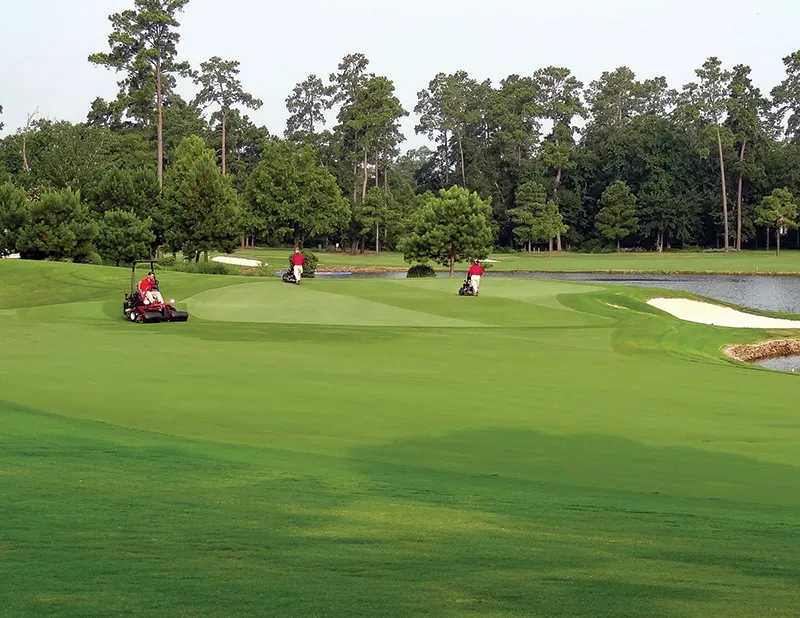
Here, natural grass has home-field advantage. Warm-season grasses like Bermuda, Zoysia, St. Augustine, and centipede love heat, and Illinois Extension notes that warm-season grasses need less water than cool-season types.
Turf struggles more than people expect. Full sun plus humidity keeps it uncomfortably hot for much of the year, and heavy rain demands serious drainage prep underneath. If your yard already holds water, fix that first. Our guide to drainage solutions for your yard walks through the options.
Midwest, Northeast, and Pacific Northwest
Most of the northern US gets enough rain that a lawn largely waters itself. Cool-season grasses like Kentucky bluegrass and tall fescue handle frost and shade far better than warm-season types.
They’re tougher than they look, too. Cornell notes these lawns can go dormant (brown but alive) for about six weeks in hot, dry spells, then green up when rain returns.
That makes turf’s biggest selling point, water savings, much weaker here. You’d mainly be paying turf prices to skip mowing. In damp climates, turf also needs extra cleaning to keep moss and mildew in check, and Vermont’s 2026 PFAS rule adds another hurdle in New England.
Mountain West and Colorado
Colorado is the trickiest state in this guide. Water is tight, which pushes homeowners toward turf. But two laws now limit it:
- PFAS rule: Since January 1, 2026, any turf installed in Colorado must be free of intentionally added PFAS.
- Landscaping rule: Under Senate Bill 24-005, local governments can no longer allow new nonfunctional turf (purely decorative grass nobody uses), artificial turf, or invasive plants on commercial property, HOA common areas, or street rights-of-way. Athletic fields are exempt.
Your own lot isn’t covered by that second law. Still, many Front Range homeowners find the best answer is a small patch of grass for play, with water-wise plants everywhere else.
HOA Rules and State Laws on Turf vs Grass
Before you sign a contract, check what your HOA can and can’t require. Protections differ a lot from state to state:
State | What the Law Says |
|---|---|
Arizona | A.R.S. 33-1819: an HOA that allows natural grass can’t ban artificial turf. It can set reasonable rules on quality and placement, and it can ban turf in areas the HOA maintains or irrigates. |
California | Civil Code 4735: HOA rules that prohibit artificial turf or low water-using plants are void. |
Texas | Property Code 202.007: HOAs can’t ban drought-resistant landscaping or water-conserving natural turf. Artificial turf isn’t mentioned. |
Florida | Statute 720.3075: HOAs can’t ban Florida-friendly landscaping. Artificial turf isn’t named. |
One more wrinkle: HOA protection doesn’t stop your city. California HOAs can’t ban turf, yet state law now lets California cities ban it. Laws change often, so confirm current rules with both your HOA and your city before you buy.
The Hybrid Yard: Natural Grass and Artificial Turf Together
You don’t have to pick one surface for the whole property. Many of the smartest yards use each one where it works best:
- Turf for dog runs, deep shade where grass won’t grow, and narrow side yards
- Natural grass for the main lawn, where kids and pets play on hot afternoons
- Drought-tolerant beds for slopes and hard-to-water corners
Our low-maintenance xeriscape front yard guide shows how to design the planted areas so they look intentional, not patchy.
Quick Checklist: Should You Choose Turf or Grass?
Answer yes or no to each question:
- Does your area restrict outdoor watering or charge high water rates?
- Do you currently pay for lawn service?
- Will you stay in your home at least 5 to 8 more years?
- Do you have heavy dog traffic or shady spots where grass won’t grow?
- Can you shade the area or avoid using it on hot afternoons?
- Do your state, city, and HOA all allow turf?
Four or more yeses? Artificial turf is worth pricing out. Mostly no? Natural grass is likely your better value.
Frequently Asked Questions About Natural Grass vs Artificial Turf
Is artificial turf cheaper than natural grass in the long run?
Only if it replaces real spending. If you pay for monthly lawn care or irrigate heavily in a dry climate, turf often breaks even in about 4 to 8 years. If you mow yourself and rain does the watering, natural grass usually stays cheaper for the life of the turf.
How much hotter is artificial turf than natural grass?
Penn State researchers found synthetic turf typically runs 35°F to 55°F hotter than natural grass on sunny days. Readings have reached 200°F on a 98°F day, while grass commonly stays between 75°F and 95°F.
Is natural grass or artificial turf better for dogs?
It depends on your climate and your dog. Grass stays cooler on paws but gets urine spots and dig holes. Pet-grade turf ends mud and digging but needs regular rinsing and gets hot in full sun, so many owners use a small turf dog run with grass everywhere else.
How long does artificial turf last compared to natural grass?
Most artificial turf lasts about 10 to 25 years, depending on quality, sun exposure, and foot traffic. A well-cared-for natural lawn has no set lifespan, since it keeps regrowing.
Can my HOA stop me from installing artificial turf?
In some states, no. Arizona and California laws limit HOAs from banning artificial turf, though HOAs can still set reasonable rules on quality and placement. Texas and Florida protect water-wise landscaping but don’t specifically name artificial turf, so check your HOA documents first.
Final Verdict: Natural Grass vs Artificial Turf
There’s no universal winner, but there is a clear winner for your yard once you know your climate, budget, and local rules.
- Cost: Sod costs roughly a tenth as much upfront. Turf pays off only when it replaces lawn service or heavy irrigation.
- Heat: Turf typically runs 35°F to 55°F hotter than grass, a real concern for kids and pets.
- Water: Turf’s biggest advantage, and it matters most in the desert Southwest.
- Region and law: Grass wins across most of the East, South, and Midwest. Wherever you live, check HOA, city, and state PFAS rules before you buy turf.
Ready to decide? Get at least three itemized quotes for both options, check your water utility’s rebate rules, and confirm your HOA and city allow turf. Leaning toward natural grass? Our sod vs seed guide will help you choose the fastest, most affordable way to get your new lawn started.
About Author
Khalid Fazal is a seasoned lawn care specialist and horticultural researcher with over 15 years of hands-on experience transforming challenging landscapes into lush, resilient green spaces. His journey didn’t start in a lab, but in a backyard full of stubborn, cracked clay that “experts” said would never grow a healthy blade of grass. Refusing to accept a yard full of dust, Khalid spent years experimenting with organic soil restoration and precise mulching, eventually turning that wasteland into a neighborhood showpiece on a shoestring budget.
From mastering core aeration techniques to optimizing soil pH for specialized turf varieties, Khalid’s approach combines old-school grit with modern agronomic science. He founded Gen Lawn to provide homeowners with honest, research-backed advice that prioritizes long-term soil health over quick-fix chemical solutions. When he isn’t analyzing soil profiles, he’s developing precision tools to help others achieve professional results without the professional price tag.

Drought Resistant Grasses for Lawns [8 Picks by US Region]
Table of Contents Home / By Khalid Fazal | Updated:...
Read More
Shade Tolerant Grass: 7 Best Types by Region [Sun Hours]
Table of Contents Home / By Khalid Fazal | Updated:...
Read More
7 Types of Cool Season Grass: Best Picks by Region [2026]
Table of Contents Home / By Khalid Fazal | Updated:...
Read More
Warm Season Grass Types: 7 Best Picks by US Region [2026]
Table of Contents Home / By Khalid Fazal | Updated:...
Read More