Artificial Turf Installation Cost in 2026: Real Prices, Hidden Fees & How to Save
Most US homeowners pay $10 to $20 per square foot for professionally installed artificial turf. For a typical 500 square foot backyard, that puts your total somewhere around $5,000 to $10,000.
Here’s the problem. Two installers can look at the same yard and quote you $7 a foot and $18 a foot. Both will tell you their price is fair.
This guide breaks down what’s actually inside an artificial turf installation cost, line by line. You’ll get real 2026 prices by yard size, the hidden fees most quotes leave out, and the truth about whether DIY saves money. You’ll also find out why most water rebates won’t pay you a cent for turf.
Quick Cost Snapshot
- Budget installs: about $6.50 to $10 per sq ft
- Typical installs: about $10 to $15 per sq ft
- Premium or small, complex yards: $20+ per sq ft
- National average project: roughly $5,800 to $6,400
How Much Does Artificial Turf Installation Cost? (2026 Averages)
National cost data points to a clear middle. Angi reports an average artificial grass installation of $5,784, with most homeowners spending somewhere between $1,300 and $15,000. Lawn Love puts the typical homeowner at about $12.75 per square foot, with prices climbing for curved yards, larger properties, and nylon turf.
That wide range isn’t a mistake. It reflects how different yards really are.
Artificial Turf Installation Cost per Square Foot
| Turf tier | Installed cost per sq ft | Best for |
|---|---|---|
| Budget (polypropylene or basic polyethylene) | $6.50 to $10 | Side yards, low-traffic areas, large flat lawns |
| Mid-range (quality polyethylene) | $10 to $15 | Most family backyards |
| Premium (nylon, pet, or cooling turf) | $15 to $22+ | Dogs, heavy traffic, hot climates, small complex yards |
Ranges compiled from 2026 cost data published by Angi, LawnStarter, US Turf Direct, and Mighty Grass.
Artificial Turf Installation Cost by Yard Size
Most people don’t expect this: smaller jobs cost more per square foot. According to Mighty Grass, projects under 400 square feet can run $17 to $25 per square foot, while jobs over 2,000 square feet often drop to around $9.
The reason is simple. Every job needs a crew, a truck, equipment, and a day of setup, whether the yard is tiny or huge.
| Yard size | Typical cost per sq ft | Estimated total |
|---|---|---|
| 200 sq ft | $15 to $25 | $3,000 to $5,000 |
| 500 sq ft | $10 to $18 | $5,000 to $9,000 |
| 1,000 sq ft | $9 to $15 | $9,000 to $15,000 |
| 2,000 sq ft | $8 to $12 | $16,000 to $24,000 |
Why Artificial Turf Installation Quotes Vary So Much
If you’ve already collected quotes and felt confused, you’re not alone. Three things cause most of the gap.
1. Material price vs. installed price. Store prices look cheap because they’re only the turf. US Turf Direct notes the synthetic grass itself usually runs $2.60 to $3.50 per square foot, and base rock, drainage prep, and labor make up the rest of the bill.
2. Fixed costs on small jobs. A 200 square foot job still pays for a full crew mobilization.
3. What’s under the turf. Base prep is where cheap installers cut corners, and it’s the part you can’t see after the job is done. The same rule applies to patios and walkways, as our hardscape installation guide explains: a failed base means a failed surface.
Bottom line: Never compare quotes by the total alone. Compare them line by line.
What’s Included in Artificial Turf Installation Cost (Line-by-Line Breakdown)
Here’s where your money actually goes. Lawn Love estimates labor at roughly 50% to 60% of the total cost of a synthetic turf install.
| Cost component | Typical price |
|---|---|
| Turf material | $2 to $8 per sq ft |
| Labor | $4 to $9 per sq ft |
| Base material (crushed rock) | $1.20 to $2.25 per sq ft |
| Infill | $0.30 to $1.75 per lb (about 1 lb per sq ft) |
| Excavation and old grass removal | $150 to $600 per project |
| Custom cuts around curves or pavers | +$1 to $3 per sq ft |
Source: Angi 2026 artificial grass cost data
Turf Material: Polyethylene vs. Polypropylene vs. Nylon
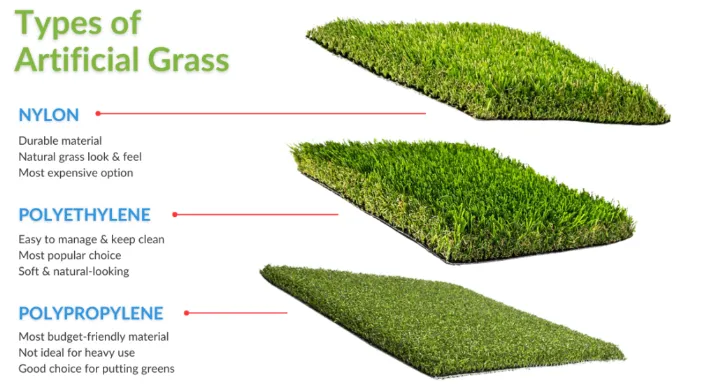
There are three main turf fibers, and each hits your budget differently:
- Polyethylene: The most popular choice. Soft, natural-looking, and mid-priced.
- Polypropylene: The cheapest option, but stiffer and less durable.
- Nylon: The toughest and most expensive. LawnStarter says to budget about 20% more if you choose nylon turf.
You’ll also see two specs on every product sheet: face weight and pile height. Face weight measures how many ounces of yarn go into the turf, not counting the backing. Pile height is simply blade length. Higher numbers usually mean a softer, lusher lawn and a higher price. This plain-English guide to pile height and face weight explains how to read them before you buy.
Going with polyethylene or polypropylene is the easiest way to save. Lawn Love estimates it can cut the turf portion of your bill by up to half.
Labor and Site Prep
Labor is the biggest single line item. Angi puts it at $4 to $9 per square foot, depending on yard size and how much digging is needed.
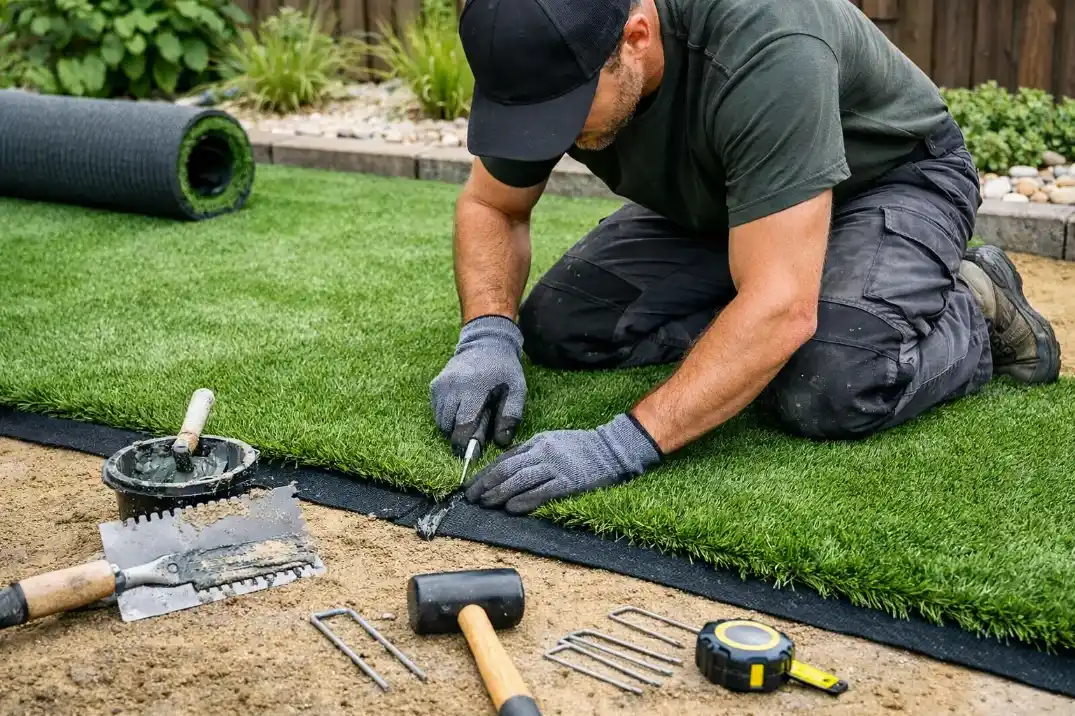
That labor covers removing the old lawn, grading, compacting a crushed rock base, and seaming the turf. Steep slopes, poor drainage, and tree roots push labor toward the top of the range.
Want to see what each step looks like? Lowe’s has a clear step-by-step artificial grass installation guide with photos.
Base, Infill, Edging and Weed Barrier
These materials are what keep turf flat, draining, and upright for years.
- Base: Angi prices base material at $1.20 to $2.25 per square foot, and skipping it invites wrinkles, bumps, and flooding.
- Infill: This is the sand or granules brushed into the blades to weigh them down and keep them standing. Plan on about a pound per square foot, at $0.30 to $1.75 per pound. This artificial turf infill buying guide compares silica sand, zeolite, and coated options.
- Weed barrier and edging: Usually bundled into the materials line. Ask your installer to confirm.
Hidden Costs Most Artificial Turf Installation Quotes Leave Out
These are the charges that show up after you sign:
- Old lawn removal and disposal: Angi suggests budgeting $150 to $600 for excavation, plus grass disposal.
- Curves and pavers: Custom cuts add $1 to $3 per square foot.
- Slopes: On sloped yards, installers anchor the perimeter with hanging timbers so the turf doesn’t slide, which adds both labor and material.
- Material waste: Curved yards waste more turf than rectangular ones, and you pay for those scraps.
- Drainage fixes: Yards that pool water need extra grading or drain work first.
Factors That Raise or Lower Your Artificial Turf Installation Cost
Location and Regional Labor Rates
Where you live changes the price as much as what you buy. High-demand Sun Belt markets like California, Arizona, and Nevada often land at the upper end of the ranges above because turf demand and labor rates run high. Rural and Midwest markets tend to be cheaper, though you may have fewer installers to choose from.
Specialty Turf: Pet, Putting Green and Cooling Turf
Pet turf and putting green turf cost more than standard landscape turf because they use denser fibers, special infill, and sometimes contoured shaping that takes longer to install.
If you have dogs, ask about zeolite infill. Zeolite is a volcanic mineral widely considered the best infill for neutralizing pet urine odors.
Do Rebates Lower Artificial Turf Installation Cost? (Usually Not)
The rebate question matters because lawns use a lot of water. The EPA says outdoor use makes up about 30% of household water nationally, and much more in dry regions. That’s why so many utilities pay homeowners to rip out grass.
But here’s what many turf sellers won’t tell you: most of those programs don’t pay for artificial turf.
- Southern California: The SoCal Water$mart turf replacement program states outright that synthetic turf is not an approved conversion.
- Phoenix, AZ: The city’s residential program pays $2 per square foot, but only for grass replaced with desert-adapted landscaping (see Arizona program roundup).
- Glendale, AZ: One of the few that does pay for artificial grass, but at just $0.25 per square foot, capped at $250 (see program list).
The big exception is Southern Nevada. The Southern Nevada Water Authority accepts permeable artificial turf as a surface option. As of September 18, 2025, it pays new single-family applicants $5 per square foot for the first 10,000 square feet. The catch is that converted areas need at least 50% living plant cover at maturity, drip irrigation, and a pre-conversion inspection before any grass comes out. Read the full SNWA program conditions before you plan around that money.
One rule applies everywhere: never remove grass before your utility approves the project, or you’ll lose the rebate. If collecting rebate money is a priority, a plant-based drought tolerant landscape usually qualifies where turf doesn’t.
DIY vs. Professional: Is Hiring Out Worth the Artificial Turf Installation Cost?
DIY Artificial Turf Installation Cost Breakdown
Doing it yourself typically saves $3 to $6 per square foot in labor, according to US Turf Direct.
Using the component prices above, DIY materials run roughly $4 to $7.50 per square foot (turf, base rock, and infill). For a 500 square foot yard, that’s about $2,000 to $3,750 in materials, compared with $5,000 to $9,000 for a pro install.
On top of materials, budget for:
- Plate compactor and sod cutter rental
- Old grass disposal
- Two or more full weekends of hard labor
Before you dig, call 811. It’s the free national service that marks buried utility lines. 811 Before You Dig lets you request marking online by state.
When DIY Artificial Turf Installation Backfires
DIY savings disappear fast when the base goes wrong. US Turf Direct warns that DIY installs run a higher risk of poor drainage or an uneven base, which can shorten turf life and affect warranty coverage.
The most common DIY failures:
- Puddles from skipped grading
- Visible seams where rolls meet
- Wrinkles from a poorly compacted base
- Voided manufacturer warranties
DIY makes the most sense for small, flat, rectangular spaces. For anything sloped, curved, or over about 500 square feet, a pro usually earns the money.
How to Vet a Local Artificial Turf Installer
Get at least three itemized quotes, and ask every installer these questions:
- How deep will you excavate, and how thick is the base layer?
- Do you compact with a plate compactor?
- How are seams joined and secured?
- What infill type and how many pounds per square foot?
- Is old lawn removal and disposal included?
- What’s your workmanship warranty, separate from the turf warranty?
- Are you licensed and insured in this state?
If a quote can’t answer these line by line, keep looking.
Artificial Turf vs. Natural Grass: 10-Year Cost Comparison
Turf costs far more upfront. The question is whether it pays you back.
| 1,000 sq ft lawn | Natural sod | Artificial turf |
|---|---|---|
| Installation | $1,650 to $2,600 | $9,000 to $15,000 |
| Yearly upkeep (pro lawn care, water) | $1,500 to $2,500 | $0 to $50 |
| 10-year total | $16,650 to $27,600 | $9,000 to $15,500 |
Sod install from GenLawn’s sod installation cost guide.
This comparison assumes you pay for professional lawn care. If you mow and fertilize yourself, natural grass looks much better on paper.
Most homeowners break even somewhere between year five and year eight, according to this 10-year cost comparison.
On a tight budget? A low maintenance xeriscape front yard cuts water and mowing too, often for less than turf.
Frequently Asked Questions
Is artificial turf cheaper than sod in the long run?
Usually, yes, if you pay for lawn care. Turf costs several times more to install, but it saves on water, mowing, and fertilizer. Most homeowners break even in 5 to 8 years. If you do your own lawn care or plan to move soon, sod often wins.
How much does it cost to install 1,000 square feet of artificial turf?
Expect roughly $9,000 to $15,000 for professional installation. The per-foot rate drops on larger jobs, so 1,000 square feet costs less per foot than a 200 square foot patch.
What is the cheapest way to install artificial grass?
Choose polyethylene or polypropylene turf, keep the layout rectangular to cut waste, and get three itemized quotes. For small flat areas, DIY can save $3 to $6 per square foot in labor.
Can I get a rebate for installing artificial turf?
Rarely. Most programs, including Southern California’s, require living plants and exclude synthetic turf. Southern Nevada is the main exception, and it still requires plant coverage and drip irrigation. Always get approval before removing grass.
Does artificial turf installation cost include removing old grass?
Often not. Excavation and disposal can add $150 to $600 or more. Ask every installer to show removal as its own line item.
Final Thoughts on Artificial Turf Installation Cost
Quick recap:
- Most homeowners pay $10 to $20 per square foot installed, or about $5,000 to $10,000 for 500 square feet.
- Labor and base prep drive most of the cost, and a good base is what makes turf last.
- Small or curved yards cost more per foot. Big, rectangular yards cost less.
- Most water rebates exclude turf, so don’t count on money back unless you’re in Southern Nevada.
- Turf usually pays for itself in 5 to 8 years compared with professionally maintained grass.
Your next step: Measure your yard, then request three itemized quotes from local installers. Use the line-by-line breakdown above to compare them. The cheapest quote isn’t always the best deal, but the one that explains its base prep usually is.
About Author
Khalid Fazal is a seasoned lawn care specialist and horticultural researcher with over 15 years of hands-on experience transforming challenging landscapes into lush, resilient green spaces. His journey didn’t start in a lab, but in a backyard full of stubborn, cracked clay that “experts” said would never grow a healthy blade of grass. Refusing to accept a yard full of dust, Khalid spent years experimenting with organic soil restoration and precise mulching, eventually turning that wasteland into a neighborhood showpiece on a shoestring budget.
From mastering core aeration techniques to optimizing soil pH for specialized turf varieties, Khalid’s approach combines old-school grit with modern agronomic science. He founded Gen Lawn to provide homeowners with honest, research-backed advice that prioritizes long-term soil health over quick-fix chemical solutions. When he isn’t analyzing soil profiles, he’s developing precision tools to help others achieve professional results without the professional price tag.
Cost of Synthetic Grass Per Square Foot (2026 Pricing Guide)
Table of Contents Home / By Khalid Fazal | Updated:...
Read More
Artificial Turf Installation Cost: $10-$20/sq ft [2026 Data]
Table of Contents Home / By Khalid Fazal | Updated:...
Read More
Soil Amendments for Lawn: Which One You Need (By Region)
Table of Contents Home / By Khalid Fazal | Updated:...
Read More
Topsoil vs Garden Soil: Which One to Buy [2026 Price Guide]
Table of Contents Home / By Khalid Fazal | Updated:...
Read More