Best Artificial Turf for Dogs: 2026 Specs, Picks and Costs by Climate
Yellow burn spots. Muddy paw prints across the kitchen floor. A backyard that smells like a kennel by July.
If your dog has already wrecked your lawn, fake grass looks like the easy fix. But the wrong turf makes it worse: it traps urine, bakes in the sun, and starts to stink within one summer.
Here’s the thing: the best artificial turf for dogs is not a brand. It’s four specs and one safety document. Once you know them, you can judge any product in a store aisle or any installer quote in minutes.
Quick answer: the best artificial turf for dogs has
- A fully permeable or flow-through backing, so urine drains straight down instead of pooling under the blades.
- A short, dense pile of about 0.875 to 1.25 inches, which is easy to clean and resists matting.
- Polyethylene blades with a cooling additive, because standard turf gets hot enough to hurt paws.
- An odor-control infill like zeolite, not crumb rubber or plain sand.
- A third-party test report showing the turf is lead-free and PFAS-free.
What Makes the Best Artificial Turf for Dogs? The 6 Specs That Matter
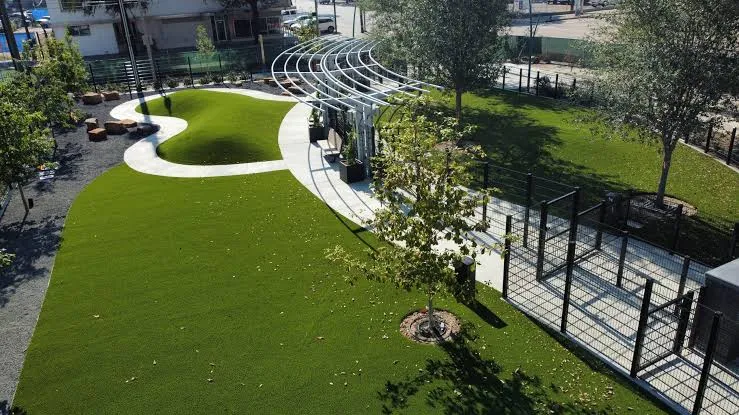
Six specs decide whether turf works with dogs or turns into a urine sponge. They’re listed below in order of importance, so if you only check one, check the first.
Backing and Drainage: Where the Best Artificial Turf for Dogs Starts
The backing is the base layer the blades are stitched into. It controls where urine goes, which makes it the single biggest factor in odor.
There are two main types:
- Perforated backing has drain holes punched every few inches. It handles rain fine, but in a spot your dog uses every day, urine can sit between the holes.
- Fully permeable or flow-through backing lets liquid pass through the entire surface. K9Grass, for example, uses a knitted flow-through backing built for edge-to-edge drainage.
Here’s the thing: two rolls can look identical in the store and drain completely differently. Ask the seller whether the backing is hole-punched or fully permeable, and ask for the drainage rate in writing.
The Right Pile Height for Dog Turf
Pile height is simply how tall the blades are. Shorter blades are easier to clean, and taller ones trap waste and odor.
FusionTurf’s pile height guide recommends 1.0 to 1.25 inches for most dogs. For multiple dogs, heavy daily use, or shady yards, it suggests 0.875 to 1.0 inch. Purchase Green sets its ceiling at 1.6 inches, because taller piles make cleanup harder and hold onto pet waste smells.
So skip the plush 1.75 inch “luxury lawn” rolls. They look great in photos and terrible after a month of potty breaks.
Face Weight and Density for Zoomies and Diggers
Face weight is the ounces of blade yarn per square yard, not counting the backing. Higher face weight means more fiber packed in, so the turf stands back up after a dog sprints across it.
Angi puts the ideal range for dogs at 70 to 90 ounces, with springy yarn that resists flattening. Also look for a thatch layer, the short curly fibers at the base that hold the taller blades upright.
Face weight is also one of the biggest price drivers. GenLawn’s cost of synthetic grass per square foot guide breaks down how each spec changes what you pay.
Blade Material and Cooling Fibers
Most pet turf uses polyethylene, which is soft and realistic; nylon is tougher but stiffer and pricier. In sunny yards, pick blades with a cooling additive. Purchase Green says its Cool Yarn turf stays up to 10 to 20% cooler in full sun than untreated grass.
The Best Infill for Dog Turf (and Why Sand Backfires)
Infill is the granular material brushed down between the blades. It weighs the turf down and keeps the blades standing.
But wait: the wrong infill makes odor worse. Angi notes that crumb rubber (ground-up recycled tires) and plain sand both hold onto urine smells. Better choices include coated sand and zeolite, a porous volcanic mineral whose tiny pores trap ammonia, the compound that makes urine smell.
FusionTurf recommends about 1.5 to 2.5 pounds of infill per square foot, groomed level. Some pet systems, including K9Grass, skip infill entirely so there’s nothing for waste to cling to.
PFAS and Safety Reports: What to Ask For
PFAS are “forever chemicals” that break down very slowly and have been linked to health problems. Some artificial turf has used them as processing aids.
The industry says it has cleaned up: turf makers pledged to remove PFAS ingredients by 2025. But California’s DTSC review notes that many lab reports only detect PFAS down to tens of parts per million, so smaller amounts could still be present.
New York is also setting a firm line. Starting December 31, 2026, state law bans the sale of carpet containing PFAS, and artificial turf counts as carpet. Mats and area rugs are not covered.
Here’s what to ask any seller for:
- A lab report for PFAS that lists the detection limit, not just a “PFAS-free” badge
- A total organic fluorine test result
- Proof the turf is lead-free
Quick Spec Checklist
Spec | Look for | Red flag |
|---|---|---|
Backing | Fully permeable or flow-through | Sparse drain holes only |
Pile height | 0.875 to 1.25 inches | Over 1.6 inches |
Face weight | 70 to 90 oz per square yard | No number listed |
Blades | Polyethylene with cooling additive | Shiny, stiff, single-tone |
Infill | Zeolite, coated sand, or none | Crumb rubber or plain sand |
Safety | PFAS report with detection limit | “Non-toxic” claim with no report |
Best Artificial Turf for Dogs by Situation
The right pick depends on how your dog actually uses the yard. GenLawn takes no paid placements, so every product below is an example of a spec, not a sponsor.
Best Artificial Turf for Dogs That Pee in One Spot (or Multiple Dogs)
Repeat potty spots are where cheap turf fails first. You need fast drainage, a short pile, and as little for urine to cling to as possible.
K9Grass Classic+ is the benchmark here. It combines a knitted flow-through backing, antimicrobial treatment built into the blades, and a no-infill design. It’s also used in dog daycares and veterinary clinics, which tells you it can handle heavy daily use. Pricing comes through local dealers, so expect a quote rather than a sticker price.
Best Pick for Large, High-Energy Dogs and Diggers
Big dogs need density. Aim for the top of the 70 to 90 ounce face weight range, a dense thatch layer, and a short pile that won’t flatten into lanes.
Purchase Green’s Pet Heaven is a good example: a 0.875 inch pile built for kennels and dog runs, listed at $4.31 per square foot in the company’s July 2025 update.
Here’s why installation matters just as much for diggers: dogs attack edges, not the middle. FusionTurf recommends sturdy edge restraints to deter digging, and K9Grass installs pin the perimeter to nailer boards with closely spaced stainless steel staples. Ask your installer exactly how the edges will be secured.
Best Dog Turf for Puppies, Seniors and Small Breeds
Soft blades and cushioning matter more than toughness here. A mid pile of 1.0 to 1.25 inches feels plush without matting.
Consider a shock pad under the turf. FusionTurf suggests a combined shock and drain pad, which adds comfort and helps liquid move through. Puppies also chew, so Angi recommends bound edges and non-fraying construction for dogs that like to gnaw.
SYNLawn’s pet turf line is worth a look for families. The company says its pet products are certified non-toxic and heavy metal compliant.
Best Budget Artificial Turf for Dogs
The budget pick is a lighter pet turf with a built-in antimicrobial. Smart Turf’s Tri Pet lists at $2.69 per square foot with a 1.125 inch pile, 55 ounce face weight, and Microban built in. Purchase Green’s Vista Sport/Pet, with its Cool Yarn additive, was listed at $2.47 per square foot.
The trade-off is honest and simple. At 55 ounces, Tri Pet sits below the 70 ounce mark, so it suits one small or medium dog better than a pack of big ones. Remember these are material prices only; installation is covered below.
Quick Comparison: Which Turf Fits Your Dog
Situation | Pile height | Backing | Infill | Example |
|---|---|---|---|---|
One potty spot or multiple dogs | 0.875 to 1.0 in | Flow-through | None or zeolite | K9Grass Classic+ |
Large dogs and diggers | 0.875 to 1.0 in | Fully permeable, reinforced | Zeolite or coated sand | Purchase Green Pet Heaven |
Puppies, seniors, small breeds | 1.0 to 1.25 in | Permeable plus shock pad | Zeolite | SYNLawn pet turf |
Tight budget | About 1.125 in | Permeable | Zeolite | Smart Turf Tri Pet |
Prices were checked in September 2026. Purchase Green’s figures come from its July 2025 product post, and all turf prices change often, so confirm before you buy.
Best Artificial Turf for Dogs in Your US Climate
Where you live changes which spec matters most. Heat is the big one in the South and West, odor in humid states, drainage in rainy ones, and brittleness where it freezes.
Best Artificial Turf for Dogs in Hot States (Southwest, Texas, SoCal)
This is turf’s biggest weakness, and you deserve the real numbers. In a 2026 Texas Tech University study, artificial turf reached 147°F while natural grass nearby stayed below 104°F. The turf topped 140°F even when the air was only 77 to 82°F.
The dogs noticed: they rested far less on the turf and rarely peed on it. The team tested one product with infrared thermometers, which can overstate the gap, but the takeaway still holds.
The American Kennel Club says surfaces can be too hot for paws once the air hits 85°F. Its vet recommends a simple check: press your hand on the surface for 10 seconds. If it’s too hot for your hand, it’s too hot for paws.
So in hot states, plan shade first and turf second:
- Put the potty and play zone under a tree, patio cover, or shade sail.
- Choose blades with a cooling additive and a zeolite infill.
- Hose the turf down before midday use.
- Keep a patch of real grass or mulch as a cool backup.
GenLawn’s natural grass vs artificial turf comparison digs deeper into heat by state.
Humid and Rainy States (Southeast, Gulf Coast, Pacific Northwest)
Moisture is the enemy here. Urine that doesn’t drain fast starts to smell, and wet leaves or pine needles hold it on the surface.
Prioritize an antimicrobial built into the blades, like K9Grass’s Alphasan or Smart Turf’s Microban, plus fully permeable backing and zeolite. FusionTurf suggests a shorter 0.875 to 1.0 inch pile in shady or humid spots so the turf dries faster. In rainy areas, the base does the heavy lifting (see the base section below), and a weekly pass with a leaf blower keeps debris from trapping moisture.
Cold Northeast and Midwest
Turf survives winter fine, but it needs gentle handling. Synthetic Grass Warehouse advises letting light snow melt on its own and clearing heavy snow with a plastic shovel only.
Here’s the part most owners get wrong: never use rock salt or chemical ice melt. Salt clogs the backing and cuts drainage, and chemicals can damage the turf. Frozen blades also turn brittle, so let the turf thaw before heavy play. For potty breaks, shovel one path with a plastic shovel and leave the rest alone.
Rebates, HOA Rules and City Bans Before You Buy Dog Turf
Local rules can cost or save you thousands, so check them before you get quotes.
Water rebates. Don’t count on one for turf. SoCal Water$mart states plainly that synthetic turf is not an approved conversion option. Its $2 per square foot rebate goes to plant-based yards.
Las Vegas is the exception, with strings attached. The Southern Nevada Water Authority pays homeowners $5 per square foot for the first 10,000 square feet of grass removed. It accepts permeable turf as a substitute for mulch, but only if living plants still cover at least 50% of the converted area.
The smart workaround in rebate areas: turf only the dog zone and plant the rest. GenLawn’s drought tolerant landscape guide covers how to qualify the planted part.
HOA rules. In California, Civil Code Section 4735 makes HOA rules that ban artificial turf void, though HOAs can still set design standards. Arizona law also stops HOAs from banning turf where natural grass is allowed, but lets them prohibit it in areas the association maintains or irrigates.
City bans. HOA protection doesn’t stop your city. California’s SB 676, signed in 2023, gave cities and counties back the power to regulate or ban synthetic turf. Carmel-by-the-Sea used it in March 2025 to prohibit artificial turf in every zoning district.
Installing and Maintaining the Best Artificial Turf for Dogs
Even the best artificial turf for dogs fails on a bad install. Most odor complaints trace back to the base and the cleaning routine, not the turf roll.
What Dog-Friendly Turf Costs
Most US homeowners pay $10 to $20 per square foot for professionally installed turf, according to GenLawn’s artificial turf installation cost guide. Small jobs cost more per foot: projects under 400 square feet can run $17 to $25.
That’s why a dog run feels pricey. A 300 square foot run at $17 to $25 per square foot lands around $5,100 to $7,500. Angi puts typical pet turf installs at $3,000 to $7,800 overall.
The gap between the $2 to $4 roll price above and the installed price is labor and base work. Skimping on either is how dog turf ends up smelling.
The Base Layer That Prevents Odor
The base is the crushed rock layer under the turf, and it does more for smell than the turf itself. K9Grass specs call for 3 to 4 inches of drainable angular gravel, and FusionTurf recommends the same depth, compacted and gently sloped.
Here’s the tip most installers won’t mention unless you ask: skip weed fabric in the dog zone. Install-It-Direct warns that weed fabric can soak up urine and make odor worse. Simple Green explains the same problem from the other side: urine collects between the turf and the barrier beneath it, and the smell builds.
Before the turf goes down, ask your installer to pour water on the finished base so you can watch it drain. If it puddles, it will stink later.
A Cleaning Routine That Actually Removes Urine Smell
Hosing alone isn’t enough. Install-It-Direct notes that rinsing only weakens urine smell; it doesn’t remove it. You need an enzyme or microbial cleaner, which uses enzymes and live bacteria to break down the urine compounds that cause odor.
This schedule is adapted from FusionTurf’s pet turf maintenance plan:
How often | What to do |
|---|---|
Daily | Pick up solid waste |
Weekly | Hose-rinse potty zones and busy paths |
Monthly | Apply an enzyme cleaner, then rinse |
Every 3 months | Brush with a stiff nylon broom to lift blades and loosen infill |
As needed | Top off zeolite infill in potty zones |
Apply enzyme cleaners at dusk. Simple Green says the product works longer when it stays damp, so a cool evening gives it more time.
And skip the pressure washer. GenLawn’s turf comparison notes that pressure washers and leaf vacuums both strip out infill.
How Long the Best Artificial Turf for Dogs Lasts
Angi estimates artificial grass lasts about 10 to 15 years with dogs, depending on the product and how hard your dog plays. Cheaper turf in hot, busy yards lands at the low end.
Watch for three signs it’s time to replace it:
- Blades stay flat in lanes even after brushing
- Odor returns within a day of an enzyme treatment
- The backing tears or seams lift where your dog digs
Frequently Asked Questions About the Best Artificial Turf for Dogs
What is the best artificial turf for dogs to pee on?
Look for flow-through or fully permeable backing, a short 0.875 to 1.0 inch pile, and zeolite infill or a no-infill pet system. An antimicrobial in the blades helps too. Some dogs hesitate at first, so start them on a small patch near where they already go.
Why does my artificial turf still smell like dog pee?
Urine is usually trapped below the blades, in the infill, the base, or a weed barrier. Rinse potty zones weekly, use an enzyme cleaner monthly, and top off zeolite. If the smell comes back within a day, the base or infill likely needs replacing.
Is artificial grass too hot for dogs’ paws?
In direct sun, it can be. A 2026 Texas Tech study recorded turf at 147°F while nearby grass stayed under 104°F. Use the 10-second hand test, add shade, and hose the turf down on hot afternoons.
The Bottom Line on the Best Artificial Turf for Dogs
The best artificial turf for dogs is the one built around drainage, not looks.
- Backing comes first. Fully permeable or flow-through drainage decides whether your yard smells.
- Go short and dense. Aim for a 0.875 to 1.25 inch pile and 70 to 90 ounces of face weight.
- Fix what’s underneath. Choose zeolite over crumb rubber and skip weed fabric under potty zones.
- Match your climate. Add shade in hot states, antimicrobials in humid ones, and never use salt where it freezes.
Your next step: measure your dog’s zone, then check your water district, HOA, and city rules. Get three local quotes, and ask each installer to confirm the spec checklist above in writing and to show you a drainage test on the base.
Want real numbers before you call anyone? Price your yard with GenLawn’s artificial turf installation cost guide.
About Author
Khalid Fazal is a seasoned lawn care specialist and horticultural researcher with over 15 years of hands-on experience transforming challenging landscapes into lush, resilient green spaces. His journey didn’t start in a lab, but in a backyard full of stubborn, cracked clay that “experts” said would never grow a healthy blade of grass. Refusing to accept a yard full of dust, Khalid spent years experimenting with organic soil restoration and precise mulching, eventually turning that wasteland into a neighborhood showpiece on a shoestring budget.
From mastering core aeration techniques to optimizing soil pH for specialized turf varieties, Khalid’s approach combines old-school grit with modern agronomic science. He founded Gen Lawn to provide homeowners with honest, research-backed advice that prioritizes long-term soil health over quick-fix chemical solutions. When he isn’t analyzing soil profiles, he’s developing precision tools to help others achieve professional results without the professional price tag.

Drought Resistant Grasses for Lawns [8 Picks by US Region]
Table of Contents Home / By Khalid Fazal | Updated:...
Read More
Shade Tolerant Grass: 7 Best Types by Region [Sun Hours]
Table of Contents Home / By Khalid Fazal | Updated:...
Read More
7 Types of Cool Season Grass: Best Picks by Region [2026]
Table of Contents Home / By Khalid Fazal | Updated:...
Read More
Warm Season Grass Types: 7 Best Picks by US Region [2026]
Table of Contents Home / By Khalid Fazal | Updated:...
Read More