
Drought Tolerant Landscape: Costs, Plants and Rebates (2026 Guide)
Your August water bill came in at triple your winter rate. And the lawn it paid for? Still brown in patches, still thirsty, still demanding another 20 minutes every evening.
Here’s the uncomfortable math behind that bill. Nationally, outdoor water use accounts for 30 percent of household use, and it climbs far higher in drier parts of the country and in water-intensive landscapes. In hotter, drier regions that number reaches as high as 70 percent. Worse, experts estimate as much as 50 percent of that water is wasted through overwatering caused by inefficient irrigation methods and systems.
So you’re paying premium rates to spill half your water onto the sidewalk.
A drought tolerant landscape fixes that. Converting to a water-efficient landscape through smart plant choice and careful design can cut outdoor water use by 20 to 50 percent. In many states, your water utility will literally pay you to make the switch.
This guide covers what it costs, what rebates are available right now, which plants work in your specific region, and the year-one mistakes that kill most conversions.
What a Drought Tolerant Landscape Really Means (Not Rocks and Cactus)
Let’s kill the biggest myth first. A drought tolerant landscape is not a gravel lot with three sad agaves.
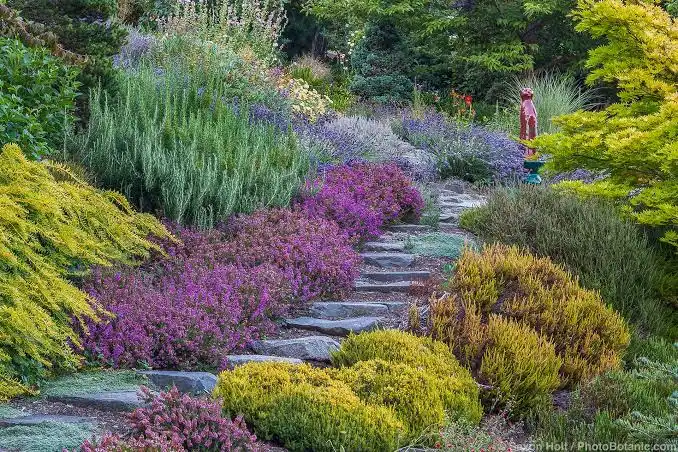
Xeriscaping does not have to mean a large rock garden with a few lonely cactuses. It can be a lush landscape full of drought-tolerant flowers, trees and grasses. The goal is matching plants to your actual rainfall instead of fighting your climate with a hose.
Drought Tolerant Landscape vs. Xeriscaping vs. Zero-Scaping
These three terms get used interchangeably, and that causes real confusion at the nursery.
- Drought tolerant landscape: The broadest term. Any yard designed to thrive on minimal supplemental water. Can include some lawn.
- Xeriscaping: A formal seven-principle design method built around water conservation. More structured, usually zero turf.
- Zero-scaping (often misspelled “xero-scaping”): The rock-and-nothing approach people fear. Cheap, hot, and genuinely ugly. Not what we’re recommending.
Here’s the thing: unlike traditional landscaping, which leans on water-hungry plants and constant irrigation, drought-tolerant landscaping takes a holistic approach, using the natural environment to build a low-maintenance garden that survives dry spells.
Real Benefits of a Drought Tolerant Landscape
Beyond the water bill, the payoff stack is genuinely strong. A well-designed xeriscape reduces maintenance requirements, conserves water, lowers utility bills, promotes biodiversity, extends the life of water infrastructure, minimizes environmental impact, and increases property value.
For scale, the Pacific Institute found that commercial property managers can cut landscape water use by 70 to 80 percent simply by replacing turf with efficiently irrigated, climate-appropriate plants. Residential results follow the same curve.
Will Your HOA Let You Do This?
This is the question that stops half of would-be converters, and almost nobody answers it.
If you’re in California, the answer is yes. California Civil Code section 4735 prohibits HOAs from banning drought-tolerant landscaping. Several other western states have passed similar protections in response to ongoing drought conditions.
Still, do this: request your HOA’s landscape guidelines in writing before you dig. Most boards approve designs that include defined edging, layered plant heights and a tidy border. What they reject is bare gravel.
What a Drought Tolerant Landscape Costs in 2026
Now for the number everyone actually wants.
Install Cost: DIY vs. Professional
Costs vary enormously by region, yard size and how much hardscape you add. Use these as planning ranges, then get local quotes.
| Scope | Typical DIY range | Typical professional range |
|---|---|---|
| Turf removal (sheet mulching) | $0.15 to $0.50 per sq ft | $1.00 to $2.50 per sq ft |
| Soil amendment and compost | $0.30 to $0.75 per sq ft | $0.75 to $1.50 per sq ft |
| Mulch (3 to 4 inch depth) | $0.40 to $1.00 per sq ft | $1.00 to $2.00 per sq ft |
| Plants (spaced properly) | $1.50 to $4.00 per sq ft | $3.00 to $8.00 per sq ft |
| Drip irrigation conversion | $0.50 to $1.25 per sq ft | $1.50 to $3.00 per sq ft |
| Full conversion | $3 to $7 per sq ft | $8 to $17 per sq ft |
Budget-wise, the savings hide in the hardscape. Gravel or small stones run roughly $30 to $50 per ton and make functional, attractive DIY pathways instead of expensive poured hardscape. Our hardscape materials guide breaks down which surfaces cost what.
Turf Replacement Rebates Worth $1 to $7 Per Square Foot
But wait. That install cost is not what you actually pay.
Water utilities across the American West are paying homeowners to remove lawns, with cities offering $1 to $7 per square foot in cash rebates to replace thirsty turf with drought-tolerant landscaping. A typical 1,000 square foot lawn drinks 48,000 to 60,000 gallons per year. Replace it with xeriscape and native plants and that same area needs only 4,500 to 12,000 gallons.
Current programs worth checking:
- SoCal Water$mart: As of August 2026 the base rebate is $2 per square foot for residential turf replacement up to 5,000 square feet per year, plus $100 per shade tree for up to five trees.
- LADWP: Eligible applications receive $5.00 per square foot up to a 5,000 square foot maximum.
- Sacramento: Turf Conversion Rebates pay up to $1.50 per square foot of replaced turf, capped at $50,000.
- San Diego: Adds a $1 per square foot bonus when you choose California-native plants.
One more freebie most people miss. LADWP notes that mulch plays a vital role in creating and maintaining a drought tolerant landscape, and City of LA residents can get it at no cost through LA Sanitation’s Free Mulch Giveaway program. Check whether your municipality runs something similar before you buy a single bag.
The Rebate Mistakes That Get Applications Denied
Here’s where people lose thousands of dollars.
- Starting work before approval. You must apply online and receive a Notice to Proceed before any work begins. LADWP requires pre-approval before you remove any grass, and the project must be finished within six months.
- Assuming artificial turf counts. Artificial turf does not qualify for most programmes, which require living drought-tolerant plants.
- Under-planting. Metropolitan’s program requires three California Friendly plants per 100 square feet plus a stormwater retention feature.
- Skipping the irrigation upgrade. Some programs mandate drip irrigation with a WaterSense smart controller.
How to Design a Drought Tolerant Landscape in 5 Steps
Step 1: Map Your Hydrozones
A hydrozone is simply a group of plants with matching water needs planted together, so one irrigation run serves all of them without drowning half and starving the rest.
Start by walking your yard and noting what varies. Michigan State University Extension advises recognizing site variations first, because soil type, light exposure, wind and evaporation rates differ across a single yard. Sandy soil dries fast while heavy clay stays moist longer, and sun plus wind can create a dry microclimate even in an area with decent rainfall.
Group your yard into three zones: high water (a small patio-adjacent area), moderate, and low or no supplemental water. EPA’s free Water Budget Tool will calculate a realistic water allowance for your zip code and landscape size.
Step 2: Fix the Soil Before You Buy a Single Plant
This is the step everyone skips, and it’s the one that decides whether your plants survive year one.
Improve soil quality by working in organic matter such as compost, which helps retain moisture and encourages healthy root growth. Dry-climate soils are usually low in organic matter and either drain too fast or compact into concrete.
Aim for 2 to 3 inches of compost tilled into the top 6 to 8 inches. Our soil quality guide walks through testing and amendment rates.
Step 3: Choose the Right Mulch for a Drought Tolerant Landscape
Mulch is the single highest-leverage purchase in a drought tolerant landscape. It cuts evaporation, moderates soil temperature, suppresses weeds and buys you days between waterings.
Organic mulch is the default choice for planted beds. Wood chips, bark, pine needles and leaves feed your soil as they break down, but they are combustible and a poor choice in wildfire-prone areas.
Inorganic mulch covers the rest. Decomposed granite, gravel and rock work where fire risk or heat reflection is a concern.
Three rules that matter more than which type you pick:
- Depth: 3 to 4 inches for organic, 2 to 3 for gravel. Thinner does not suppress weeds. Thicker suffocates roots. See how deep mulch should be.
- Keep it off the stems. Pull mulch back 2 to 3 inches from every trunk and crown. Piling it against bark invites rot and pests.
- Skip the landscape fabric. It blocks the organic matter you just spent money adding, and weeds root in the mulch layer above it anyway.
Choosing between wood and stone for a given bed? Our mulch or stone comparison covers the tradeoffs, and the free mulch calculator tells you exactly how many cubic yards to order.
Step 4: Add Permeable Hardscape
Permeable surfaces let rain reach the soil instead of running into the storm drain.
Water-permeable surfaces like gravel and stepping stone paths are core hardscape components of drought-tolerant landscaping, allowing rain or irrigation to reach the soil. Permeable pavers and gravel let water percolate into the ground and reduce runoff.
Add clean landscape edging between beds and paths. It’s the detail that makes a low-water yard read as designed rather than neglected, and it’s what wins HOA approvals.
Step 5: Convert to Drip Irrigation
Sprinklers spray water into the air, where wind and heat take a cut before it lands. Drip lines deliver water directly to the root zone.
The controller matters as much as the emitters. Swapping a standard clock-based controller for a WaterSense labeled model can save an average home up to 15,000 gallons annually. And if you leave the old system running unattended, a household with a poorly maintained automatic irrigation system can waste up to 25,000 gallons of water a year.
Best Plants for a Drought Tolerant Landscape by Region
Check your zone on the USDA Plant Hardiness Zone Map before buying anything.
| Region | Reliable performers | Notes |
|---|---|---|
| Southwest / Arid West | Agave, penstemon, desert marigold, red yucca, blue grama grass | Gravel mulch, minimal organic matter, wide plant spacing |
| Southeast / Humid South | Muhly grass, lantana, coneflower, yaupon holly, coreopsis | Drainage matters more than drought here |
| Midwest / Northeast | Russian sage, catmint, sedum, coneflower, little bluestem | Cold hardy plus drought hardy is the requirement |
| Pacific Northwest | Ceanothus, manzanita, lavender, kinnikinnick, ornamental oregano | Wet winters, bone-dry summers |
A handful of workhorses perform across most of the country. Agastache, catmint, sedum, spirea, amsonia, Russian sage and salvia are dependable drought-tolerant choices, along with several ornamental grasses. For evergreen structure, arborvitae, columnar Mugo pine and dwarf Norway spruce hold up well.
Native species deserve first look. Natives need less water and maintenance, are less likely to need replacing, and are more likely to thrive.
Drought Tolerant Landscape Ideas by Yard Type
Front Yard
Front yards carry curb appeal pressure, so lead with structure. One approach trades thirsty turf for a stone patio, letting rainfall seep between the stones to irrigate the surrounding landscape, with bright seating adding year-round color. Cottage-garden looks also work, using shrub and climbing roses, alstroemeria and Mexican bush sage.
For a full front-yard walkthrough, see our low maintenance xeriscape front yard guide.
Backyard and Slopes
Slopes shed water before it soaks in. Terrace them, plant deep-rooted natives, and use heavier mulch that will not float away. Our sloped yard landscaping guide covers retention options.
Under $1,000 on a Budget
Repurposed materials, DIY gravel paths and native plants keep costs down without looking cheap. Add sheet mulching instead of sod cutting, buy plants in 1-gallon rather than 5-gallon sizes, and phase the project across two seasons.
Year One Maintenance (Where Most Conversions Fail)
The Establishment Watering Period
“Drought tolerant” describes an established plant, not a new one.
In one demonstration garden, the first year required a fair amount of watering to establish the plants, while in later years only new plantings needed extra attention. Expect to water deeply once or twice a week through the first full growing season, then taper.
Seasonal Maintenance Calendar
- Spring: Top up mulch to full depth, check drip emitters for clogs, prune winter dieback
- Summer: Deep water new plants only, pull weeds early before they seed
- Fall: Best planting window in most regions, cut back spent perennials selectively
- Winter: Leave ornamental grasses standing for structure and wildlife cover
5 Mistakes That Kill a Drought Tolerant Landscape
- Cutting off water immediately after planting
- Mulching too thin to suppress weeds, or piling it against stems
- Planting on unamended, compacted soil
- Spacing plants for how they look today rather than mature size
- Leaving the old sprinkler schedule running on the new beds
Frequently Asked Questions About Drought Tolerant Landscaping
How much water does a drought tolerant landscape save?
A properly designed water-efficient landscape reduces outdoor water use by 20 to 50 percent. In practice, a 1,000 square foot lawn using 48,000 to 60,000 gallons annually drops to 4,500 to 12,000 gallons after conversion to xeriscape and native plants.
What is the cheapest drought tolerant landscaping option?
Sheet mulching over existing turf, planted with small native starts and finished with DIY gravel paths. Gravel runs around $30 to $50 per ton, and natives cost less over time because you replace them less often.
Do drought tolerant landscapes still need irrigation?
Yes, especially in year one. After establishment, most well-matched plantings survive on rainfall plus occasional deep watering during extended dry spells. A drip system with a smart controller handles this efficiently.
Does a drought tolerant landscape increase home value?
Xeriscape landscapes are recognized for increasing property value alongside lowering utility bills and reducing maintenance. In drought-prone markets, buyers increasingly treat low water demand as a feature rather than a compromise.
What is the best mulch for a drought tolerant landscape?
Organic mulch such as shredded bark or wood chips for planted beds, because it improves soil as it decomposes. Switch to gravel or decomposed granite in wildfire-prone zones, since organic mulches are combustible.
The Bottom Line
- Outdoor water is 30 percent of household use nationally and up to 70 percent in dry regions, with half of it commonly wasted
- A proper conversion cuts outdoor water use 20 to 50 percent
- Rebates of $1 to $7 per square foot can cover a large share of your install cost
- Apply for the rebate before touching your lawn, or you forfeit it
- Soil prep and correct mulch depth decide whether the whole thing survives year one
Start with the easiest win. Measure your beds, run the numbers through our free mulch calculator, and get 3 to 4 inches down before your next dry stretch. Then call your water utility and ask what turf replacement rebate you qualify for. That one phone call is often worth thousands.
Sources
- EPA WaterSense: Statistics and Facts
- EPA WaterSense: How We Use Water
- EPA WaterSense: Labeled Controllers
- SoCal Water$mart Turf Replacement Program
- LADWP Turf Replacement Rebate
- Metropolitan Water District Turf and Trees Program
- Michigan State University Extension: Drought Tolerant Plants
- Take Care of Texas: How to Create a Drought-Tolerant Yard
- USDA Plant Hardiness Zone Map
About Author
Khalid Fazal is a seasoned lawn care specialist and horticultural researcher with over 15 years of hands-on experience transforming challenging landscapes into lush, resilient green spaces. His journey didn’t start in a lab, but in a backyard full of stubborn, cracked clay that “experts” said would never grow a healthy blade of grass. Refusing to accept a yard full of dust, Khalid spent years experimenting with organic soil restoration and precise mulching, eventually turning that wasteland into a neighborhood showpiece on a shoestring budget.
From mastering core aeration techniques to optimizing soil pH for specialized turf varieties, Khalid’s approach combines old-school grit with modern agronomic science. He founded Gen Lawn to provide homeowners with honest, research-backed advice that prioritizes long-term soil health over quick-fix chemical solutions. When he isn’t analyzing soil profiles, he’s developing precision tools to help others achieve professional results without the professional price tag.
Cost of Synthetic Grass Per Square Foot (2026 Pricing Guide)
Table of Contents Home / By Khalid Fazal | Updated:...
Read More
Artificial Turf Installation Cost: $10-$20/sq ft [2026 Data]
Table of Contents Home / By Khalid Fazal | Updated:...
Read More
Soil Amendments for Lawn: Which One You Need (By Region)
Table of Contents Home / By Khalid Fazal | Updated:...
Read More
Topsoil vs Garden Soil: Which One to Buy [2026 Price Guide]
Table of Contents Home / By Khalid Fazal | Updated:...
Read More