
Dollar Spot Fungus in Lawns: How to Identify, Treat, and Prevent It (By Region)
Small, straw-colored spots about the size of a silver dollar have popped up across your lawn, and every morning there seem to be more of them. Most homeowners respond by watering at night or holding back fertilizer. Both moves feed the problem.
That’s dollar spot fungus, and it’s one of the most fixable lawn diseases in the US. It attacks the grass blades, not the roots, and it thrives on lawns that are short on nitrogen and stay wet overnight. Correct those two things and most lawns grow right out of it, often without a single fungicide application.
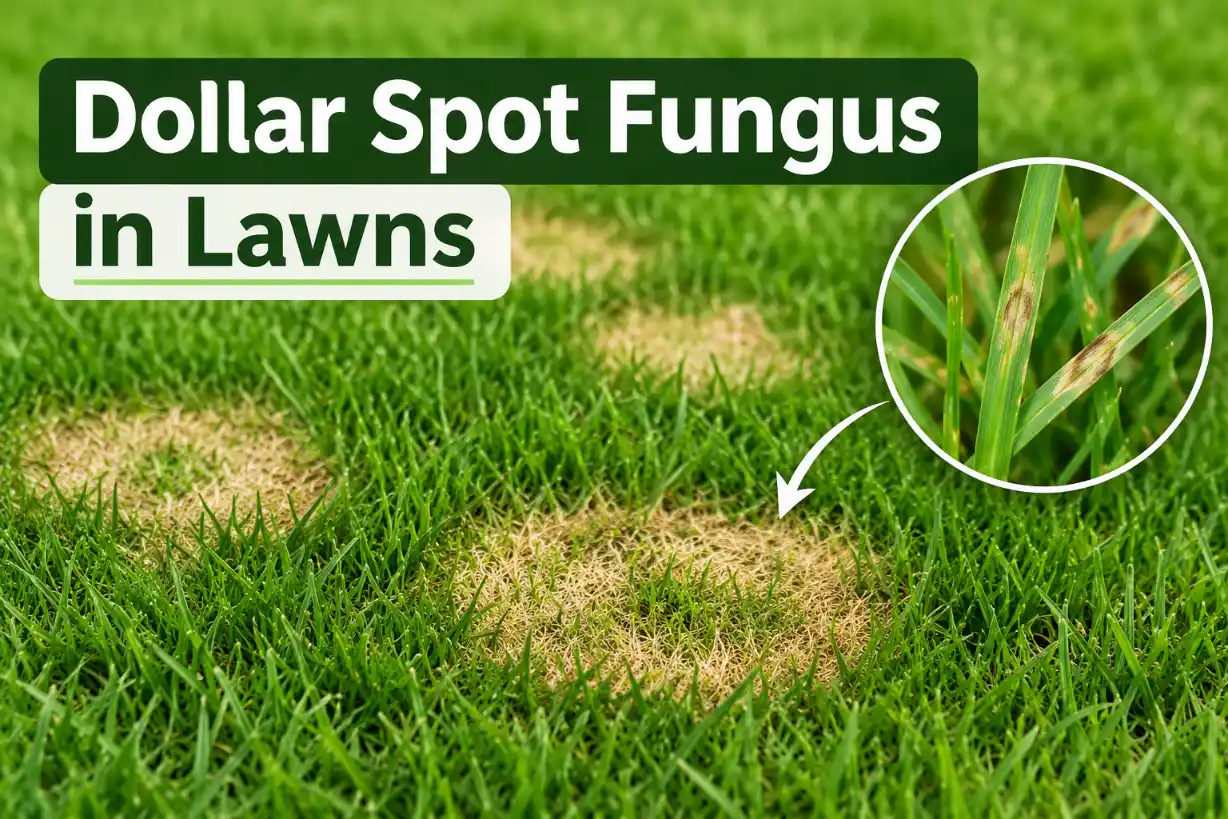
What Dollar Spot Fungus Looks Like (and What It Isn’t)
Getting the ID right matters more than any product you buy. Dollar spot gets mistaken for brown patch, drought, and dog spots all the time, and each one needs a different fix.
Signs of Dollar Spot Fungus on Your Lawn
Spot size depends on how high you mow. On lawns cut at 2 to 3 inches, spots usually run 2 to 5 inches across, according to Penn State Extension. On short golf greens they stay coin-sized, which is where the name comes from.
Left alone, neighboring spots merge into large, irregular dead areas. That’s usually the point where people decide it’s drought.
Here’s the giveaway: walk out early, while dew is still on the grass. Active dollar spot often shows fine, white threads stretched over the spots like cobwebs. Those threads are mycelium, the growing body of the fungus, and Iowa State Extension notes that foot traffic and mowers carry them across the yard.
The Hourglass Lesion That Confirms Dollar Spot Fungus
Pull a few blades from the edge of a spot, where green grass meets tan. Dollar spot leaves a bleached, tan band across the blade with a reddish-brown border on each side. The band often pinches in at the middle, giving it an hourglass shape.
No other common lawn disease leaves this mark. If you see it, you have your answer. The Texas A&M Plant Disease Handbook has close-up photos worth comparing against your blades.
Dollar Spot Fungus vs. Brown Patch, Drought, and Dog Spots
Problem | Spot size | What the blades show | Nitrogen link |
|---|---|---|---|
Dollar spot | 2 to 5 inches on home lawns | Hourglass lesion with reddish-brown borders | Worse when nitrogen is low |
Brown patch | 6 inches to several feet | Irregular tan blotches, no hourglass | Worse when nitrogen is high |
Drought stress | Large, uneven areas in sunny or sandy spots | Blades fold and turn blue-gray, then tan, with no lesions | None |
Dog urine | One round spot per visit | Dead center ringed by dark green grass, no lesions | Too much nitrogen in one place |
If your spots match the brown patch row, our guide to brown patches on lawn in summer covers that fix instead. It’s nearly the opposite of what follows here.
Why Dollar Spot Fungus Shows Up in Your Lawn
Three conditions line up before you ever see a spot: hungry grass, long wet nights, and a way for the fungus to travel.
Low Nitrogen: The Trigger Most Homeowners Miss
Dollar spot fungus is a hunger disease. Grass that’s short on nitrogen grows slowly, and slow grass can’t replace infected blades fast enough to hide the damage.
How short is short? University of Wisconsin plant pathologist Paul Koch told LawnStarter that lawns getting less than 2 pounds of nitrogen per 1,000 square feet a year are at higher risk. NC State Extension adds that underfed grass also recovers more slowly once it’s infected.
Here’s the trap: brown patch gets worse with extra nitrogen. People who confuse the two diseases often cut back on fertilizer, which is exactly what dollar spot wants.
Dew, Cool Nights, and Warm Days
The fungus needs wet leaves to infect. NC State puts the requirement at 10 to 12 hours of continuous leaf wetness, which is why heavy morning dew drives so many outbreaks.
Temperature sets the season. Infection starts in spring once nights stay above 50°F. Texas A&M notes the fungus is most active on humid 70 to 85°F days followed by nights near 60°F, the exact combination that soaks a lawn in dew. Activity usually slows once daytime highs stay above 90°F.
How Dollar Spot Fungus Spreads Across a Yard
Evening watering is the most common self-inflicted wound. It stacks sprinkler water on top of dew and keeps blades wet all night long.
Thatch comes next. That’s the spongy layer of dead stems and roots between the soil and the green blades, and the University of Minnesota Extension warns that more than half an inch of it harbors disease. To check yours, cut a 2-inch-deep wedge of lawn and measure that brown layer with a ruler.
Then there’s equipment. Mowers, shoes, and wheelbarrows carry infected leaf bits from spot to spot, which is why the disease often shows up in lines that follow your mowing path.
When Dollar Spot Fungus Hits in Your Region
Weather decides the timing, not the calendar. Watch for the same pattern everywhere: humid days, dewy nights above 50°F, and highs below 90°F. Where you live just changes when that pattern shows up and which grasses take the hit.
Dollar Spot Fungus in the Northeast and Midwest
Cool-season lawns of Kentucky bluegrass, perennial ryegrass, and fine fescue are the main targets here. Penn State Extension says activity in Pennsylvania typically peaks in late summer, with another round in early to mid fall when nights turn cool and days stay warm.
Penn State also points out that a late spring nitrogen feeding helps grass outgrow the infections that start in early summer. Our lawn fertilizer schedule lays out that timing for your area.
Dollar Spot Fungus in the Transition Zone
The band running roughly from Kansas to Virginia grows tall fescue, Kentucky bluegrass, zoysia, and bermuda side by side, so dollar spot has plenty of hosts. LawnStarter reports that the Mid-Atlantic can see problems for most of the year, with a peak in summer.
Mixed lawns make diagnosis harder here. Check blades from a few different areas before you treat, since one grass type may be infected while another nearby is just drought-stressed.
Dollar Spot Fungus in the South and West
In the South, bermuda and zoysia are the grasses to watch. Texas A&M notes that highly managed bermudagrass and zoysiagrass are more susceptible, while St. Augustine and centipede seldom see serious damage. Expect spots in spring and fall, with a break when summer highs park above 90°F.
If dollar spot keeps coming back every year, switching grass can be the permanent fix. Our guide to warm season grass types compares your options by region.
Out West, the risk drops. Washington State University notes it’s not a major disease in western Washington, though irrigated lawns that stay wet overnight can still pick it up.
How to Get Rid of Dollar Spot Fungus (Step by Step)
Work through these steps in order. Most home lawns are back to green after the first three, and never need step four.
Step 1: Feed the Lawn a Light Dose of Nitrogen
This is the fix that does the heavy lifting. Kansas State University recommends about 0.5 pound of actual nitrogen per 1,000 square feet per month to suppress a summer outbreak. If you haven’t fertilized in months, Purdue Turfgrass Science suggests 0.75 to 1 pound per 1,000 square feet, mostly slow-release.
“Actual nitrogen” means the nitrogen inside the bag, not the bag’s weight. With a 24-0-6 fertilizer, for example, you’d spread about 2 pounds of product per 1,000 square feet to deliver 0.5 pound of nitrogen. If the numbers on the bag are new to you, our breakdown of the NPK ratio for grass explains them.
Don’t overshoot. A heavy dose can trade your dollar spot problem for brown patch.
Step 2: Water Deep, Before Sunrise
Timing matters more than volume. NC State recommends watering between midnight and 6 AM, so the sprinkler runs while the grass is already wet with dew instead of adding extra wet hours after dark.
Water less often but more deeply, so the whole root zone gets soaked, as Penn State advises. Let the soil tell you when to water again, not a fixed timer.
Step 3: Mow Dry, Bag Clippings, and Clean the Deck
Mow only when the grass is dry. Iowa State notes that mowing dry grass cuts down on spread, and our guide on whether it’s bad to mow the lawn in the rain covers the other reasons to wait.
Bag the clippings from infected areas and throw them out rather than composting them. Then hose off the mower deck before you move to clean parts of the yard, which NC State specifically recommends.
Keep the mowing height at 2 to 3 inches. Kansas State says regular mowing at that height speeds recovery.
Step 4: Use Fungicide Only When It’s Worth It
But wait: before you buy anything, know that fungicide is rarely needed. The Connecticut Agricultural Experiment Station says most damaged lawns recover by regrowing from roots and crowns the fungus never touched. Save fungicide for lawns where spots keep spreading after a few weeks of steps one through three.
If you do treat, check the active ingredient first. Virginia Tech found that azoxystrobin, the ingredient in Scotts DiseaseEx, has essentially no activity against dollar spot. Look instead for propiconazole, myclobutanil, or thiophanate-methyl, which are registered for dollar spot control. Virginia Tech also suggests products that combine two ingredients for more reliable suppression.
One more catch: dollar spot builds resistance to fungicides quickly, according to NC State. Every fungicide carries a FRAC code on its label, a number that groups products by how they attack the fungus. The University of Kentucky explains how to rotate between different codes so the fungus doesn’t adapt. Don’t use the same code twice in a row.
Step 5: Help the Lawn Recover and Fill Bare Spots
Once the spots stop spreading, new blades fill in from the edges. Keep up the feeding and morning watering while that happens.
If some spots stay bare after a month of good growing weather, reseed them. Choose a cultivar rated for dollar spot resistance, which NC State recommends. The National Turfgrass Evaluation Program publishes those ratings. Our step-by-step guide on how to overseed a patchy lawn walks you through the rest.
If your thatch measured over half an inch, add core aeration to the plan. Our guide on when to aerate your lawn gives the right timing for your grass type.
Frequently Asked Questions About Dollar Spot Fungus
Will dollar spot fungus go away on its own?
It can fade when the weather turns too hot or too cold, but it comes back when dewy nights return if the lawn is still underfed. Fixing nitrogen and watering is what actually ends the cycle.
Does dollar spot fungus kill grass permanently?
Rarely. The fungus infects leaf blades, and most grass regrows from roots and crowns that survived. In severe cases, WSU notes the crowns and roots can decay too, and those spots need reseeding.
Is dollar spot fungus caused by too much or too little nitrogen?
Too little. Underfed, slow-growing grass is the most susceptible. That’s the opposite of brown patch, which gets worse with excess nitrogen, so diagnose before you change your fertilizer.
How do you treat dollar spot fungus naturally?
Steps one through three above are all non-chemical: feed with a slow-release organic nitrogen, water before sunrise, and mow dry. For organic lawn care, the Connecticut Agricultural Experiment Station lists biological products registered for dollar spot, including ones based on Bacillus subtilis QST713 and Streptomyces lydicus WYEC108.
How long does a lawn take to recover from dollar spot?
Plan on several weeks. Even lawns treated with fungicide typically take at least a month to recover, according to LawnStarter. Proper feeding speeds things up, while recovery slows in late fall as grass growth slows down.
Stop Dollar Spot Fungus Before It Spreads
Dollar spot looks alarming, but it’s a signal more than a disaster. Your lawn is telling you it’s hungry and staying wet too long.
- Confirm it first: look for the hourglass lesion and morning cobwebs before treating anything.
- Feed, don’t starve: about 0.5 pound of nitrogen per 1,000 square feet is the core fix.
- Water before sunrise, mow only when dry, and bag infected clippings.
- Watch for humid days, dewy nights above 50°F, and highs under 90°F in your region.
- Treat fungicide as the last resort, check the active ingredient, and rotate FRAC codes.
Check when you last fertilized. If it’s been more than a couple of months, pull up our lawn fertilizer schedule and get a light feeding down this week, before the next run of dewy nights.
About Author
Khalid Fazal is a seasoned lawn care specialist and horticultural researcher with over 15 years of hands-on experience transforming challenging landscapes into lush, resilient green spaces. His journey didn’t start in a lab, but in a backyard full of stubborn, cracked clay that “experts” said would never grow a healthy blade of grass. Refusing to accept a yard full of dust, Khalid spent years experimenting with organic soil restoration and precise mulching, eventually turning that wasteland into a neighborhood showpiece on a shoestring budget.
From mastering core aeration techniques to optimizing soil pH for specialized turf varieties, Khalid’s approach combines old-school grit with modern agronomic science. He founded Gen Lawn to provide homeowners with honest, research-backed advice that prioritizes long-term soil health over quick-fix chemical solutions. When he isn’t analyzing soil profiles, he’s developing precision tools to help others achieve professional results without the professional price tag.

Snow Mold Patches After the Melt? Most Recover in 3 Weeks
Table of Contents Home / By Khalid Fazal | Updated:...
Read More
Dollar Spot Fungus: Fix It Without Fungicide (By Region)
Table of Contents Home / By Khalid Fazal | Updated:...
Read More
Best Weed and Feed for Lawns: 7 Picks by Grass Type [2026]
Table of Contents Home / By Khalid Fazal | Updated:...
Read More
How to Get Rid of Dandelions in Lawn for Good (By Region)
Table of Contents Home / By Khalid Fazal | Updated:...
Read More