
Mulch Installation: Step-by-Step Guide
Mulch installation means preparing the bed, spreading mulch 2 to 4 inches deep, and keeping it 2 to 3 inches away from every trunk and stem. A 500 square foot bed at 3 inch depth takes about 4.6 cubic yards and costs $115 to $230 in materials if you do it yourself.
This guide covers the prep, the five installation steps, how much to order, and the placement errors that damage plants.
Before you start: prep the bed
Most DIY mulch jobs fail at the prep stage, not the spreading stage.
Pull the weeds first. Remove existing weeds by hand or with a hoe, taking as much root as you can. Mulch laid over established weeds will not kill them, they push straight through. If the bed is badly infested, apply a pre-emergent two weeks ahead and let it activate. Full method: how to remove weeds from mulch and can you put mulch over weeds.
Edge the beds. Cut a clean trench about 2 to 3 inches deep along the bed border with a half-moon edger or flat spade. This keeps mulch in and grass out, and it is the single thing that makes a DIY job look professional. See edging and mulching for technique.
Skip the landscape fabric in planting beds. Soil builds up on top of it, weeds root into that layer, and it blocks water and air from reaching the soil. Fabric is only worth using under gravel in non-planting areas, on erosion-prone slopes, or in utility zones.
Choose your mulch
Pick the material before you order. Shredded hardwood bark is the default for flower and shrub beds. Wood chips last longer and suit trees and pathways. Pine straw is cheap and works for acid-loving plants. Rubber and gravel do not decompose, which makes them right for playgrounds and xeriscape and wrong for garden beds.
For a full breakdown by plant and use case, see best mulch for gardens, best bagged mulch for flower beds, and mulch or stone for landscaping.
How much mulch to order
Use the free mulch calculator to get your exact number in a few seconds. It handles odd bed shapes and converts to bags or bulk yards.
If you would rather do it by hand:
Bed square footage × depth in inches ÷ 324 = cubic yards needed
| Bed size | 2 inch depth | 3 inch depth | 4 inch depth |
|---|---|---|---|
| 100 sq ft | 0.6 cu yd | 0.9 cu yd | 1.2 cu yd |
| 250 sq ft | 1.5 cu yd | 2.3 cu yd | 3.1 cu yd |
| 500 sq ft | 3.1 cu yd | 4.6 cu yd | 6.2 cu yd |
| 1,000 sq ft | 6.2 cu yd | 9.3 cu yd | 12.3 cu yd |
One cubic yard equals about 13.5 bags of 2 cubic foot bagged mulch. For coverage math on other depths, see how much will a yard of mulch cover and how many bags is 2 yards of mulch.
Bagged or bulk? Bagged is easier to transport and store, and it makes sense for small beds, touch-ups, and properties with tight access. Bulk is delivered loose and costs far less per cubic yard, so it wins on anything over 3 to 4 cubic yards. Most landscape suppliers deliver free within a set radius.
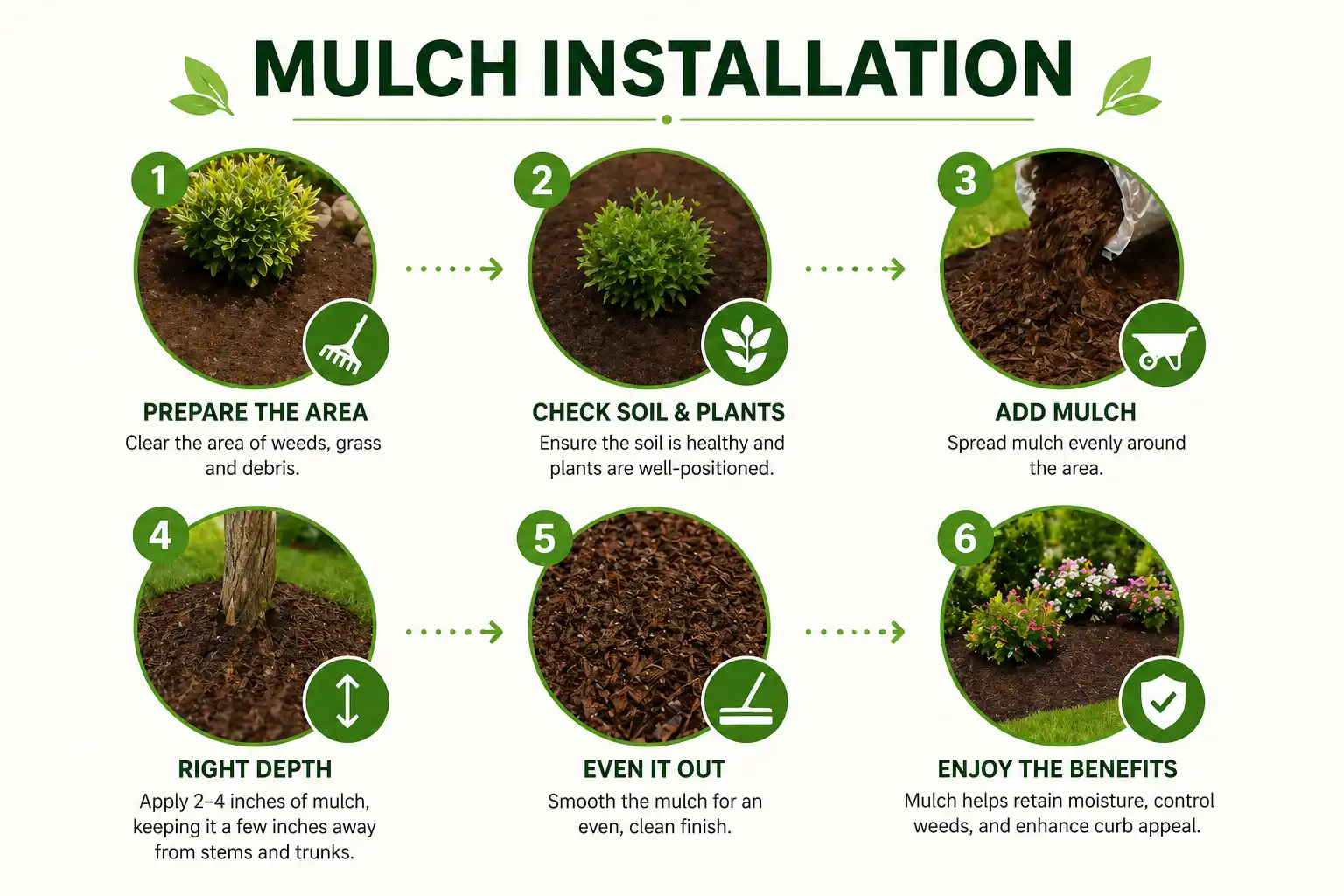
The five installation steps
- Confirm your quantity and order. Measure the beds, run the numbers, and order once. Running short mid-job means a second delivery fee.
- Dump and stage. Drop bulk mulch on a tarp in the driveway, not directly on the lawn, and move it in wheelbarrow loads to the far end of the bed first so you work backward toward your exit.
- Spread evenly at 2 to 4 inches. Use a hard rake, working from the center outward and pulling material toward the edges. Under 2 inches will not suppress weeds or hold moisture. Over 4 inches starves roots of oxygen and water. More on depth by plant type: how deep should mulch be.
- Pull mulch back from every trunk and stem. Leave a 2 to 3 inch gap around the base of each plant, shrub, and tree. Around trees you want a flat donut, never a cone piled against the bark.
- Water it in. A thorough soak settles the mulch, starts organic breakdown, and keeps bark and chips from blowing around before they knit together.
What it costs
| Route | Cost |
|---|---|
| Bagged mulch | $3 to $8 per 2 cu ft bag |
| Bulk mulch delivered | $25 to $50 per cubic yard |
| Edging tool, one-time | $25 to $60 |
| Professional installation | $75 to $250 per cubic yard, labor and materials |
For a 500 square foot bed at 3 inch depth, that is $115 to $230 doing it yourself, or roughly $345 to $1,150 installed by a crew. Pricing swings by region and by whether the quote includes weeding and edging, so get at least three.
Hiring out makes sense on large properties, on slopes and difficult terrain, or when you want prep included. For straightforward beds, DIY is a weekend.
Mistakes that cost you plants
Volcano mulching is the one that does real damage. Piling mulch into a cone against a tree trunk traps moisture against the bark, causing rot and giving insects and rodents a place to work. Mature trees die from this over several seasons. Keep the gap and keep the ring flat.
The other three worth watching:
- Too deep. Past 4 inches, mulch restricts oxygen and water to the roots.
- Mixing fresh wood chips into soil. This ties up nitrogen as it decomposes. Chips go on top, not in.
- Mulching over wet, compacted old mulch. Check total depth before adding. If the existing layer is already 3 to 4 inches, rake some out first. See should I remove old mulch.
FAQ
How deep should mulch be? 2 to 4 inches. Two is the minimum that suppresses weeds, four is the ceiling before roots suffer. Details here.
How often does mulch need replacing? Most organic mulches need refreshing every 1 to 2 years. See when to replace mulch.
Can you install mulch over existing mulch? Yes, if the old layer is still sound and the combined depth stays under 4 inches. Otherwise rake some out first.
When is the best time to mulch? Spring, roughly March through May, with an optional fall round in October and November for root insulation. Any time the ground is not frozen works. Full timing guide.
Does mulch attract termites or cause mold? Thick, wet mulch can harbor pests and grow surface fungi. Correct depth and spacing prevent most of it. See does mulch attract termites and mold spores in mulch.

How to Get Rid of Japanese Beetles (What Actually Works)
Table of Contents Home / By Khalid Fazal | Updated:...
Read More
Chinch Bug Treatment: What Works and When to Apply by Region
Table of Contents Home / By Khalid Fazal | Updated:...
Read More
How Do I Get Rid of Ants in My Lawn? And get rid of the Colony
Table of Contents Home / By Khalid Fazal | Updated:...
Read More
Best Fungicide for Lawns: 6 Picks Matched to Your Disease
Table of Contents Home / By Khalid Fazal | Updated:...
Read More